Vascular Surgery Section, Ochsner Health, New Orleans, LA.
Vascular Surgery Section, Ochsner Health, New Orleans, LA.
J Vasc Surg. 2022 Dec;76(6):1710-1718. doi: 10.1016/j.jvs.2022.07.004. Epub 2022 Jul 13.
The financial effects of the coronavirus disease 2019 (COVID-19) pandemic have fundamentally changed the healthcare environment, with hospitals expected to have lost billions in 2021. A preexisting nationwide nursing shortage became drastically worse during the pandemic amid dramatically increasing labor costs. We examined the evolution and financial effects of these changes during repeated pandemic surges within a vascular surgery division at a tertiary medical center.
Operating room, inpatient unit, and outpatient clinic financial data were examined retrospectively. The monthly averages for a 14-month control cohort before COVID-19 (January 2019 to February 2020) were compared to the averages for seven interval groups of sequential, 3-month cohorts from March 2020 through November 2021 (groups 1-7).
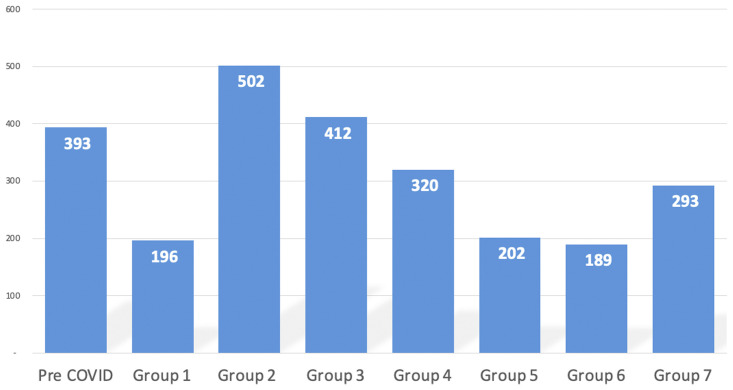
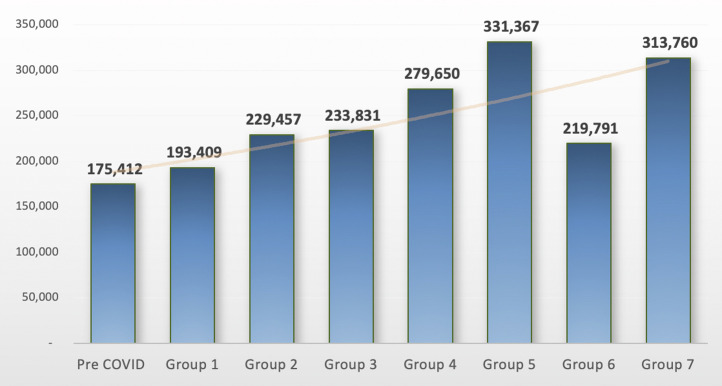
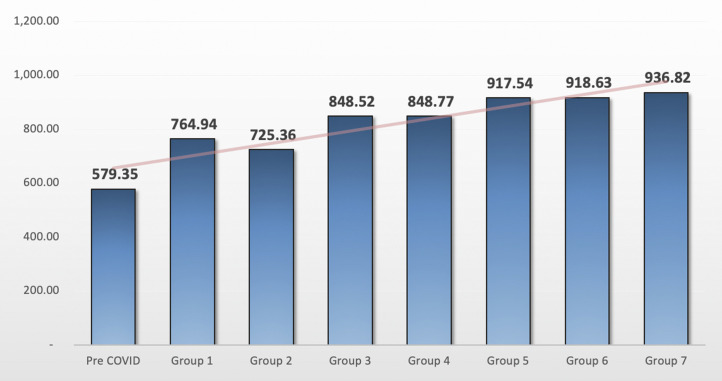
The monthly relative value unit (RVU) generation had returned to the mean before the COVID-19 pandemic (2520 RVUs) after an isolated decrease early in the pandemic (group 1; 1734 RVUs). The RVUs ranged from 2540 to 2863 per month for groups 2 to 5, with a slight decline in groups 6 and 7. The average monthly RVUs in the COVID-19 period (2437 RVUs) were nearly equivalent (P = .93) to those for the pre-COVID-19 cohort. An analysis of payor mix demonstrated an increase in commercial and Medicaid payors, with a respective decrease in Medicare payors, during COVID-19. The contribution to indirect, or profit, from inpatient hospital and outpatient clinical revenue showed a drastic decrease in group 1, followed by a swift rebound when the government restrictions were eased (group 2). The total monthly vascular nursing unit expense demonstrated a marked increase with each sequential group during COVID-19, with an average monthly upsurge of +$82,171 (+47%; P < .001). An increase in the nursing labor expenses of +$884 per vascular case (from $1630 to $2514; +54%; P < .001) was observed in the COVID-19 era. The nursing labor costs per patient day had increased from $580 to $852 (+$272; +53%; P < .001). The nursing labor cost per RVU had increased from $69.5 to $107.7 (+$38.2; +55%; P < .001). On a system-wide level, the agency-related nursing costs had increased from $4.9 million to $13.6 million per month (+178%; P < .001) in 2021 compared with 2020.
The COVID-19 pandemic has had severe, nationwide effects on healthcare delivery, exacerbating the deleterious effects of an existing, critical nursing shortage. To the best of our knowledge, the present study is the first detailed analysis of this phenomenon and its effects on a surgical division. Our results have demonstrated a progressive, drastic increase in nursing labor costs during the pandemic, with a resultant sustained erosion of financial margins despite a level of clinical productivity, as measured in RVUs, equal to the prepandemic standards. This precarious trend is not sustainable and will require increased, targeted government funding.

2019 年冠状病毒病(COVID-19)大流行的财务影响从根本上改变了医疗环境,预计 2021 年医院将损失数十亿美元。在大流行期间,全国范围内已经存在的护理人员短缺问题在劳动力成本急剧上升的情况下变得更加严重。我们在一家三级医疗中心的血管外科部门内反复出现大流行浪潮期间,研究了这些变化的演变和财务影响。
回顾性检查手术室、住院病房和门诊诊所的财务数据。将 COVID-19 之前的 14 个月对照队列(2019 年 1 月至 2020 年 2 月)的每月平均值与从 2020 年 3 月至 2021 年 11 月的七个连续 3 个月队列的七个间隔组的平均值进行比较(组 1-7)。
在大流行早期孤立下降后(第 1 组,1734 RVUs),每月相对价值单位(RVU)生成已恢复到 COVID-19 大流行前的平均值(2520 RVUs)。第 2 组至第 5 组的 RVU 范围为 2540 至 2863,第 6 组和第 7 组略有下降。COVID-19 期间的平均每月 RVU(2437 RVUs)与 COVID-19 前队列(P =.93)几乎相同。支付者组合的分析表明,COVID-19 期间商业和医疗补助支付者的比例增加,而医疗保险支付者的比例相应减少。从住院医院和门诊临床收入中获得的间接(或利润)贡献显示,第 1 组急剧下降,随后随着政府限制的放宽(第 2 组)迅速反弹。COVID-19 期间,每月血管护理单元费用显示每个连续组均有明显增加,平均每月增加 82171 美元(增加 47%;P <.001)。在 COVID-19 时代,观察到每个血管病例的护理劳动力费用增加了 884 美元(从 1630 美元增加到 2514 美元;增加 54%;P <.001)。患者住院日的护理劳动成本从 580 美元增加到 852 美元(增加 272 美元;增加 53%;P <.001)。每 RVU 的护理劳动成本从 69.5 美元增加到 107.7 美元(增加 38.2 美元;增加 55%;P <.001)。在系统层面上,与代理相关的护理成本从 2020 年每月 490 万美元增加到 2021 年的 1360 万美元(增加 178%;P <.001)。
COVID-19 大流行对医疗服务的提供产生了严重的全国性影响,加剧了现有严重护理短缺的不利影响。据我们所知,本研究是对这种现象及其对外科部门影响的首次详细分析。我们的研究结果表明,在大流行期间护理劳动力成本持续急剧增加,尽管 RVU 衡量的临床生产力水平与大流行前标准相当,但财务利润率仍持续下降。这种不稳定的趋势是不可持续的,将需要增加有针对性的政府资金。