Department of Health Policy and Management, Johns Hopkins Bloomberg School of Public Health, Baltimore, Maryland.
Johns Hopkins Carey Business School, Washington, DC.
JAMA Health Forum. 2022 May 13;3(5):e221018. doi: 10.1001/jamahealthforum.2022.1018. eCollection 2022 May.
The COVID-19 pandemic has had a negative association with hospital operations. To help health care facilities and clinicians stay financially viable during the COVID-19 pandemic, Congress provided $175 billion in subsidies. It remains unclear how much financial losses hospitals incurred owing to operational disruptions during the COVID-19 pandemic and whether subsidies were sufficient to offset the financial losses.
To assess changes in the operational financial performance and overall financial viability of hospitals during the COVID-19 pandemic.
This cross-sectional study included 1378 US hospitals whose fiscal years began in January and 785 hospitals whose fiscal years began in July (all with continuous observations from 2016 through 2020). RAND Hospital Data, a compiled and processed version of Medicare Cost Reports, were used. The data were analyzed on March 12, 2022.
The operational disruptions experienced and relief funds received by US hospitals during the COVID-19 pandemic.
A hospital's annual operating margin, overall profit margin, and other nonoperating income as a share of total revenue from January 2016 to December 2020.
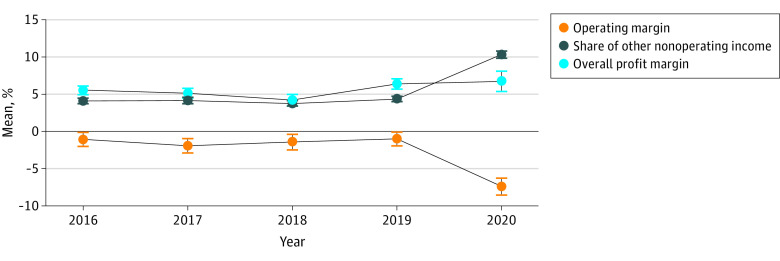
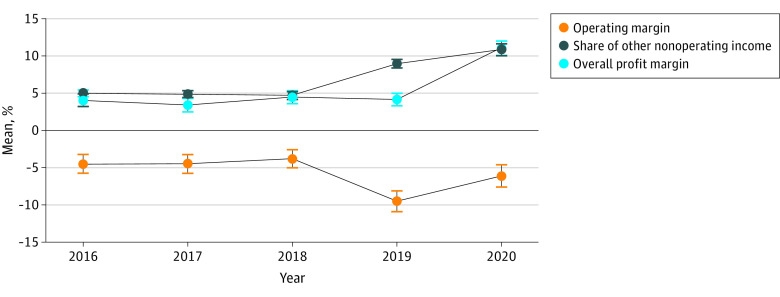
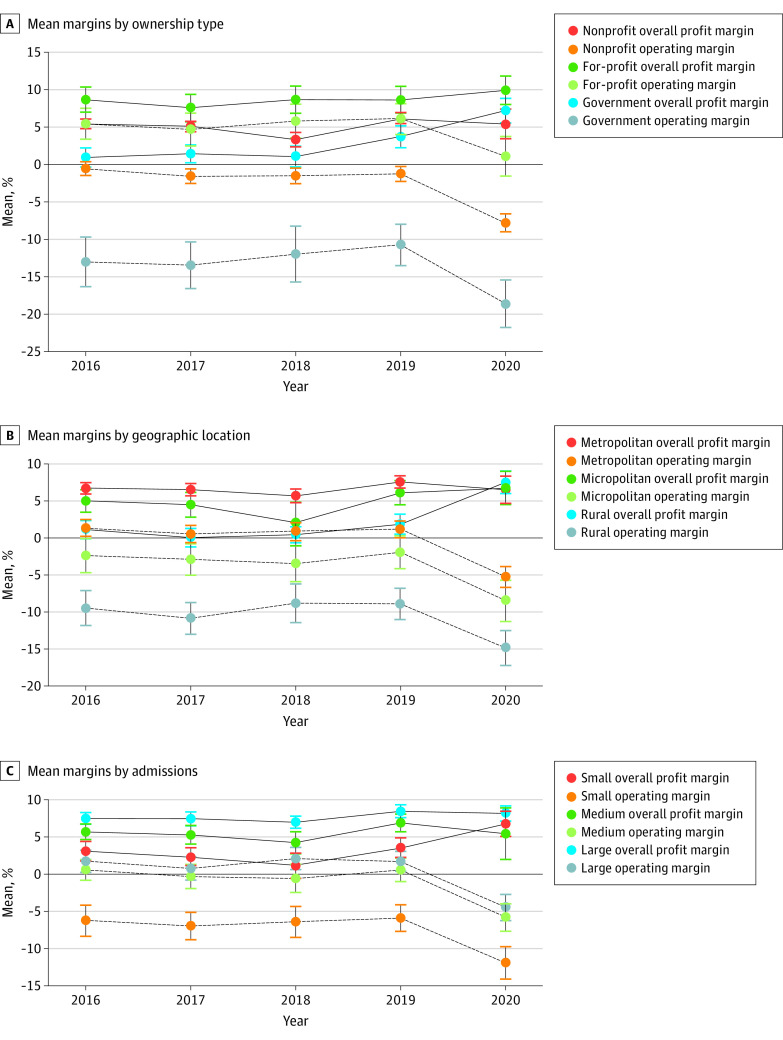
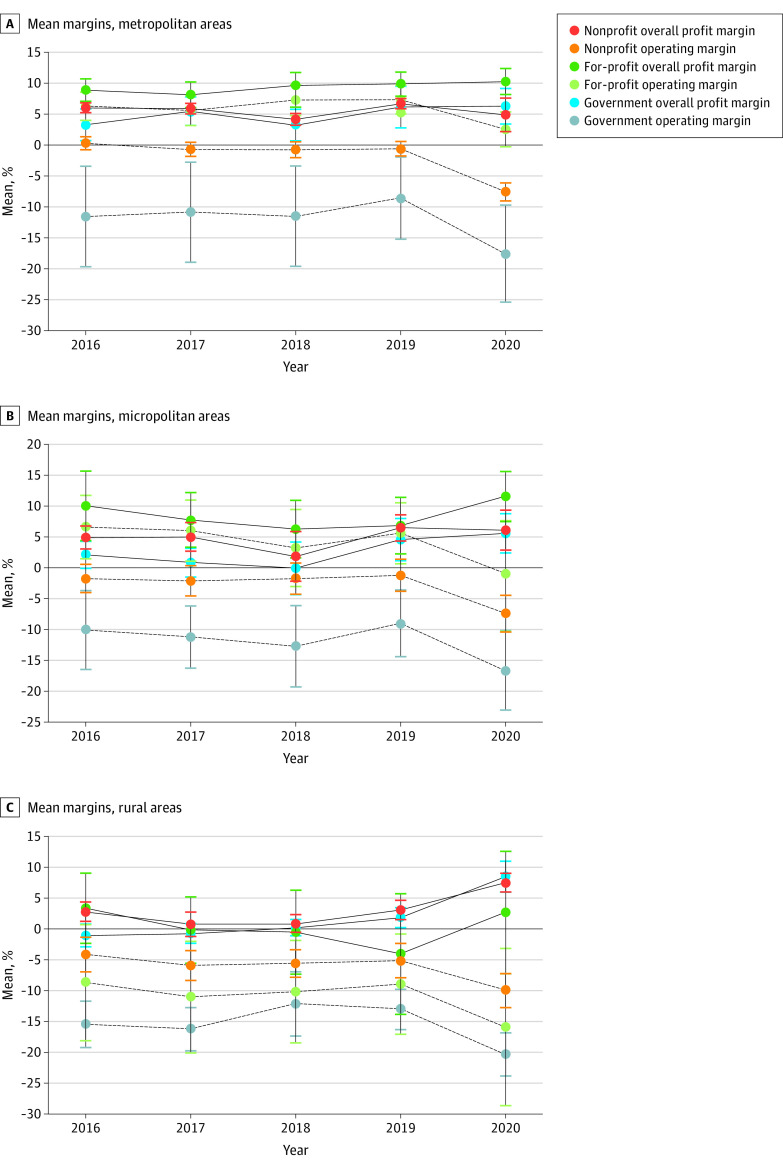
Among the 1378 hospitals with fiscal years beginning in January, the mean operating margin declined from -1.0% (95% CI,-1.9% to -0.1%) in 2019 to -7.4% (95% CI, -8.5% to -6.3%) in 2020. The mean share of other nonoperating income grew from 4.4% (95% CI, 4% to 4.7%) in 2019 to 10.3% (95% CI, 9.9% to 10.8%) in 2020. The mean overall profit in 2020 (6.7%; 95% CI, 5.4% to 8.1%) remained as stable as prior years. Government, rural, and smaller hospitals showed higher mean overall profit margins in 2020 than in 2019 (7.2% vs 3.7%, 7.5% vs 1.9%, and 6.7% vs 3.5%, respectively). These results remained consistent when hospitals whose fiscal years began in July were examined.
The results of this cross-sectional study suggest that although hospitals experienced a sizeable reduction in operating margins in 2020, their overall profit margins remained similar to those in prior years, suggesting that the COVID-19 relief fund effectively offset the financial losses for hospitals during the COVID-19 pandemic. Government, rural, and smaller hospitals, which were supported by some targeted fund allocations, generated higher overall profit margins during 2020 than in prior years.
COVID-19 大流行对医院运营产生了负面影响。为了帮助医疗机构和临床医生在 COVID-19 大流行期间保持财务生存能力,国会提供了 1750 亿美元的补贴。目前尚不清楚医院在 COVID-19 大流行期间因运营中断而遭受了多少财务损失,以及补贴是否足以弥补这些损失。
评估 COVID-19 大流行期间医院运营财务绩效和整体财务生存能力的变化。
设计、地点和参与者:本横断面研究包括 1378 家美国医院,其财政年度从 1 月开始,以及 785 家财政年度从 7 月开始的医院(均从 2016 年至 2020 年连续观察)。使用的是 Medicare Cost Reports 的编译和处理版本的 RAND 医院数据。数据于 2022 年 3 月 12 日进行分析。
COVID-19 大流行期间美国医院经历的运营中断和获得的救济资金。
2016 年 1 月至 2020 年 12 月期间,一家医院的年度营业利润率、整体利润率和其他非营业收入占总收入的份额。
在财政年度从 1 月开始的 1378 家医院中,营业利润率从 2019 年的-1.0%(95%CI,-1.9%至-0.1%)下降到 2020 年的-7.4%(95%CI,-8.5%至-6.3%)。其他非营业收入的份额从 2019 年的 4.4%(95%CI,4%至 4.7%)增长到 2020 年的 10.3%(95%CI,9.9%至 10.8%)。2020 年的平均整体利润(6.7%;95%CI,5.4%至 8.1%)与前几年一样稳定。政府、农村和较小的医院在 2020 年的整体利润率均高于 2019 年(分别为 7.2%比 3.7%、7.5%比 1.9%和 6.7%比 3.5%)。当检查财政年度从 7 月开始的医院时,这些结果仍然一致。
这项横断面研究的结果表明,尽管医院在 2020 年的营业利润率大幅下降,但它们的整体利润率与前几年相似,这表明 COVID-19 救济基金有效地抵消了 COVID-19 大流行期间医院的财务损失。受到一些有针对性的资金分配支持的政府、农村和较小的医院在 2020 年的整体利润率高于前几年。