Huang Jian-Qiang, Yu Meng, Yong Xuefeng, Ho Chun-Yu
Guangdong Provincial Key Laboratory of Catalysis, Southern University of Science and Technology, Shenzhen, 518055, China.
Shenzhen Grubbs Institute, Southern University of Science and Technology, Shenzhen, 518055, China.
Nat Commun. 2022 Jul 16;13(1):4145. doi: 10.1038/s41467-022-31896-y.
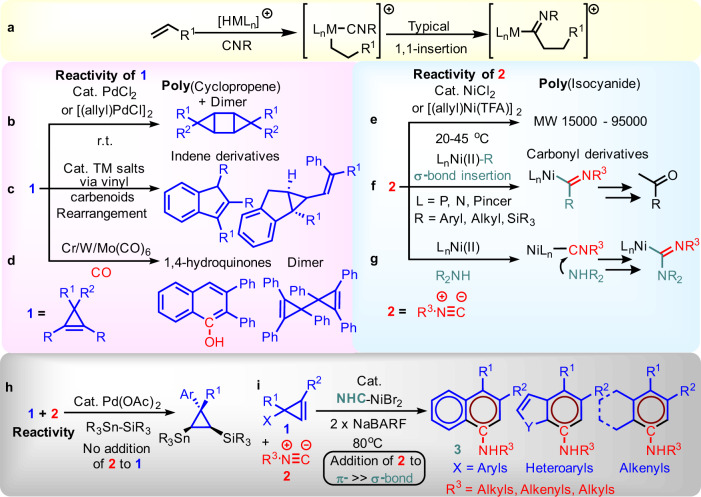
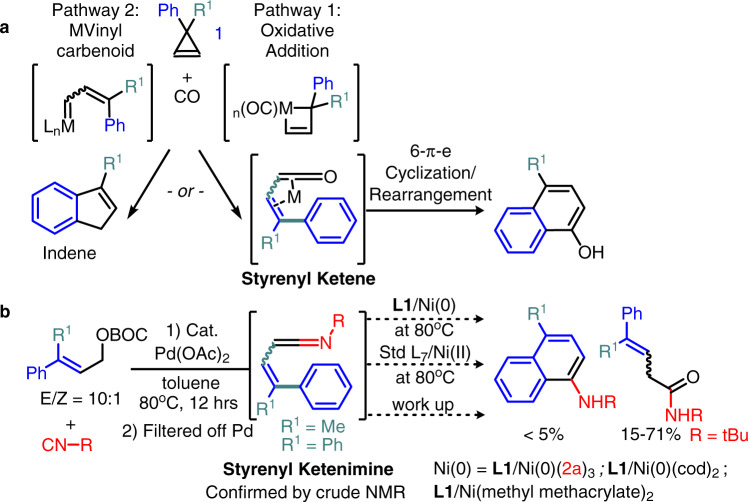
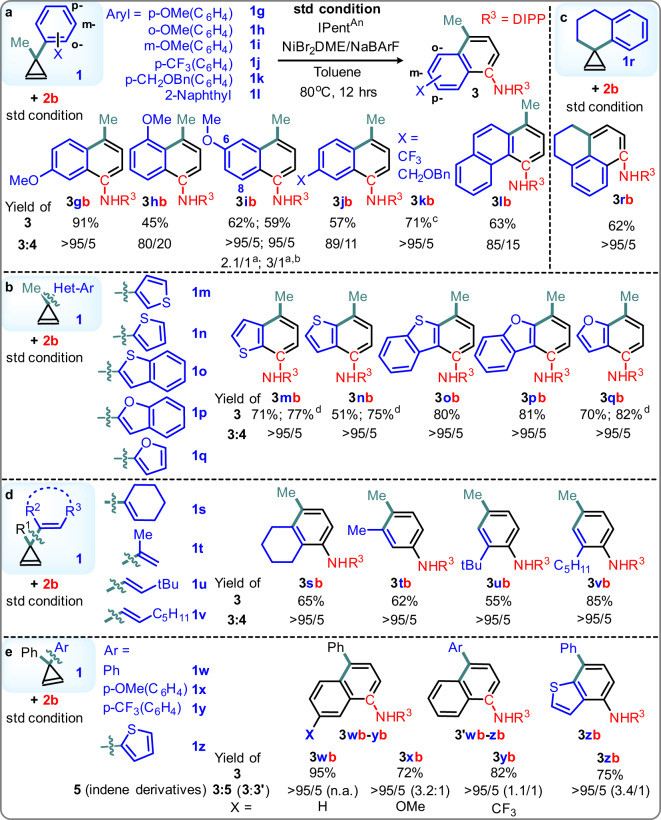
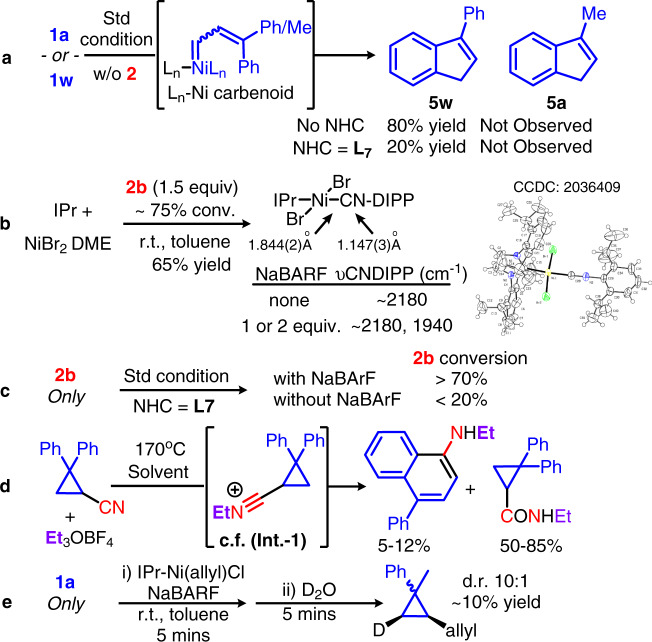
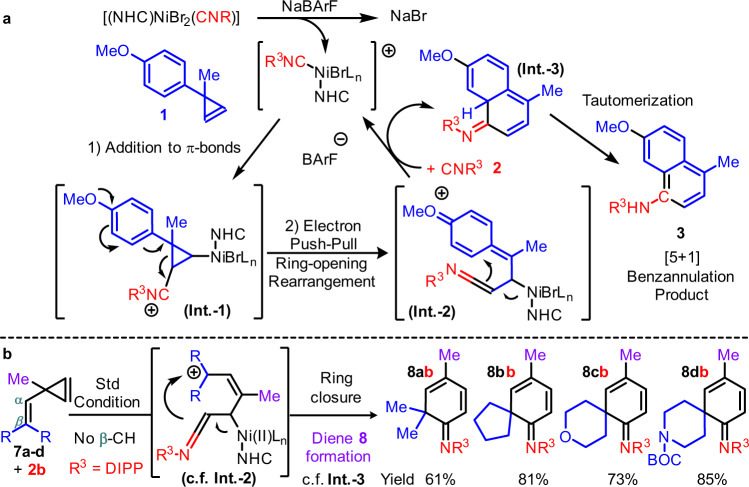
Isocyanides are common compounds in fine and bulk chemical syntheses. However, the direct addition of isocyanide to simple unactivated cyclopropene via transition metal catalysis is challenging. Most of the current approaches focus on 1,1-insertion of isocyanide to M-R or nucleophilc insertion. That is often complicated by the competitive homo-oligomerization reactivity occurring at room temperature, such as isocyanide 1,1-insertion by Ni(II). Here we show a (N-heterocyclic carbene)Ni(II) catalyst that enables cyclopropene-isocyanide [5 + 1] benzannulation. As shown in the broad substrate scope and a [trans-(N-heterocyclic carbene)Ni(isocyanide)Br] crystal structure, the desired cross-reactivity is cooperatively controlled by the high reactivity of the cyclopropene, the sterically bulky N-heterocyclic carbene, and the strong coordination ability of the isocyanide. This direct addition strategy offers aromatic amine derivatives and complements the Dötz benzannulation and Semmelhack/Wulff 1,4-hydroquinone synthesis. Several sterically bulky, fused, and multi-substituted anilines and unsymmetric functionalized spiro-ring structures are prepared from those easily accessible starting materials expediently.
异腈是精细和大宗化学品合成中的常见化合物。然而,通过过渡金属催化将异腈直接加成到简单的未活化环丙烯上具有挑战性。目前的大多数方法集中在异腈对M-R的1,1-插入或亲核插入。这通常因室温下发生的竞争性均聚反应而变得复杂,例如Ni(II)催化的异腈1,1-插入。在此,我们展示了一种(N-杂环卡宾)Ni(II)催化剂,它能够实现环丙烯-异腈的[5 + 1]苯并环化反应。如广泛的底物范围和[反式-(N-杂环卡宾)Ni(异腈)Br]晶体结构所示,所需的交叉反应性是由环丙烯的高反应性、空间位阻较大的N-杂环卡宾以及异腈的强配位能力协同控制的。这种直接加成策略提供了芳香胺衍生物,并补充了多特兹苯并环化反应以及塞梅尔哈克/伍尔夫1,4-对苯二酚合成反应。从那些容易获得的起始原料出发,可以方便地制备出几种空间位阻较大、稠合的和多取代的苯胺以及不对称官能化的螺环结构。