Center for Global Health and Department of Epidemiology, Colorado School of Public Health, Aurora, CO, USA.
Children's Hospital Colorado, Aurora, CO, USA.
J Dev Orig Health Dis. 2023 Feb;14(1):61-69. doi: 10.1017/S2040174422000423. Epub 2022 Jul 18.
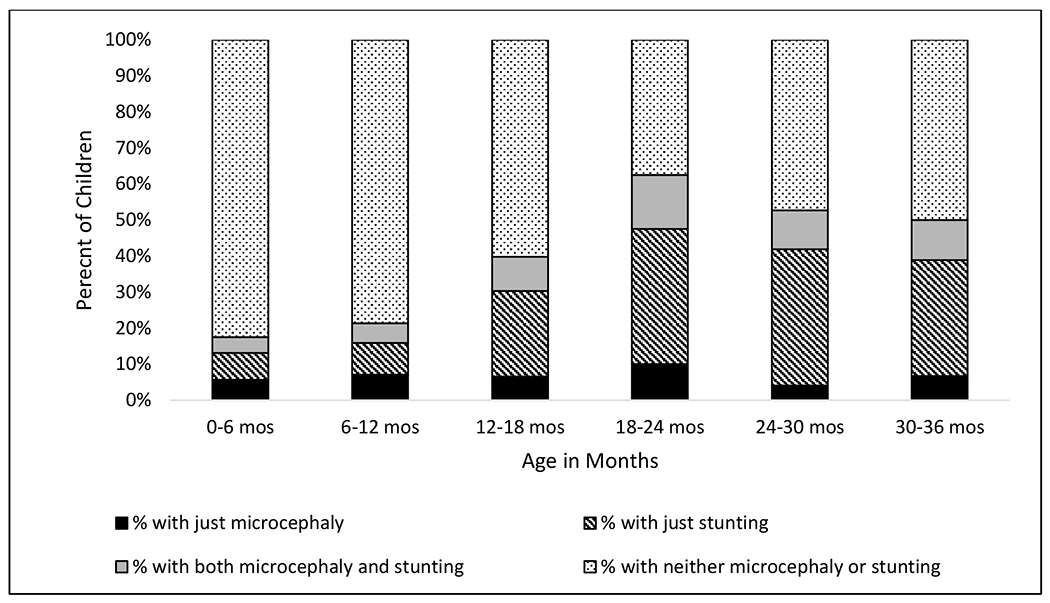
Stunting (<-2 SD of length- or height-for-age on WHO growth curves) is the most used predictor of child neurodevelopmental (ND) risk. Occipitofrontal head circumference (OFC) may be an equally feasible, but more direct and robust predictor. We explored association of the two measurements with ND outcome, separately and combined, and examined if cutoffs are more efficacious than continuous measures in predicting ND risk. Infants and young children in rural Guatemala ( = 642; age range = 0.1-35.9 months) were enrolled in a prospective natural history study, and their ND was tested using the Mullen Scales of Early Learning (MSEL) longitudinally. Length- or height-for-age and OFC-for-age were calculated. We performed age-adjusted multivariable regression analyses to explore the association between 1) length or height and ND, 2) OFC and ND, and 3) both length or height and OFC combined, with ND; concurrently, predictively, and longitudinally, as continuous variables and using WHO z-score cutoffs. Continuous length- or height-for-age and OFC z-scores were more strongly associated with MSEL than the traditional -2 SD WHO cutoff. The combination of height-for-age z-score and OFC z-score was consistently, strongly associated with the MSEL Early Learning Composite concurrently (p-values 0.0004-0.11), predictively (p-value 0.001-0.07), with the exception of the 18-24 months age group which had very few records, and in the longitudinal model (p-value <0.0001-0.004). The combination of continuous length- or height-for-age and OFC shows additional utility in estimating ND risk in infants and young children. Measurement of OFC may improve precision of prediction of ND risk in infants and young children.
发育迟缓(<-2 SD 的身长或身高与 WHO 生长曲线相比)是儿童神经发育(ND)风险最常用的预测指标。头围(OFC)可能是同样可行的,但更直接和有力的预测指标。我们分别和联合探讨了这两种测量方法与 ND 结果的关系,并研究了与连续测量相比,使用截点来预测 ND 风险是否更有效。危地马拉农村的婴儿和幼儿(=642;年龄范围为 0.1-35.9 个月)被纳入前瞻性自然史研究,并使用 Mullen 早期学习量表(MSEL)进行纵向 ND 测试。计算了身长或身高与 OFC 年龄比。我们进行了年龄调整的多变量回归分析,以探讨 1)身长或身高与 ND 的关系,2)OFC 与 ND 的关系,3)两者的身长或身高和 OFC 结合与 ND 的关系;同时,作为连续变量并使用 WHO z 分数截点进行了预测性和纵向分析。连续的身长或身高 z 分数和 OFC z 分数与 MSEL 比传统的 -2 SD WHO 截点更紧密相关。身高年龄 z 分数和 OFC 年龄 z 分数的组合与 MSEL 早期学习综合成绩在同时(p 值 0.0004-0.11)、预测(p 值 0.001-0.07)时具有一致性、强烈的相关性,18-24 个月年龄组除外,该年龄组记录很少,且在纵向模型中(p 值 <0.0001-0.004)。连续的身长或身高与 OFC 的组合在估计婴儿和幼儿的 ND 风险方面具有额外的效用。OFC 的测量可能会提高婴儿和幼儿 ND 风险预测的准确性。