Division of Physiotherapy, Stellenbosch University, Faculty of Medicine and Health Sciences, Cape Town, South Africa.
Institute of Sport and Exercise Medicine, Stellenbosch University, Faculty of Medicine and Health Sciences, Cape Town, South Africa.
BMJ Glob Health. 2021 Jun;6(6). doi: 10.1136/bmjgh-2021-005190.
The effects of healthcare-related inequalities are most evident in low-resource settings. Such settings are often not explicitly defined, and umbrella terms which are easier to operationalise, such as 'low-to-middle-income countries' or 'developing countries', are often used. Without a deeper understanding of context, such proxies are pregnant with assumptions, insinuate homogeneity that is unsupported and hamper knowledge translation between settings.
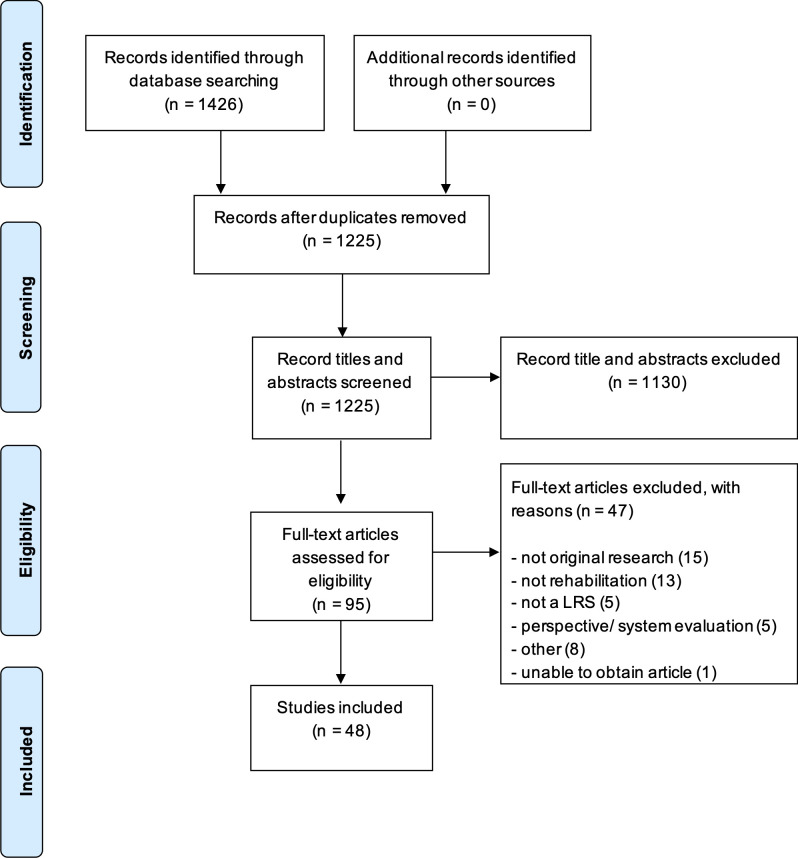
A systematic scoping review was undertaken to start unravelling the term 'low-resource setting'. PubMed, Africa-Wide, Web of Science and Scopus were searched (24 June 2019), dating back ≤5 years, using terms related to 'low-resource setting' and 'rehabilitation'. Rehabilitation was chosen as a methodological vehicle due to its holistic nature (eg, multidisciplinary, relevance across burden of disease, and throughout continuum of care) and expertise within the research team. Qualitative content analysis through an inductive approach was used.
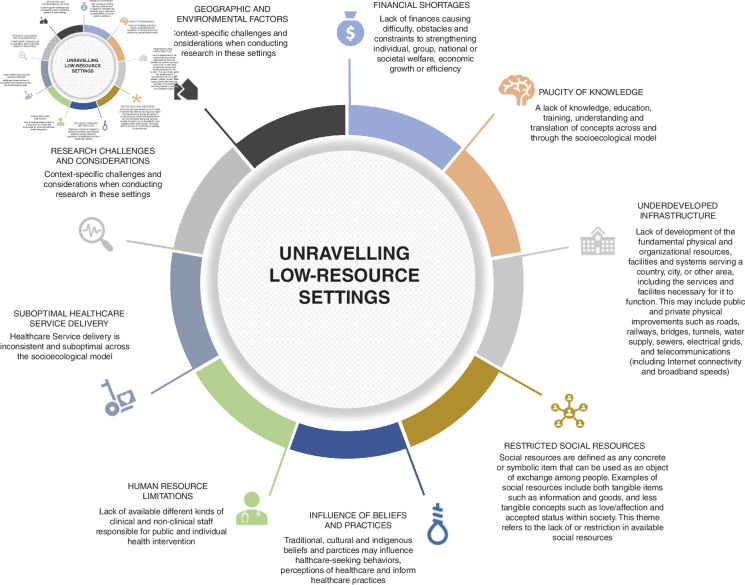
A total of 410 codes were derived from 48 unique articles within the field of rehabilitation, grouped into 63 content categories, and identified nine major themes relating to the term 'low-resource setting'. Themes that emerged relate to (1) financial pressure, (2) suboptimal healthcare service delivery, (3) underdeveloped infrastructure, (4) paucity of knowledge, (5) research challenges and considerations, (6) restricted social resources, (7) geographical and environmental factors, (8) human resource limitations and (9) the influence of beliefs and practices.
The emerging themes may assist with (1) the groundwork needed to unravel 'low-resource settings' in health-related research, (2) moving away from assumptive umbrella terms like 'low-to-middle-income countries' or 'low/middle-income countries' and (3) promoting effective knowledge transfer between settings.
医疗相关不平等的影响在资源匮乏的环境中最为明显。这些环境通常没有明确界定,而诸如“中低收入国家”或“发展中国家”等更容易操作的伞式术语通常被使用。如果没有对背景有更深入的了解,这些代理就充满了假设,暗示没有得到支持的同质性,并阻碍了不同环境之间的知识转移。
为了开始揭示“资源匮乏环境”这一术语,我们进行了系统的范围界定审查。使用与“资源匮乏环境”和“康复”相关的术语,从 PubMed、Africa-Wide、Web of Science 和 Scopus 进行了搜索(2019 年 6 月 24 日),回溯不超过 5 年。选择康复作为一种方法学工具,是因为它具有整体性(例如,多学科、与疾病负担相关、贯穿整个护理连续体),并且在研究团队中具有专业知识。通过归纳法进行定性内容分析。
从康复领域的 48 篇独特文章中得出了 410 个代码,分为 63 个内容类别,并确定了与“资源匮乏环境”相关的九个主要主题。出现的主题涉及(1)财政压力,(2)医疗服务提供欠佳,(3)基础设施欠发达,(4)知识匮乏,(5)研究挑战和考虑因素,(6)受限的社会资源,(7)地理和环境因素,(8)人力资源限制以及(9)信仰和实践的影响。
新兴主题可能有助于(1)在健康相关研究中解开“资源匮乏环境”所需的基础工作,(2)摆脱诸如“中低收入国家”或“低/中等收入国家”等假设性伞式术语,以及(3)促进不同环境之间的有效知识转移。