Newnham College, University of Cambridge, Cambridge, United Kingdom; Division of Biological Anthropology, Department of Archaeology and Anthropology, University of Cambridge, Cambridge, United Kingdom.
Am J Hum Biol. 2014 Jul-Aug;26(4):481-90. doi: 10.1002/ajhb.22551. Epub 2014 Apr 7.
The causes of the "dual burden" of stunting and obesity remain unclear, and its existence at the individual level varies between populations. We investigate whether the individual dual burden differentially affects low socioeconomic status Peruvian children from contrasting environments (urban lowlands and rural highlands), and whether tibia length can discount the possible autocorrelation between adiposity proxies and height due to height measurement error.
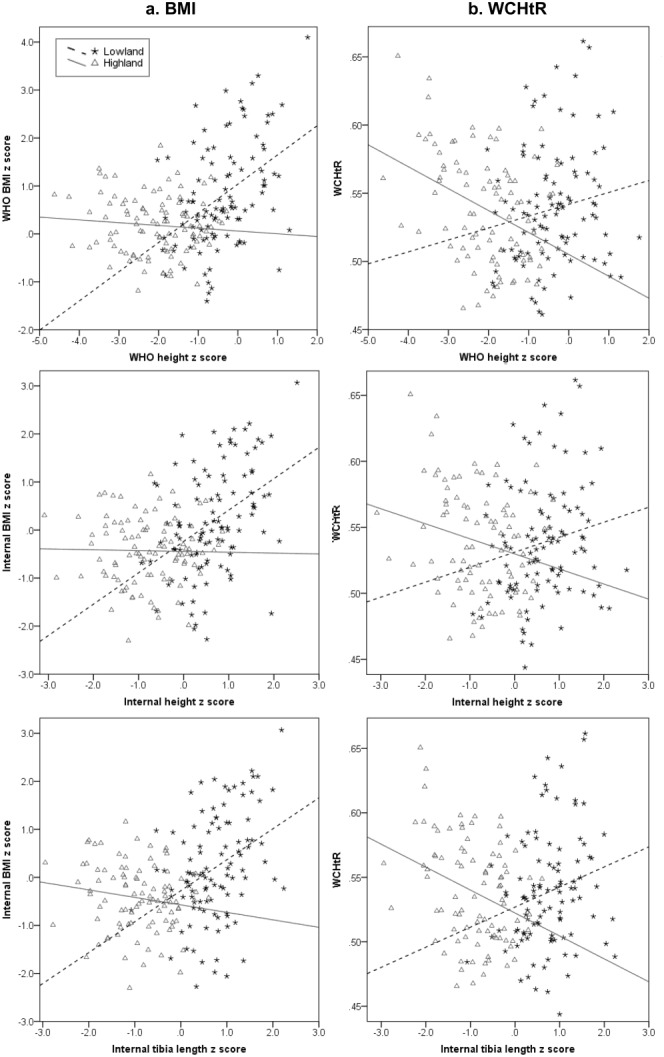
Stature, tibia length, weight, and waist circumference were measured in children aged 3-8.5 years (n = 201). Height and body mass index (BMI) z scores were calculated using international reference data. Age-sex-specific centile curves were also calculated for height, BMI, and tibia length. Adiposity proxies (BMI z score, waist circumference-height ratio (WCHtR)) were regressed on height and also on tibia length z scores.
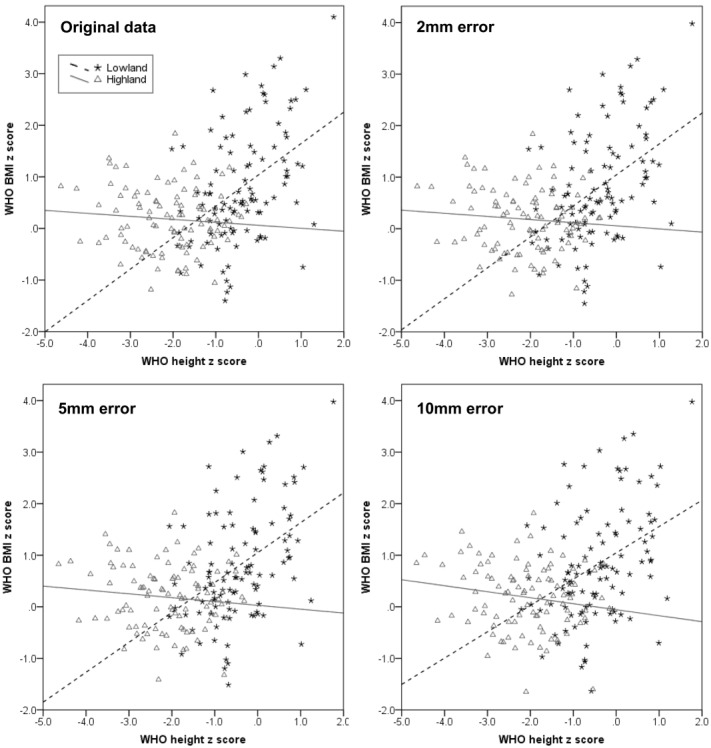
Regression model interaction terms between site (highland vs. lowland) and height indicate that relationships between adiposity and linear growth measures differed significantly between samples (P < 0.001). Height was positively associated with BMI among urban lowland children, and more weakly with WCHtR. Among rural highland children, height was negatively associated with WCHtR but unrelated to BMI. Similar results using tibia length rather than stature indicate that stature measurement error was not a major concern.
Lowland and rural highland children differ in their patterns of stunting, BMI, and WCHtR. These contrasts likely reflect environmental differences and overall environmental stress exposure. Tibia length or knee height can be used to assess the influence of measurement error in height on the relationship between stature and BMI or WCHtR.
发育迟缓与肥胖的“双重负担”的原因尚不清楚,其在个体层面的存在因人群而异。我们研究了个体的双重负担是否会对来自不同环境(城市低地和农村高地)的秘鲁低收入家庭儿童产生不同的影响,以及胫骨长度是否可以由于身高测量误差而抵消肥胖指标与身高之间的可能自相关性。
对 3-8.5 岁的儿童(n=201)进行身高、胫骨长度、体重和腰围测量。使用国际参考数据计算身高和体重指数(BMI)z 分数。还为身高、BMI 和胫骨长度计算了年龄性别特异性百分位数曲线。将肥胖指标(BMI z 分数、腰围-身高比(WCHtR))与身高进行回归,也与胫骨长度 z 分数进行回归。
根据地点(高地与低地)和身高的回归模型交互项表明,肥胖与线性生长指标之间的关系在样本之间存在显著差异(P<0.001)。城市低地儿童的身高与 BMI 呈正相关,与 WCHtR 的相关性较弱。而在农村高地儿童中,身高与 WCHtR 呈负相关,与 BMI 无关。使用胫骨长度而不是身高的相似结果表明,身高测量误差不是一个主要问题。
低地和农村高地儿童在身材矮小、BMI 和 WCHtR 方面存在差异。这些差异可能反映了环境差异和整体环境应激暴露。胫骨长度或膝关节高度可用于评估身高测量误差对身高与 BMI 或 WCHtR 之间关系的影响。