Laboratories for Integrative Neuroscience and Endocrinology, Faculty of Health Sciences, University of Bristol, Bristol, UK.
J Exp Zool A Ecol Integr Physiol. 2022 Dec;337(9-10):939-951. doi: 10.1002/jez.2639. Epub 2022 Jul 18.
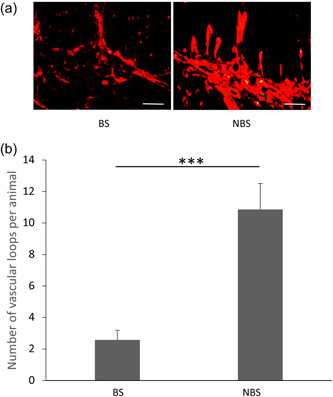
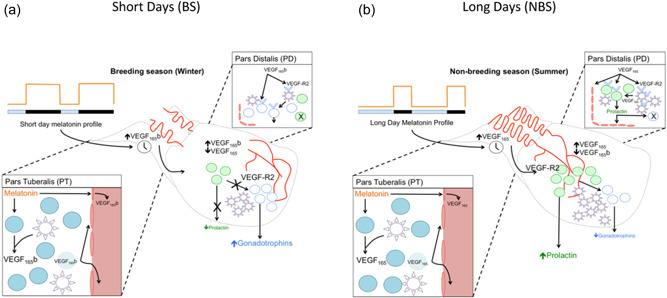
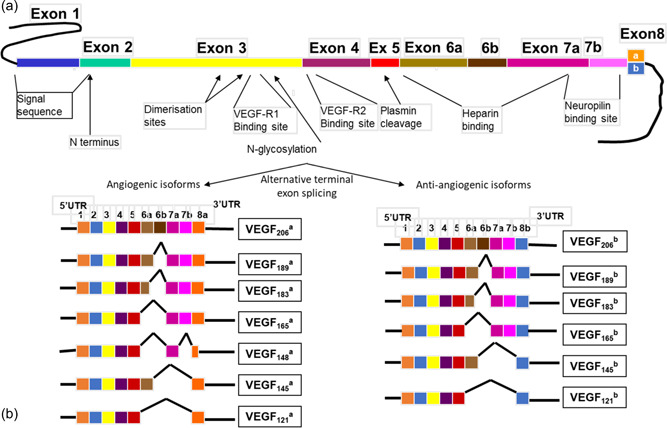
Adaptation to annual changes in the environment is controlled by hypophysial hormones. In temperate zones, photoperiod is the primary external cue that regulates annual biological cycles and is translated by the pattern of melatonin secretion acting primarily in the hypophysial pars tuberalis. Angiogenic mechanisms within this tissue contribute to decode the melatonin signal through alternative splicing of the vascular endothelial growth factor A (VEGF-A) gene in both the pars tuberalis and the capillary loops of the infundibulum. The resulting melatonin-evoked differential productions of VEGF-A isoforms will induce seasonal remodeling of the vascular connection between the hypothalamus and hypophysis, and act as paracrine messengers in the pars distalis to generate the required seasonal endocrine response. Specifically, the long melatonin signal in winter upregulates antiangiogenic VEGF-A isoforms, which will reduce the number of vascular loops and the density of VEGF receptors in endocrine and folliculo-stellate (FS) cells, inhibit prolactin secretion, and stimulate FSH. In contrast, the short melatonin signal in summer upregulates proangiogenic VEGF-A isoforms that will increase the number of vascular loops and the density of VEGF receptors in endocrine and FS cells, stimulate prolactin secretion, and suppress FSH. A similar system has been identified in long day seasonal breeders, revealing that this is a conserved mechanism of adaptation across species. Thus, an angiogenesis-based, intrahypophysial system for annual time measurement controls local microvascular plasticity and conveys the photoperiodic signal readout from the melatonin sensitive pars tuberalis to the endocrine cells of the pars distalis to regulate seasonal adaptation to the environment.
适应环境的年度变化是由垂体激素控制的。在温带地区,光周期是调节年度生物周期的主要外部线索,它通过褪黑素分泌模式来调节,主要作用于垂体的结节部。该组织中的血管生成机制有助于通过血管内皮生长因子 A(VEGF-A)基因在结节部和漏斗部毛细血管环中的选择性剪接来解码褪黑素信号。由此产生的褪黑素诱导的 VEGF-A 异构体的差异产生将诱导下丘脑和垂体之间的血管连接的季节性重塑,并作为旁分泌信使在垂体远侧部发挥作用,以产生所需的季节性内分泌反应。具体而言,冬季长的褪黑素信号上调抗血管生成的 VEGF-A 异构体,这将减少血管环的数量和内分泌细胞和卵泡星状细胞(FS)中的 VEGF 受体密度,抑制催乳素分泌,并刺激 FSH。相比之下,夏季短的褪黑素信号上调促血管生成的 VEGF-A 异构体,这将增加血管环的数量和内分泌细胞和 FS 细胞中的 VEGF 受体密度,刺激催乳素分泌,并抑制 FSH。在长日照季节性繁殖者中也发现了类似的系统,表明这是一种跨物种适应的保守机制。因此,基于血管生成的垂体内年度时间测量系统控制局部微血管可塑性,并将来自褪黑素敏感的结节部的光周期信号读出传递给垂体远侧部的内分泌细胞,以调节对环境的季节性适应。