Zaragoza-García Oscar, Gutiérrez-Pérez Ilse Adriana, Delgado-Floody Pedro, Parra-Rojas Isela, Jerez-Mayorga Daniel, Campos-Jara Christian, Guzmán-Guzmán Iris Paola
Faculty of Chemical-Biological Sciences, Universidad Autónoma de Guerrero, Chilpancingo 39087, Guerrero, Mexico.
Department of Physical Education, Sport, and Recreation, Universidad de La Frontera, Temuco 4780000, Chile.
Int J Hypertens. 2022 Jul 7;2022:4522493. doi: 10.1155/2022/4522493. eCollection 2022.
Hypertension (HTN) is recognized as a significant public health problem in the world. The objective of this study is to evaluate emergent anthropometric indices as predictors of preHTN and HTN according to age and sex in a sample of Mexican adults.
A cross-sectional study was conducted in 1,150 participants aged 18-80 years old. Anthropometric data and blood pressure measurements were analyzed. Comparisons between men and women were carried out by independent analysis. Cutoff points for each emergent anthropometric index were obtained using the values' upper second and third tertiles. Logistic regression models and receiver operating characteristics curve analyses were used to assess the association and the predictive value of several emergent anthropometric indices with the presence of preHTN and HTN.
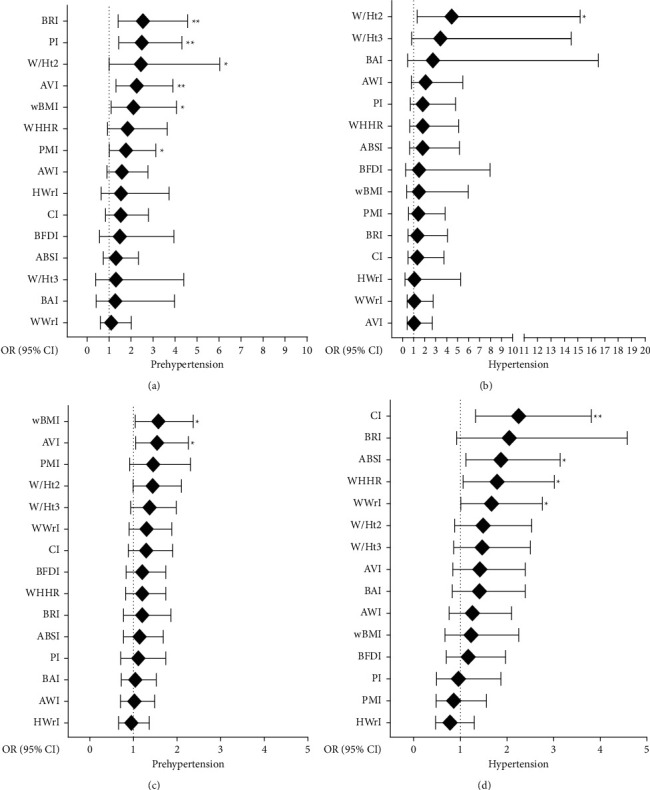
The prevalence of preHTN and HTN was 29.74% and 14.35%, respectively. In a logistic regression analysis adjusted by age and sex, the body roundness index (BRI) (OR = 2.08, < 0.001) and conicity index (CI) (OR = 1.37, =0.044) were associated with preHTN, while CI (OR = 2.47, < 0.001) and waist to height squared (W/Ht) (OR = 2.19, < 0.001) were associated with HTN. Furthermore, in both sexes, BRI was the main predictor of preHTN (AUC: 0.634 and 0.656, respectively). Particularly, according to sex and age range, the predictive emergent anthropometric indices in men were the body shape index (ABSI) and waist to height cubic (W/Ht) (AUC = 0.777 and 0.771, respectively), whereas in women, the predictors were CI and ABSI (AUC = 0.737 and 0.729, respectively). In men ≤40 years old, central body fat indices were predictors of preHTN and HTN, but in men >40 years old, the predictor indices were W/Ht and W/Ht. In women ≤40 years, the pulse mass index (PMI) was the best main predictor (AUC = 0.909) of HTN.
CI, PMI, W/Ht, W/Ht, and ABSI could represent differential predictors of preHTN and HTN between men and women according to age range.
高血压被认为是全球一个重大的公共卫生问题。本研究的目的是在一组墨西哥成年人样本中,根据年龄和性别评估新兴人体测量指标作为高血压前期和高血压预测指标的情况。
对1150名年龄在18至80岁的参与者进行了一项横断面研究。分析了人体测量数据和血压测量值。通过独立分析对男性和女性进行了比较。使用各指标值的上第二个和第三个三分位数获得每个新兴人体测量指标的切点。采用逻辑回归模型和受试者工作特征曲线分析来评估几种新兴人体测量指标与高血压前期和高血压存在之间的关联及预测价值。
高血压前期和高血压的患病率分别为29.74%和14.35%。在按年龄和性别调整的逻辑回归分析中,身体圆润度指数(BRI)(OR = 2.08,P < 0.001)和锥度指数(CI)(OR = 1.37,P = 0.044)与高血压前期相关,而CI(OR = 2.47,P < 0.001)和腰高平方比(W/Ht)(OR = 2.19,P < 0.001)与高血压相关。此外,在男女两性中,BRI都是高血压前期的主要预测指标(AUC分别为0.634和0.656)。特别是,根据性别和年龄范围,男性中预测新兴人体测量指标是体型指数(ABSI)和腰高立方比(W/Ht)(AUC分别为0.777和0.771),而在女性中,预测指标是CI和ABSI(AUC分别为0.737和0.729)。在40岁及以下的男性中,中心体脂指标是高血压前期和高血压的预测指标,但在40岁以上的男性中,预测指标是W/Ht和W/Ht。在40岁及以下的女性中,脉搏质量指数(PMI)是高血压的最佳主要预测指标(AUC = 0.909)。
CI、PMI、W/Ht、W/Ht和ABSI可根据年龄范围代表男女高血压前期和高血压的不同预测指标。