School of Nursing, Anhui Medical University, Hefei, China.
Front Public Health. 2022 Jun 30;10:940161. doi: 10.3389/fpubh.2022.940161. eCollection 2022.
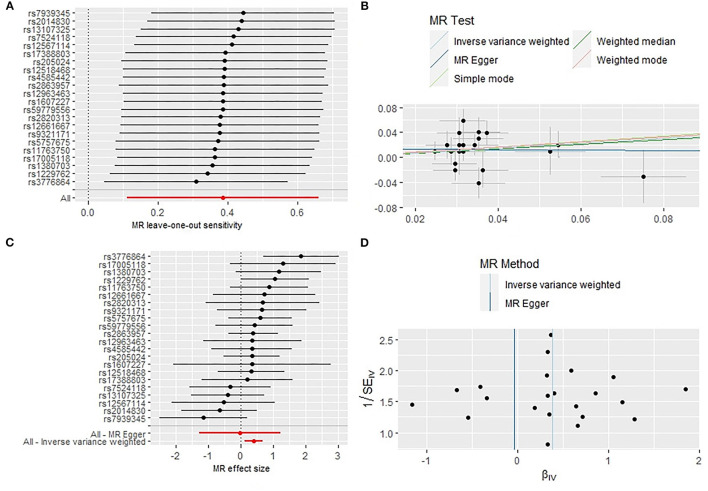
Currently, the causal association between sleep disorders and rheumatoid arthritis (RA) has been poorly understood. In this two-sample Mendelian randomization (TSMR) study, we tried to explore whether sleep disorders are causally associated with RA. Seven sleep-related traits were chosen from the published Genome-Wide Association Study (GWAS): short sleep duration, frequent insomnia, any insomnia, sleep duration, getting up, morningness (early-to-bed/up habit), and snoring, 27, 53, 57, 57, 70, 274, and 42 individual single-nucleotide polymorphisms (SNPs) ( < 5 × 10) were obtained as instrumental variables (IVs) for these sleep-related traits. Outcome variables were obtained from a public GWAS study that included 14,361 cases and 43,923 European Ancestry controls. The causal relationship between sleep disturbances and RA risk were evaluated by a two-sample Mendelian randomization (MR) analysis using inverse variance weighted (IVW), MR-Egger regression, weighted median, and weight mode methods. MR-Egger Regression and Mendelian randomization pleiotropy residual sum and outlier (MR-PRESSO) were used to test for horizontal pleomorphism and outliers. There was no evidence of a link between RA and frequent insomnia (IVW, odds ratio (OR): 0.99; 95% interval (CI): 0.84-1.16; = 0.858), any insomnia (IVW, OR: 1.09; 95% CI: 0.85-1.42; = 0.489), sleep duration (IVW, OR: 0.65, 95% CI: 0.38-1.10, = 0.269), getting up (IVW, OR: 0.56, 95% CI: 0.13-2.46, = 0.442), morningness (IVW, OR: 2.59; 95% CI: 0.73-9.16; = 0.142), or snoring (IVW, OR: 0.95; 95% CI: 0.68-1.33; = 0.757). Short sleep duration (6h) had a causal effect on RA, as supported by IVW and weighted median (OR: 1.47, 95% CI: 1.12-1.94, = 0.006; OR: 1.43, 95%CI:1.01-2.05, = 0.047). Sensitivity analysis showed that the results were stable. Our findings imply that short sleep duration is causally linked to an increased risk of RA. Therefore, sleep length should be considered in disease models, and physicians should advise people to avoid short sleep duration practices to lower the risk of RA.
目前,睡眠障碍与类风湿关节炎(RA)之间的因果关联尚未得到充分理解。在这项两样本孟德尔随机化(TSMR)研究中,我们试图探讨睡眠障碍是否与 RA 存在因果关系。从已发表的全基因组关联研究(GWAS)中选择了七个与睡眠相关的特征:睡眠时间短、频繁失眠、任何失眠、睡眠时间、起床、早晨型(早睡早起习惯)和打鼾,获得了 27、53、57、57、70、274 和 42 个个体单核苷酸多态性(SNP)(<5×10)作为这些与睡眠相关特征的工具变量(IVs)。结局变量来自一项包含 14361 例病例和 43923 例欧洲血统对照的公开 GWAS 研究。使用逆方差加权(IVW)、MR-Egger 回归、加权中位数和加权模式方法,通过两样本孟德尔随机化(MR)分析评估睡眠障碍与 RA 风险之间的因果关系。MR-Egger 回归和孟德尔随机化多效性残余总和和异常值(MR-PRESSO)用于测试水平多态性和异常值。没有证据表明 RA 与频繁失眠(IVW,比值比(OR):0.99;95%置信区间(CI):0.84-1.16;=0.858)、任何失眠(IVW,OR:1.09;95%CI:0.85-1.42;=0.489)、睡眠时间(IVW,OR:0.65,95%CI:0.38-1.10,=0.269)、起床(IVW,OR:0.56,95%CI:0.13-2.46,=0.442)、早晨型(IVW,OR:2.59;95%CI:0.73-9.16;=0.142)或打鼾(IVW,OR:0.95;95%CI:0.68-1.33;=0.757)之间存在关联。短睡眠时间(6 小时)对 RA 有因果影响,这得到了 IVW 和加权中位数的支持(OR:1.47,95%CI:1.12-1.94,=0.006;OR:1.43,95%CI:1.01-2.05,=0.047)。敏感性分析表明结果稳定。我们的研究结果表明,短睡眠时间与 RA 风险增加存在因果关系。因此,在疾病模型中应考虑睡眠时间,医生应建议人们避免短睡眠时间,以降低 RA 的风险。