Dos Santos Célia, Paiva Juvenal, Romero María Lucila, Agazzoni Mara, Kempfer Ana Catalina, Rotondo Sabrina, Casinelli María Marta, Alberto María Fabiana, Sánchez-Luceros Analía
Laboratory of Haemostasis and Thrombosis CONICET National Academy of Medicine Institute of Experimental Medicine Buenos Aires Argentina.
Department of Haemostasis and Thrombosis National Academy of Medicine Haematologic Research Institute "Mariano R. Castex" Buenos Aires Argentina.
EJHaem. 2021 Jan 19;2(2):149-156. doi: 10.1002/jha2.154. eCollection 2021 May.
Introduction: Thrombotic microangiopathies (TMAs) are rare disorders associated with fatal outcomes if left uncared for. However, healthcare problems in developing countries tend to limit medical assistance to patients.
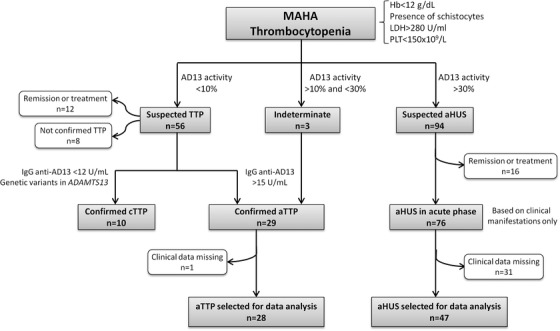
Methods: We prospectively studied an Argentine cohort of 294 consecutive patients from 2013 to 2016. Patients' subcategory classification relied on clinical symptoms and presence or absence of trigger events associated with TMA.
Main suspected disorders were the primary TMAs known as thrombotic thrombocytopenic purpura (TTP) (n = 72/294, 24%) and atypical haemolytic uraemic syndrome (aHUS) (n = 94/294, 32%). In acute phase, demographic parameters for acquired TTP (aTTP) (n = 28) and aHUS (n = 47) showed that both groups were characterised by a young median age (37 and 25 years, respectively) and female predominance (60% and 86%). Median of a disintegrin and metalloproteinase with a thrombospondin type 1 motif, member 13 activity was significantly lower in aTTP than in aHUS group (1.4% vs 83%) and was associated with a more severe thrombocytopenia (15 × 10 vs 53 × 10/L). Creatinine (Cr) and urea (Ur) were significantly increased in aHUS compared to aTTP subjects (Cr: 3.7 vs 0.7 mg/dL, Ur: 118 vs 33 mg/dL). Gastrointestinal and neurological symptoms were more frequent in aHUS and aTTP, respectively.
The first description of a TMA cohort in Argentina revealed similar clinical presentations to those of other countries.
血栓性微血管病(TMA)是一类罕见疾病,若不加以治疗往往会导致致命后果。然而,发展中国家的医疗问题往往限制了对患者的医疗救助。
我们对2013年至2016年期间阿根廷的294例连续患者进行了前瞻性研究。患者的亚类分类取决于临床症状以及与TMA相关的触发事件的有无。
主要疑似疾病是原发性TMA,即血栓性血小板减少性紫癜(TTP)(n = 72/294,24%)和非典型溶血性尿毒症综合征(aHUS)(n = 94/294,32%)。在急性期,获得性TTP(aTTP)(n = 28)和aHUS(n = 47)的人口统计学参数显示,两组的特征均为中位年龄较轻(分别为37岁和25岁)且女性占主导(分别为60%和86%)。具有血小板反应蛋白1型基序的去整合素和金属蛋白酶13活性的中位数在aTTP组显著低于aHUS组(1.4%对83%),并且与更严重的血小板减少症相关(15×10对53×10/L)。与aTTP受试者相比,aHUS患者的肌酐(Cr)和尿素(Ur)显著升高(Cr:3.7对0.7mg/dL,Ur:118对33mg/dL)。胃肠道症状和神经系统症状分别在aHUS和aTTP中更常见。
阿根廷TMA队列的首次描述显示出与其他国家相似的临床表现。