Dark Frances Louise, Gore-Jones Victoria, Newman Ellie, Wheeler Maddison, Demonte Veronica, Northwood Korinne
Metro South Addiction and Mental Health Services, Brisbane, QLD, Australia.
School of Medicine, The University of Queensland, Brisbane, QLD, Australia.
Front Psychiatry. 2022 Jul 1;13:878429. doi: 10.3389/fpsyt.2022.878429. eCollection 2022.
Various modes of delivering cognitive remediation (CR) are effective, but there have been few head-to-head trials of different approaches. This trial aimed to evaluate the relative effectiveness of two different programmes, Cognitive Compensatory Training (CCT) and Computerized Interactive Remediation of Cognition-Training for Schizophrenia (CIRCuiTs).
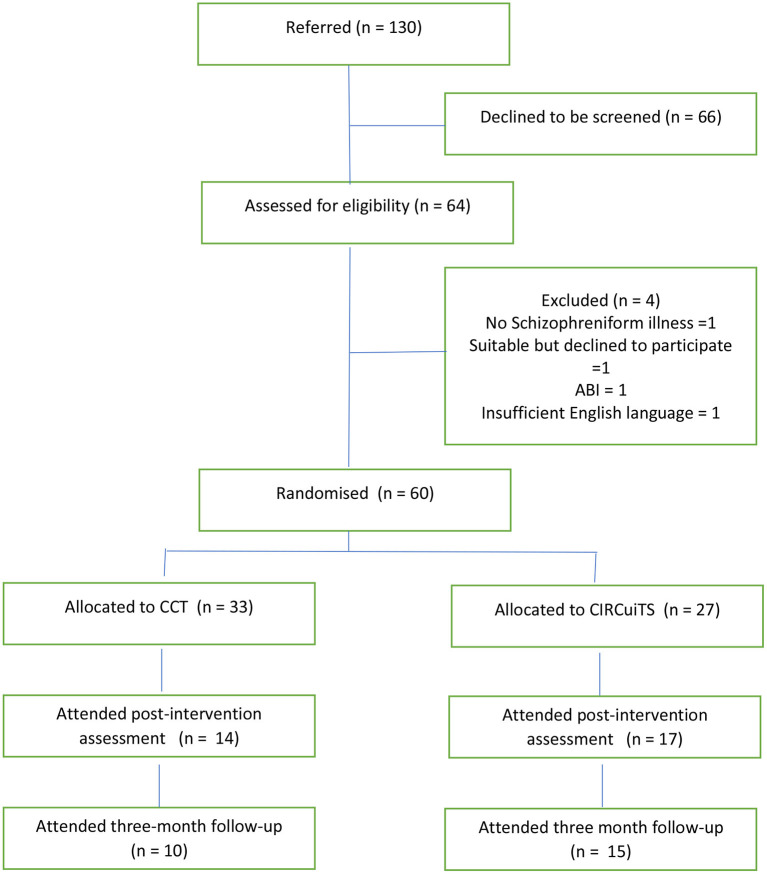
The study used a single-blind randomized, controlled trial to examine the efficacy and effectiveness of the two therapies. The study aimed to enroll 100 clinically stable patients between the ages of 18 and 65 years who had been diagnosed with a schizophrenia spectrum disorder. Participants were randomized to either the CCT or CIRCuiTs therapy groups. The primary outcome measures were neurocognition using the Brief Assessment of Cognition Scale (BACS) and the Subjective Scale to Investigate Cognition in Schizophrenia (SSTICS). The secondary measure was functional outcomes using the Social Functioning Scale (SFS).
There was no group difference in any of the outcome measures post-intervention or at follow-up. Both groups had a small improvement on their SSTICS scores between baseline (M = 30.52 and SD = 14.61) and post-intervention (M = 23.96 and SD = 10.92). Verbal memory scores as measured by list learning improved for both groups between baseline ( = -1.62) and 3-month follow-up ( = -1.03). Both groups improved on the token motor task between baseline ( = -1.38) and post-intervention ( = -0.69). Both groups had a decline in Symbol Coding scores between baseline (z = 0.05) and 3-month follow-up (z = -0.82).
This underpowered study found no difference in effect between the two approaches studied. If future studies confirm this finding, then it has implications for services where cost and lack of computer technology could pose a barrier in addressing the cognitive domain of schizophrenia spectrum disorders. The final sample size compromised the power of the study to conclusively determine a significant effect.
多种认知康复(CR)交付模式均有效,但针对不同方法的直接比较试验较少。本试验旨在评估两种不同方案,即认知补偿训练(CCT)和精神分裂症认知的计算机化交互式康复训练(CIRCuiTs)的相对有效性。
本研究采用单盲随机对照试验来检验这两种疗法的疗效和有效性。研究目标是招募100名年龄在18至65岁之间、临床症状稳定且被诊断患有精神分裂症谱系障碍的患者。参与者被随机分配到CCT或CIRCuiTs治疗组。主要结局指标是使用简易认知评估量表(BACS)和精神分裂症认知调查主观量表(SSTICS)进行的神经认知评估。次要指标是使用社会功能量表(SFS)评估的功能结局。
干预后或随访时,任何结局指标在两组间均无差异。两组在基线时(M = 30.52,标准差 = 14.61)和干预后(M = 23.96,标准差 = 10.92)的SSTICS评分均有小幅改善。两组在基线时( = -1.62)和3个月随访时( = -1.03)通过列表学习测得的言语记忆分数均有所提高。两组在基线时( = -1.38)和干预后( = -0.69)的标记运动任务上均有改善。两组在基线时(z = 0.05)和3个月随访时(z = -0.82)的符号编码分数均有所下降。
这项功效不足的研究发现,所研究的两种方法在效果上没有差异。如果未来的研究证实这一发现,那么对于那些成本和缺乏计算机技术可能成为解决精神分裂症谱系障碍认知领域障碍的服务机构而言,这具有重要意义。最终样本量影响了研究得出显著效果的检验效能。