Cheng Jingyang, Huang Hao, Liu Wenwen, Zhou Yupeng, Han Weipeng, Wang Xiuyan, Zhang Yihui
Key Laboratory of the Ministry of Education for Coastal and Wetland Ecosystems, College of the Environment and Ecology, Xiamen University, Xiamen, China.
Front Plant Sci. 2022 Jun 29;13:911804. doi: 10.3389/fpls.2022.911804. eCollection 2022.
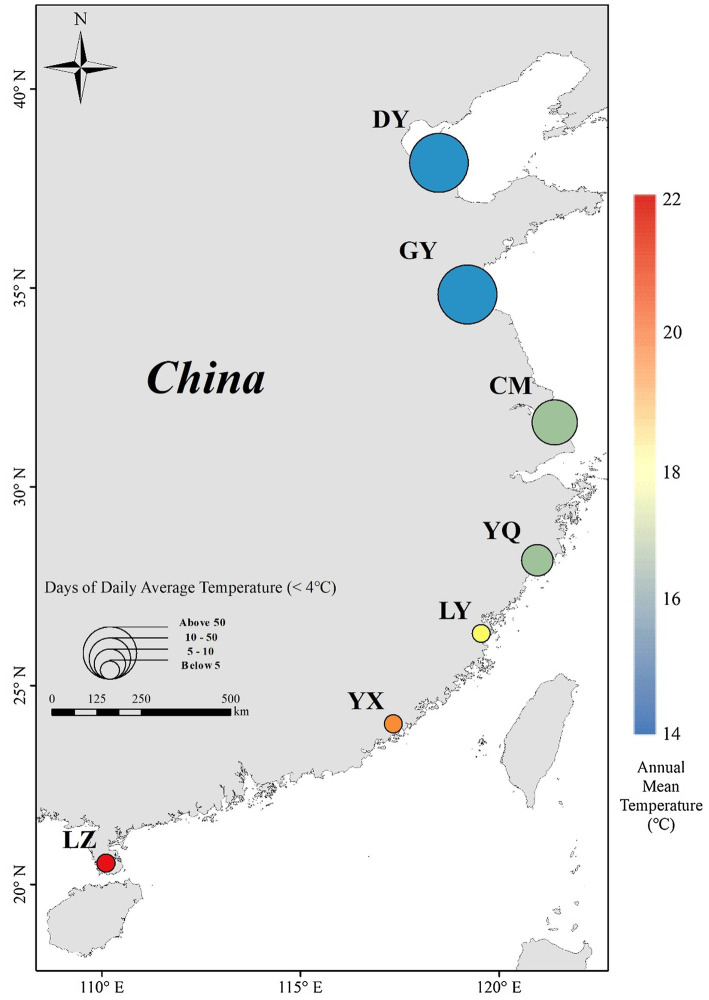
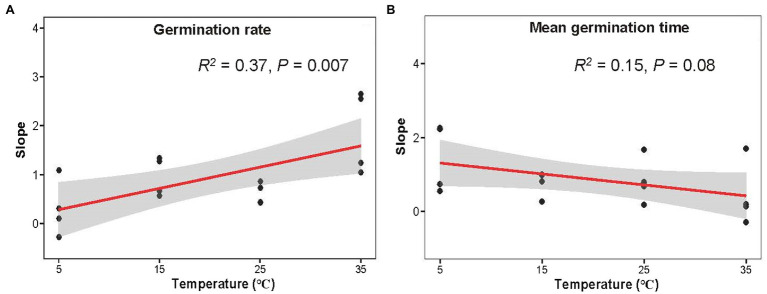
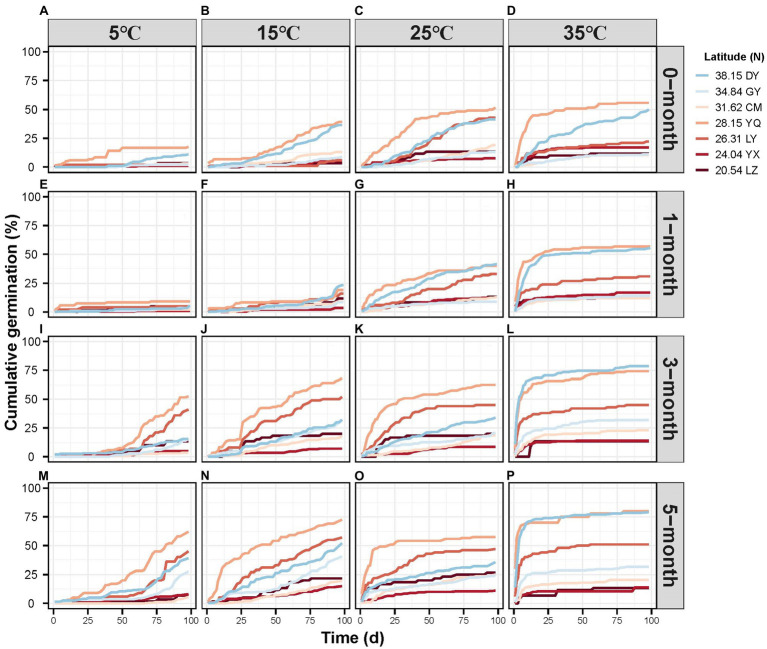
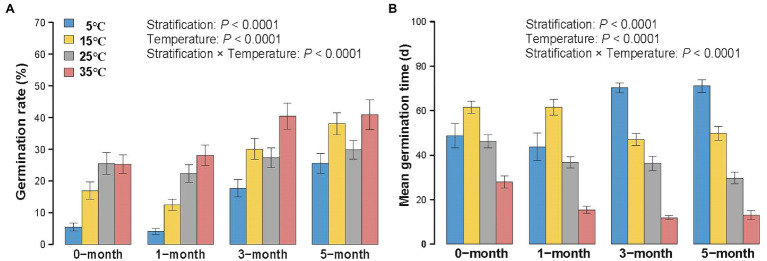
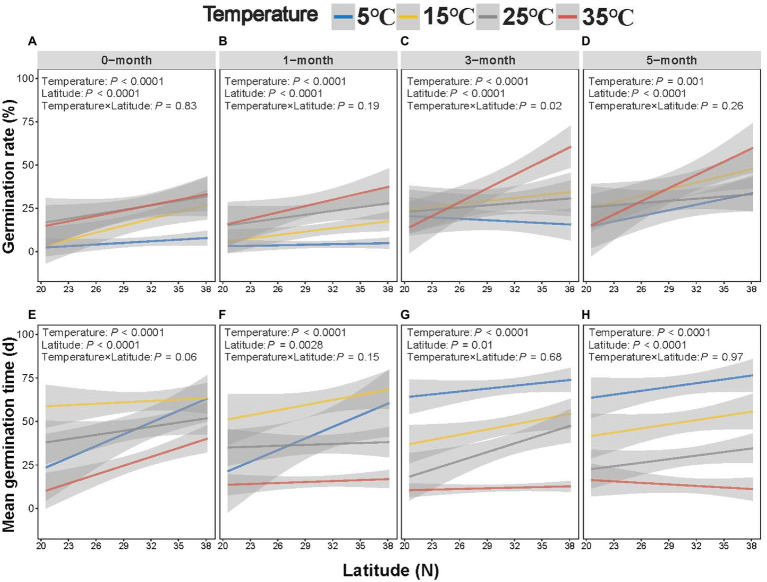
Seed germination is critical to the life history of plants, playing an important role in the successful recruitment, colonization, and even invasion of new individuals within and outside population distribution ranges. Cold stratification and temperature are the key factors affecting seed germination traits. Studying how these two factors drive geographical variation in seed germination is essential to analyze and predict the geographical distribution range of alien plants in novel habitats. , native to the United States, was introduced into China in 1979 and has spread over 20° of latitude along the eastern coast of China. Germination plays a crucial role in 's large-scale invasion and diffusion across latitude. To evaluate the effects of cold stratification and temperature on seed germination of across latitude, we collected seeds at seven locations across latitude in China. We exposed these provenances to cold stratification at 4°C (0, 1, 3, and 5 months) and germination temperature (5°C, 15°C, 25°C, and 35°C) treatments in growth chambers. Seed germination was observed for 98 days, and we calculated germination rate, germination index, and germination time. Results indicated that longer cold stratification significantly promoted germination rate and germination index, but decreased germination time. Similarly, higher germination temperature significantly promoted germination rate and germination index, but decreased germination time. Moreover, there were significant interactive effects on germination traits between cold stratification and temperature. Seed germination traits showed linear relationships with latitude, indicating that . seeds from different provenances germinated at different times and adopted different germination strategies. The stratification and temperature are the most important factors regulating the dormancy and germination seeds, so they can be important drivers of this variation along latitude. Under scenarios of warmer regional temperature, seeds at higher latitudes could germinate earlier and have higher germination rate, which would favor a potential northern expansion of this invasive plant.
种子萌发对植物的生活史至关重要,在种群分布范围内外新个体的成功招募、定殖甚至入侵中发挥着重要作用。低温层积和温度是影响种子萌发特性的关键因素。研究这两个因素如何驱动种子萌发的地理变异对于分析和预测外来植物在新栖息地的地理分布范围至关重要。 原产于美国,1979年引入中国,已在中国东部沿海地区跨越20个纬度扩散。萌发在 沿纬度的大规模入侵和扩散中起着关键作用。为了评估低温层积和温度对 沿纬度种子萌发的影响,我们在中国沿纬度的七个地点收集了种子。我们将这些种源在生长室中进行4°C(0、1、3和5个月)的低温层积和萌发温度(5°C、15°C、25°C和35°C)处理。观察种子萌发98天,并计算萌发率、萌发指数和萌发时间。结果表明,较长的低温层积显著提高了萌发率和萌发指数,但缩短了萌发时间。同样,较高的萌发温度显著提高了萌发率和萌发指数,但缩短了萌发时间。此外,低温层积和温度对萌发特性存在显著的交互作用。种子萌发特性与纬度呈线性关系,表明 不同种源的种子在不同时间萌发并采用不同的萌发策略。层积和温度是调节种子休眠和萌发的最重要因素之一,因此它们可能是这种沿纬度变异的重要驱动因素。在区域温度升高的情况下,高纬度地区的种子可能更早萌发且具有更高的萌发率,这将有利于这种入侵植物向北扩张。 (注:原文中部分地方有缺失信息,翻译时保留了原文格式)