Baggio Stéphanie, Togni Giuseppe, Eckerle Isabella, Vuillemier Nicolas, Kaiser Laurent, Gétaz Laurent
Division of Prison Health, Geneva University Hospitals and University of Geneva, Geneva, Switzerland.
Institute of Primary Health Care (BIHAM), University of Bern, Bern, Switzerland.
Pract Lab Med. 2022 Aug;31:e00290. doi: 10.1016/j.plabm.2022.e00290. Epub 2022 Jul 12.
Serological assays for the presence of anti-SARS-CoV-2 antibodies are crucially needed for research and monitoring of the SARS-CoV-2 pandemic. Antibodies are reliability detected in capillary blood, a minimally invasive and cost-effective alternative to venous blood testing. However, there is a limited knowledge on feasibility of capillary blood self-sampling. This study compared the feasibility of capillary blood self-testing in people aged less than 65 people aged 65 or more. A secondary aim was to investigate the performance of the Hem-Col® (no additive) device compared to venous blood testing.
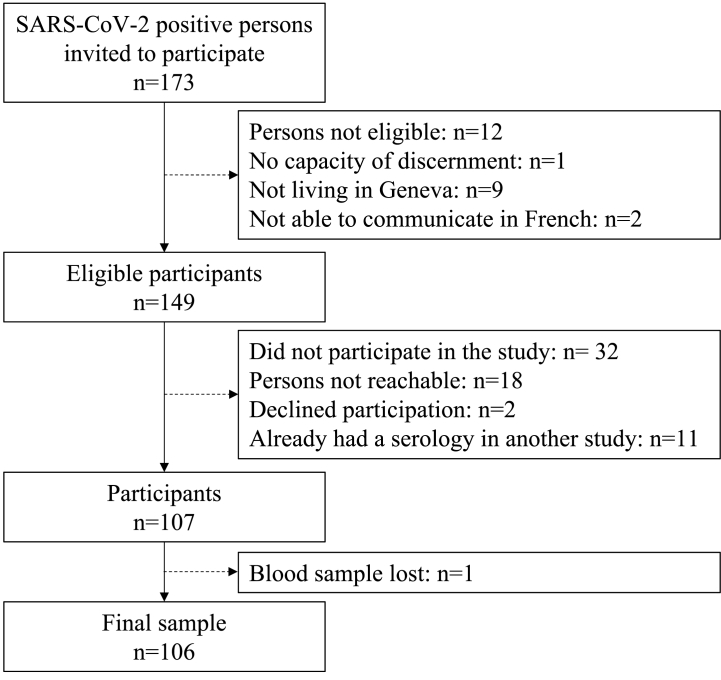
Data were collected in a prospective study in Switzerland (n = 106). Capillary blood was collected using the Hem-Col® (no additive) device. Feasibility was assessed using 1) collecting the recommended amount of capillary blood and 2) achieving all steps of capillary blood collection. A sample of 5 ml of venous blood was also collected.
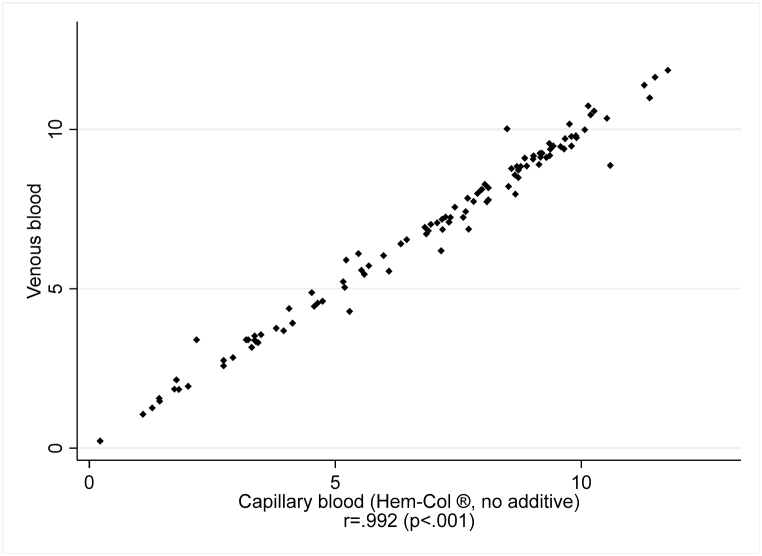
For the primary objective, 86.2%/62.1% of patients aged less than 65 collected the recommended amount of capillary blood/achieved all steps 62.5%/39.6% of patients aged 65 or more (p = .006/p = .022). For the secondary objective, the correlation between capillary and venous blood was r = 0.992 and kappa = 1.
Capillary blood self-testing appeared as a feasible and reliable alternative to venous blood testing. Such alternative would improve access to serological testing and spare health care resources. However, the difference between age groups should be considered when using self-sampling devices. Help should be developed for older people, such as phone counseling or encouraging asking younger family members for help.
对于严重急性呼吸综合征冠状病毒2(SARS-CoV-2)大流行的研究和监测而言,检测抗SARS-CoV-2抗体的血清学检测至关重要。在毛细血管血中能可靠地检测到抗体,这是一种微创且经济高效的静脉血检测替代方法。然而,关于毛细血管血自我采样的可行性了解有限。本研究比较了65岁以下人群和65岁及以上人群进行毛细血管血自我检测的可行性。第二个目的是研究Hem-Col®(无添加剂)设备与静脉血检测相比的性能。
在瑞士进行的一项前瞻性研究中收集数据(n = 106)。使用Hem-Col®(无添加剂)设备采集毛细血管血。通过以下方式评估可行性:1)采集推荐量的毛细血管血;2)完成毛细血管血采集的所有步骤。还采集了5毫升静脉血样本。
对于主要目标,65岁以下患者中86.2%/62.1%采集到了推荐量的毛细血管血/完成了所有步骤,65岁及以上患者中这一比例为62.5%/39.6%(p = 0.006/p = 0.022)。对于第二个目标,毛细血管血与静脉血之间的相关性为r = 0.992,kappa值为1。
毛细血管血自我检测似乎是一种可行且可靠的静脉血检测替代方法。这种替代方法将改善血清学检测的可及性并节省医疗资源。然而,使用自我采样设备时应考虑年龄组之间的差异。应为老年人提供帮助,例如电话咨询或鼓励他们向年轻家庭成员求助。