Université Paris Cité, Institut National de la Santé Et Recherche Médicale (INSERM), Paris Cardiovascular Research Center PARCC, Paris, France.
UFR Santé Médecine Biologie Humaine, Université Sorbonne Paris Nord, Bobigny, France.
Front Endocrinol (Lausanne). 2022 Jun 29;13:906586. doi: 10.3389/fendo.2022.906586. eCollection 2022.
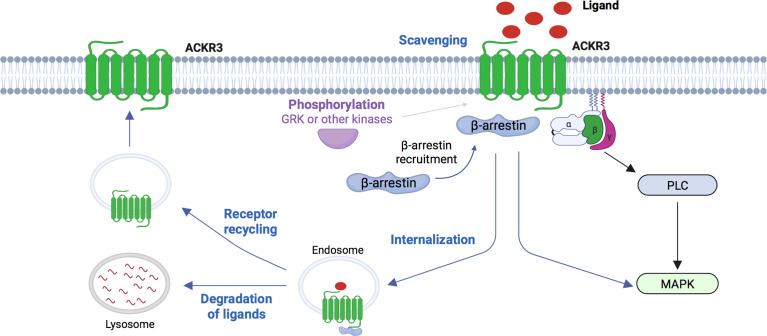
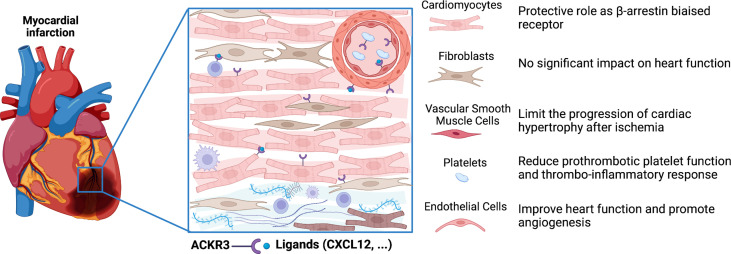
Chemokines, and their receptors play a crucial role in the pathophysiology of cardiovascular diseases (CVD). Chemokines classically mediate their effects by binding to G-protein-coupled receptors. The discovery that chemokines can also bind to atypical chemokine receptors (ACKRs) and initiate alternative signaling pathways has changed the paradigm regarding chemokine-related functions. Among these ACKRs, several studies have highlighted the exclusive role of ACKR3, previously known as C-X-C chemokine receptor type 7 (CXCR7), in CVD. Indeed, ACKR3 exert atheroprotective, cardioprotective and anti-thrombotic effects through a wide range of cells including endothelial cells, platelets, inflammatory cells, fibroblasts, vascular smooth muscle cells and cardiomyocytes. ACKR3 functions as a scavenger receptor notably for the pleiotropic chemokine CXCL12, but also as a activator of different pathways such as β-arrestin-mediated signaling or modulator of CXCR4 signaling through the formation of ACKR3-CXCR4 heterodimers. Hence, a better understanding of the precise roles of ACKR3 may pave the way towards the development of novel and improved therapeutic strategies for CVD. Here, we summarize the structural determinant characteristic of ACKR3, the molecules targeting this receptor and signaling pathways modulated by ACKR3. Finally, we present and discuss recent findings regarding the role of ACKR3 in CVD.
趋化因子及其受体在心血管疾病 (CVD) 的病理生理学中发挥着关键作用。趋化因子通过与 G 蛋白偶联受体结合来发挥其经典作用。趋化因子也可以与非典型趋化因子受体 (ACKR) 结合并启动替代信号通路的发现,改变了与趋化因子相关功能的范式。在这些 ACKR 中,几项研究强调了 ACKR3(以前称为 C-X-C 趋化因子受体 7 (CXCR7))在 CVD 中的独特作用。事实上,ACKR3 通过包括内皮细胞、血小板、炎症细胞、成纤维细胞、血管平滑肌细胞和心肌细胞在内的多种细胞发挥抗动脉粥样硬化、心脏保护和抗血栓作用。ACKR3 作为一种清道夫受体,特别是作为多效趋化因子 CXCL12 的受体,此外,还作为 β-抑制蛋白介导的信号或通过形成 ACKR3-CXCR4 异二聚体调节 CXCR4 信号的激活剂发挥作用。因此,更好地了解 ACKR3 的精确作用可能为开发针对 CVD 的新型和改进的治疗策略铺平道路。在这里,我们总结了 ACKR3 的结构决定因素、针对该受体的分子和 ACKR3 调节的信号通路。最后,我们提出并讨论了最近关于 ACKR3 在 CVD 中的作用的发现。