Waranugraha Yoga, Rizal Ardian, Rohman Mohammad Saifur, Tsai Chia-Ti, Chiu Fu-Chun
Department of Cardiology and Vascular Medicine, Faculty of Medicine, University of Brawijaya, Malang, Indonesia.
Division of Cardiology, Department of Internal Medicine, National Taiwan University Hospital, Taipei, Taiwan.
Arrhythm Electrophysiol Rev. 2022 Apr;11:e10. doi: 10.15420/aer.2021.37.
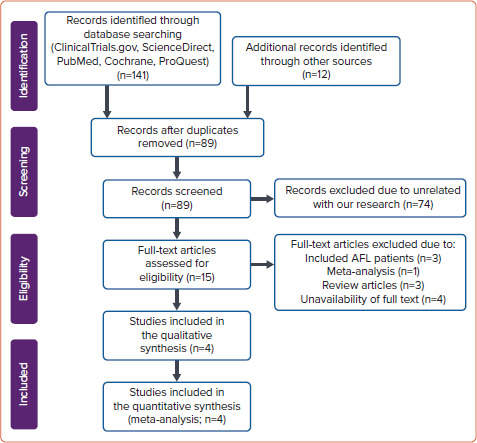
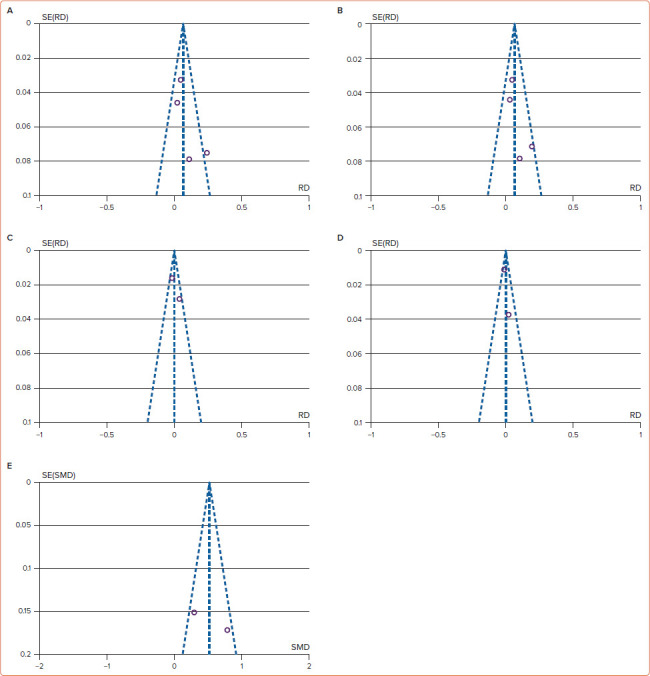
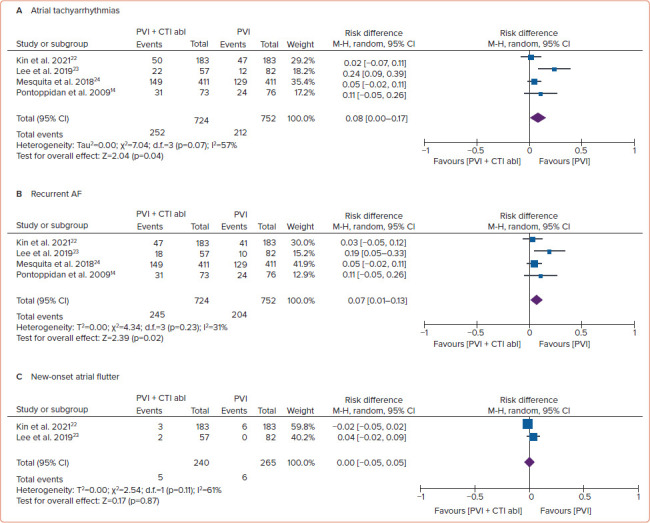
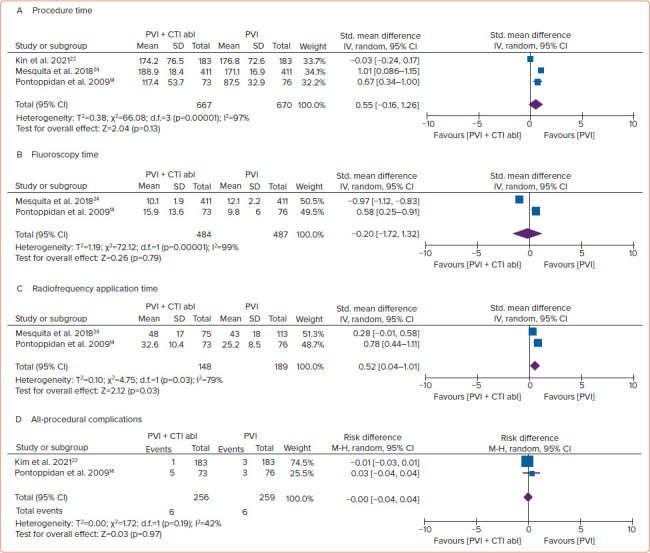
The advantage of prophylactic cavotricuspid isthmus (CTI) ablation for AF patients without documented atrial flutter is still unclear. The present study aimed to evaluate the role of prophylactic CTI ablation in this population. A systematic review and meta-analysis study was conducted. The overall effects estimation was conducted using random effects models. The pooled effects were presented as the risk difference and standardised mean difference for dichotomous and continuous outcomes, respectively. A total of 1,476 patients from four studies were included. The risk of atrial tachyarrhythmias following a successful catheter ablation procedure was greater in the pulmonary vein isolation + CTI ablation group than pulmonary vein isolation alone group (34.8% versus 28.2%; risk difference 0.08; 95% CI [0.00-0.17]; p=0.04). Prophylactic CTI ablation was associated with a higher recurrent AF rate (33.8% versus 27.1%; risk difference 0.07; 95% CI [0.01-0.13]; p=0.02). Additional prophylactic CTI ablation to pulmonary vein isolation significantly increased the radio frequency application time (standardised mean difference 0.52; 95% CI [0.04-1.01]; p=0.03). This study suggested that prophylactic CTI ablation was an ineffective and inefficient approach in AF without documented typical atrial flutter patients.
对于无记录在案的心房扑动的房颤患者,预防性三尖瓣峡部(CTI)消融的优势仍不明确。本研究旨在评估预防性CTI消融在该人群中的作用。进行了一项系统评价和荟萃分析研究。使用随机效应模型进行总体效应估计。汇总效应分别以二分法和连续结果的风险差异和标准化平均差异表示。共纳入来自四项研究的1476例患者。成功的导管消融术后,肺静脉隔离+CTI消融组的房性快速性心律失常风险高于单纯肺静脉隔离组(34.8%对28.2%;风险差异0.08;95%CI[0.00-0.17];p=0.04)。预防性CTI消融与较高的房颤复发率相关(33.8%对27.1%;风险差异0.07;95%CI[0.01-0.13];p=0.02)。在肺静脉隔离基础上额外进行预防性CTI消融显著增加了射频应用时间(标准化平均差异0.52;95%CI[0.04-1.01];p=0.03)。本研究表明,对于无记录在案的典型心房扑动的房颤患者,预防性CTI消融是一种无效且低效的方法。