
剖析埃塞俄比亚地方城市空间规划文件中纳入的恢复力原则:来自正在城市化的二级城市孔博尔查的实践
Unpacking principles of resilience mainstreamed in Ethiopia's local urban spatial planning documents: practices from Kombolcha, an urbanizing secondary city.
作者信息
Maru Mulugeta, Worku Hailu
机构信息
Ethiopian Institute of Architecture, Building Construction and City Development/EiABC/, Addis Ababa University/AAU/, Po. Box. 518, Addis Ababa, Ethiopia.
出版信息
Heliyon. 2022 Mar 19;8(3):e09137. doi: 10.1016/j.heliyon.2022.e09137. eCollection 2022 Mar.
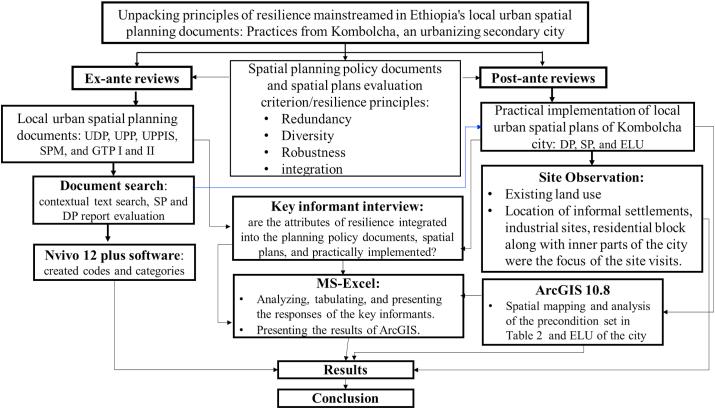
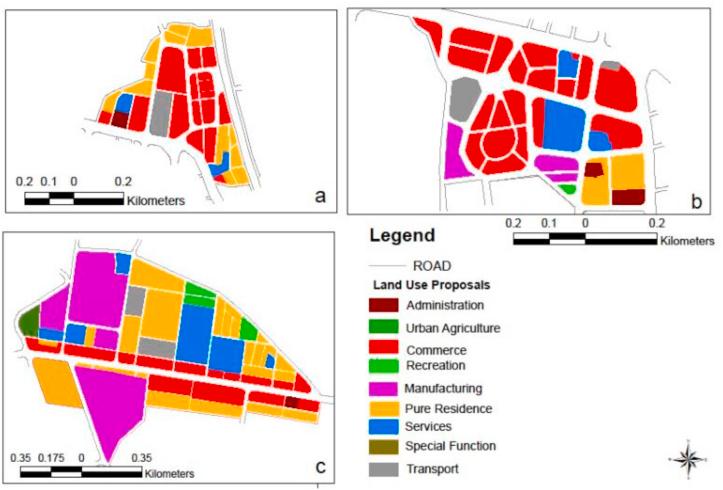
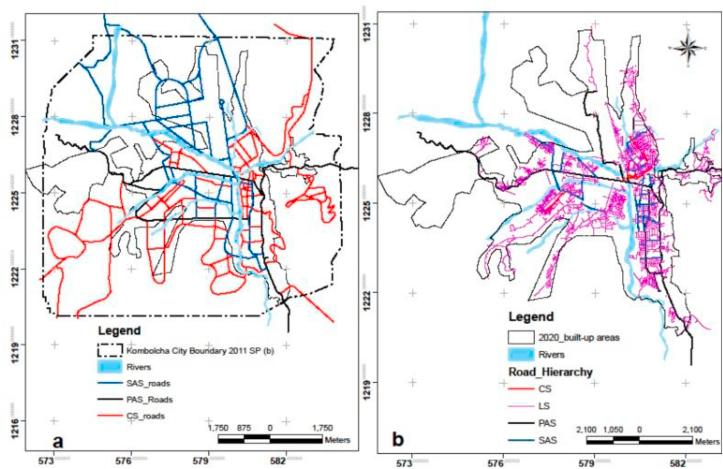
Adopting and enforcing redundancy, diversity, robustness, and integration principles are required to create spatially resilient cities. However, no studies have demonstrated their significance and application to local urban spatial planning legal frameworks (policy documents) and plans. Therefore, this study aims to fill this gap through an ex-ante review of six Ethiopian spatial planning policy documents: the Urban Development Policy (UDP), the Urban Planning Proclamation (UPP), the Structure Plan Manual (SPM), the Urban Plan Preparation and Implementation Strategy (UPPIS), and the first and second Growth and Transformation Plans (GTP I and II). Besides, the paper undertook post-ante evaluations of the 2001 Development Plan (DP), 2011 Structure Plan (SP), and the 2020 existing land use (ELU) of Kombolcha, a secondary city located in the South Wollo Zone of Amhara National Regional State, Ethiopia. Site observations supplemented the desk-based policy evaluation, Google Earth images, and data gathered from twenty-three purposefully selected key informants. NVivo 12 plus software aided the content analysis, where codes and categories were created based on the characteristics, and respective scores/coefficients were recorded. The findings revealed inconsistencies in the principles' mainstreaming with integration was well assimilated into the policy documents, receiving a score of 67.22, followed by redundancy, a value of 54.21. The tally for diversity and robustness were 44.84 and 31.83, respectively. Concerning policy-specific review, GTP I and II received the highest values of 54.28 and 57.74, respectively. However, UPPIS got the lowest with 18.50. Despite the plans' optimistic visions of addressing hazards and population growth-induced development pressures, their practical implementation had been hampered by the dominance of residential and manufacturing land-uses, haphazard block arrangements, and the municipality's limited ability to implement the proposals. The study, hence, necessitated capacity-building activities to improve local governments' spatial plan implementation capacities. The active participation of stakeholders and institutional collaboration also need further attention from all tiers of government.
采用并实施冗余、多样性、稳健性和整合原则是创建具有空间弹性城市的必要条件。然而,尚无研究证明这些原则在地方城市空间规划法律框架(政策文件)和规划中的重要性及应用情况。因此,本研究旨在通过对埃塞俄比亚六份空间规划政策文件进行事前审查来填补这一空白,这六份文件分别是《城市发展政策》(UDP)、《城市规划公告》(UPP)、《结构规划手册》(SPM)、《城市规划编制与实施战略》(UPPIS)以及第一和第二个《增长与转型计划》(GTP I和II)。此外,本文还对2001年发展规划(DP)、2011年结构规划(SP)以及埃塞俄比亚阿姆哈拉民族州南沃洛区的二级城市科姆博尔查2020年的现有土地利用情况(ELU)进行了事后评估。实地观察补充了基于案头的政策评估、谷歌地球图像以及从23名经过有目的挑选的关键信息提供者那里收集的数据。NVivo 12 plus软件辅助进行内容分析,根据特征创建代码和类别,并记录各自的分数/系数。研究结果显示,这些原则在主流化方面存在不一致之处,其中整合被很好地融入政策文件,得分为67.22,其次是冗余,得分为54.21。多样性和稳健性的得分分别为44.84和31.83。关于具体政策审查,GTP I和II分别获得了最高值54.28和57.74。然而,UPPIS得分最低,为18.50。尽管这些规划在应对灾害和人口增长引发的发展压力方面有着乐观的愿景,但其实际实施却受到住宅和制造业土地利用占主导、街区布局杂乱以及市政当局实施提案能力有限的阻碍。因此,该研究有必要开展能力建设活动,以提高地方政府实施空间规划的能力。利益相关者的积极参与和机构合作也需要各级政府给予进一步关注。







 Zotero 插件