Novack Miriam A, Chan Dana, Waxman Sandra
Department of Medical Social Sciences, Feinberg School of Medicine, Northwestern University, Chicago, IL, United States.
Department of Psychology, Northwestern University, Evanston, IL, United States.
Front Psychol. 2022 Jun 30;13:896049. doi: 10.3389/fpsyg.2022.896049. eCollection 2022.
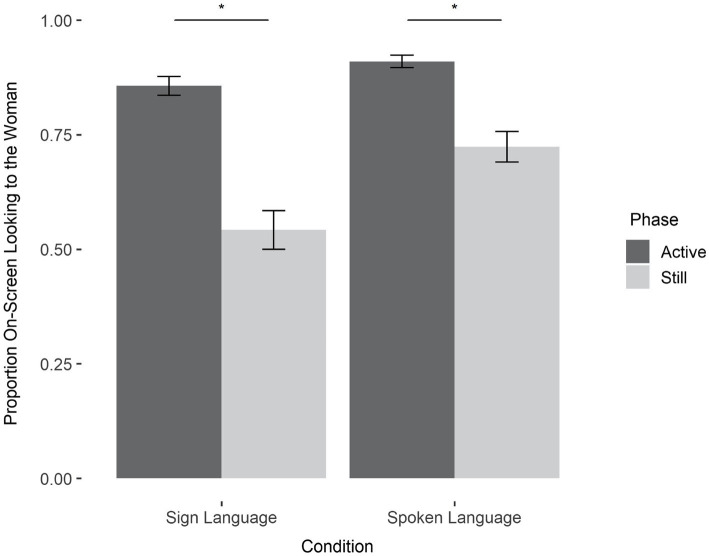
Infants are endowed with a proclivity to acquire language, whether it is presented in the auditory or visual modality. Moreover, in the first months of life, listening to language supports fundamental cognitive capacities, including infants' facility to form object categories (e.g., dogs and bottles). Recently, we have found that for English-acquiring infants as young as 4 months of age, this precocious interface between language and cognition is sufficiently broad to include not only their native spoken language (English), but also sign language (American Sign Language, ASL). In the current study, we take this work one step further, asking how "sign-naïve" infants-hearing infants with no prior exposure to sign language-deploy their attentional and social strategies in the context of episodes involving either spoken or sign language. We adopted a now-standard categorization task, presenting 4- to 6-month-old infants with a series of exemplars from a single category (e.g., dinosaurs). Each exemplar was introduced by a woman who appeared on the screen together with the object. What varied across conditions was whether this woman introduced the exemplar by speaking (English) or signing (ASL). We coded infants' visual attentional strategies and their spontaneous vocalizations during this task. Infants' division of attention and visual switches between the woman and exemplar varied as a function of language modality. In contrast, infants' spontaneous vocalizations revealed similar patterns across languages. These results, which advance our understanding of how infants allocate attentional resources and engage with communicative partners across distinct modalities, have implications for specifying our theories of language acquisition.
婴儿天生就有学习语言的倾向,无论语言是以听觉还是视觉形式呈现。此外,在生命的最初几个月里,听语言有助于发展基本的认知能力,包括婴儿形成物体类别的能力(例如,狗和瓶子)。最近,我们发现,对于年仅4个月大的学习英语的婴儿来说,语言与认知之间这种早熟的联系非常广泛,不仅包括他们的母语口语(英语),还包括手语(美国手语,ASL)。在当前的研究中,我们将这项工作进一步推进,研究“不懂手语”的婴儿——即从未接触过手语的听力正常的婴儿——在涉及口语或手语的情境中如何运用他们的注意力和社交策略。我们采用了一种现在标准的分类任务,向4到6个月大的婴儿展示来自单一类别的一系列示例(例如恐龙)。每个示例都由一名女性介绍,她与物体一起出现在屏幕上。不同条件下的差异在于,这名女性是通过说话(英语)还是手语(ASL)来介绍示例。我们在这项任务中对婴儿的视觉注意力策略和自发发声进行了编码。婴儿的注意力分配以及在女性和示例之间的视觉切换因语言形式而异。相比之下,婴儿的自发发声在不同语言中呈现出相似的模式。这些结果增进了我们对婴儿如何分配注意力资源以及如何与不同形式的交流伙伴互动的理解,对明确我们的语言习得理论具有启示意义。