Northwestern University, Evanston, USA.
Sci Rep. 2019 Mar 1;9(1):3293. doi: 10.1038/s41598-019-39511-9.
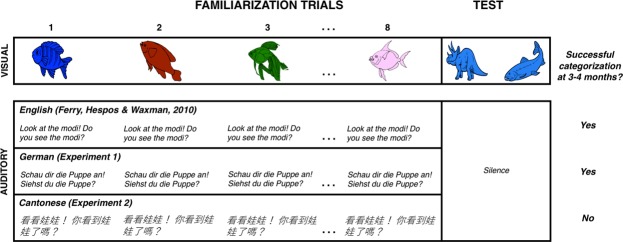
The power of human language derives not only from the precision of its signal or the complexity of its grammar, but also from its links to cognition. Infants as young as 3 months have begun to link language and core cognitive capacities. At 3 and 4 months, this link is not exclusive to human language: listening to vocalizations of nonhuman primates also supports infant cognition. By 6 months, infants have tuned this link to human speech alone. Here we provide evidence that infants' increasing precision in speech perception shapes which signals they will link to cognition. Infants listening to German, a nonnative language that shares key rhythmic and prosodic properties with their own native language (English), successfully formed object categories. In contrast, those listening to Cantonese, a language that differs considerably in these suprasegmental properties, failed. This provides the first evidence that infants' increasingly precise perceptual tuning to the sounds of their native language sets constraints on the range of human languages they will link to cognition: infants begin to specify which human languages they will link to core cognitive capacities even before they sever the link between nonhuman primate vocalizations and cognition.
人类语言的力量不仅源于其信号的准确性或语法的复杂性,还源于其与认知的联系。3 个月大的婴儿就已经开始将语言和核心认知能力联系起来。3 到 4 个月大时,这种联系并不局限于人类语言:聆听非人类灵长类动物的发声也能支持婴儿的认知。到 6 个月大时,婴儿已经将这种联系单独调整到人类的语音上。在这里,我们提供的证据表明,婴儿在语音感知方面的精确性提高会影响他们将哪些信号与认知联系起来。听德语的婴儿——一种与他们自己的母语(英语)共享关键节奏和韵律特征的非母语——成功地形成了物体类别。相比之下,听粤语的婴儿则失败了,粤语在这些超音段特征上有很大的差异。这提供了第一个证据,证明婴儿对母语声音的感知调整越来越精确,限制了他们将认知联系起来的人类语言的范围:婴儿甚至在切断非人类灵长类动物发声与认知之间的联系之前,就开始确定他们将与哪些人类语言建立联系认知能力。