Laboratory for Language and Cognitive Neuroscience, School of Speech, Language, and Hearing Sciences, San Diego State University San Diego, CA, USA.
Department of Psychology, University of Washington Seattle, WA, USA ; Department of Radiology, University of Washington Seattle, WA, USA.
Front Psychol. 2014 May 27;5:484. doi: 10.3389/fpsyg.2014.00484. eCollection 2014.
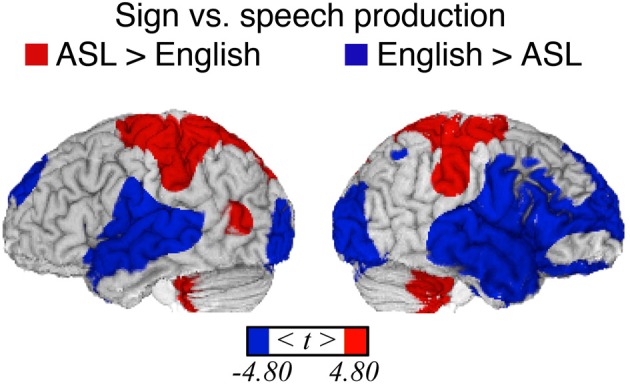
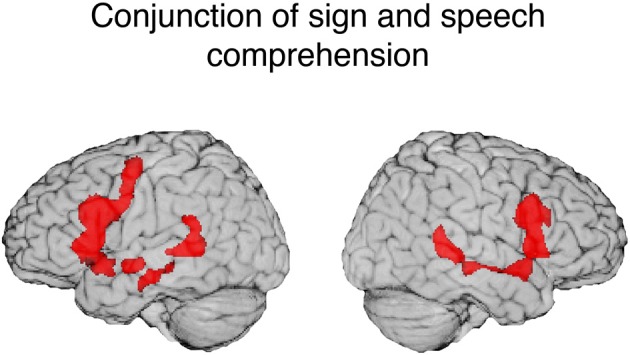
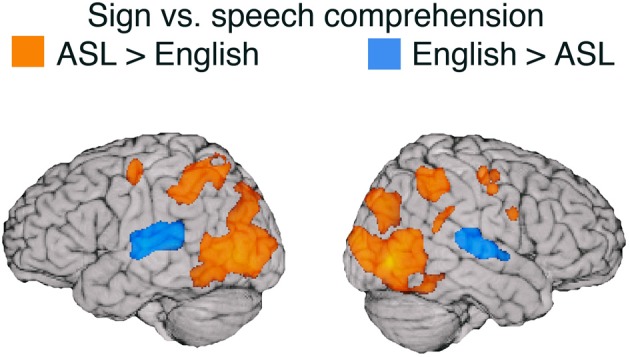
To investigate the impact of sensory-motor systems on the neural organization for language, we conducted an H2 (15)O-PET study of sign and spoken word production (picture-naming) and an fMRI study of sign and audio-visual spoken language comprehension (detection of a semantically anomalous sentence) with hearing bilinguals who are native users of American Sign Language (ASL) and English. Directly contrasting speech and sign production revealed greater activation in bilateral parietal cortex for signing, while speaking resulted in greater activation in bilateral superior temporal cortex (STC) and right frontal cortex, likely reflecting auditory feedback control. Surprisingly, the language production contrast revealed a relative increase in activation in bilateral occipital cortex for speaking. We speculate that greater activation in visual cortex for speaking may actually reflect cortical attenuation when signing, which functions to distinguish self-produced from externally generated visual input. Directly contrasting speech and sign comprehension revealed greater activation in bilateral STC for speech and greater activation in bilateral occipital-temporal cortex for sign. Sign comprehension, like sign production, engaged bilateral parietal cortex to a greater extent than spoken language. We hypothesize that posterior parietal activation in part reflects processing related to spatial classifier constructions in ASL and that anterior parietal activation may reflect covert imitation that functions as a predictive model during sign comprehension. The conjunction analysis for comprehension revealed that both speech and sign bilaterally engaged the inferior frontal gyrus (with more extensive activation on the left) and the superior temporal sulcus, suggesting an invariant bilateral perisylvian language system. We conclude that surface level differences between sign and spoken languages should not be dismissed and are critical for understanding the neurobiology of language.
为了探究感觉运动系统对语言神经组织的影响,我们使用 H2(15)O-PET 技术对美国手语(ASL)母语使用者的手势和口语产生(图片命名)以及手势和视听口语理解(检测语义异常句子)进行了研究,并使用 fMRI 技术进行了研究。口语和手势产生的直接对比显示,手语产生时双侧顶叶皮层的激活程度更高,而口语产生时双侧颞上回(STC)和右侧额皮质的激活程度更高,这可能反映了听觉反馈控制。令人惊讶的是,语言产生的对比显示,口语时双侧枕叶皮层的激活程度相对增加。我们推测,口语时视觉皮层的激活程度增加可能实际上反映了手语时的皮层衰减,这种衰减有助于区分自我产生的和外部产生的视觉输入。口语和手势理解的直接对比显示,口语时双侧 STC 的激活程度更高,而手势时双侧枕颞皮质的激活程度更高。手势理解与手势产生一样,比口语更广泛地激活了双侧顶叶皮质。我们假设,后顶叶的激活部分反映了 ASL 中与空间分类器结构相关的处理,而前顶叶的激活可能反映了在手势理解过程中作为预测模型的隐蔽模仿。理解的联合分析显示,口语和手势双侧都激活了额下回(左侧激活程度更高)和颞上沟,这表明存在一个不变的双侧皮层语言系统。我们得出结论,不应忽视手语和口语之间的表面差异,这对于理解语言的神经生物学至关重要。