Hualing Mi
National Key Laboratory of Plant Molecular Genetics, CAS Center for Excellence in Molecular Plant Sciences, Institutes of Plant Physiology and Ecology, Shanghai, China.
Front Microbiol. 2022 Jul 1;13:933160. doi: 10.3389/fmicb.2022.933160. eCollection 2022.
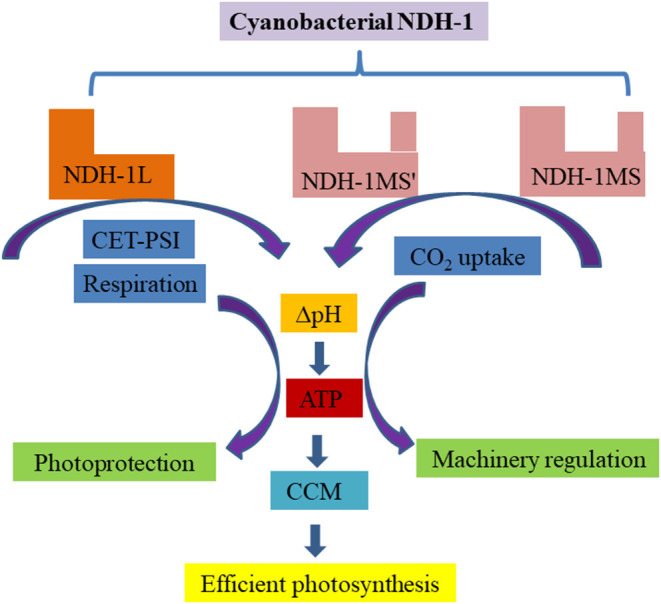
Light reaction of photosynthesis is efficiently driven by protein complexes arranged in an orderly in the thylakoid membrane. As the 5th complex, NAD(P)H dehydrogenase complex (NDH-1) is involved in cyclic electron flow around photosystem I to protect plants against environmental stresses for efficient photosynthesis. In addition, two kinds of NDH-1 complexes participate in CO uptake for CO concentration in cyanobacteria. In recent years, great progress has been made in the understanding of the assembly and the structure of NDH-1. However, the regulatory mechanism of NDH-1 in photosynthesis remains largely unknown. Therefore, understanding the regulatory mechanism of NDH-1 is of great significance to reveal the mechanism of efficient photosynthesis. In this mini-review, the author introduces current progress in the research of cyanobacterial NDH-1. Finally, the author summarizes the possible regulatory mechanism of cyanobacterial NDH-1 in photosynthesis and discusses the research prospect.
光合作用的光反应由类囊体膜中有序排列的蛋白质复合体有效驱动。作为第五种复合体,NAD(P)H脱氢酶复合体(NDH-1)参与围绕光系统I的循环电子流,以保护植物免受环境胁迫,实现高效光合作用。此外,两种NDH-1复合体参与蓝细菌中用于二氧化碳浓缩的二氧化碳摄取。近年来,在对NDH-1的组装和结构的理解方面取得了很大进展。然而,NDH-1在光合作用中的调控机制在很大程度上仍然未知。因此,了解NDH-1的调控机制对于揭示高效光合作用的机制具有重要意义。在这篇小型综述中,作者介绍了蓝细菌NDH-1研究的当前进展。最后,作者总结了蓝细菌NDH-1在光合作用中可能的调控机制,并讨论了研究前景。