Díaz-Gavidia Constanza, Barría Carla, Weller Daniel L, Salgado-Caxito Marilia, Estrada Erika M, Araya Aníbal, Vera Leonardo, Smith Woutrina, Kim Minji, Moreno-Switt Andrea I, Olivares-Pacheco Jorge, Adell Aiko D
Escuela de Medicina Veterinaria, Facultad de Ciencias de la Vida, Universidad Andres Bello, Santiago, Chile.
Millennium Initiative for Collaborative Research on Bacterial Resistance (MICROB-R), Santiago, Chile.
Front Microbiol. 2022 Jun 30;13:768527. doi: 10.3389/fmicb.2022.768527. eCollection 2022.
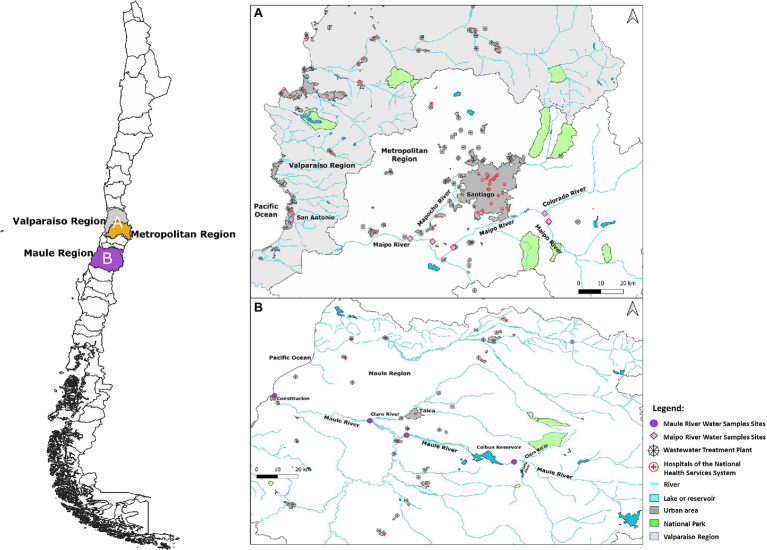
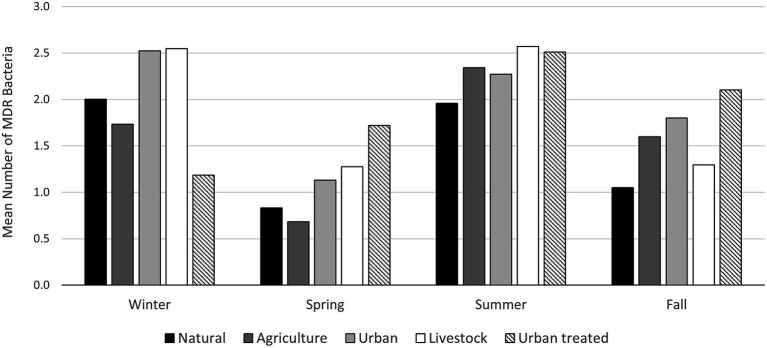
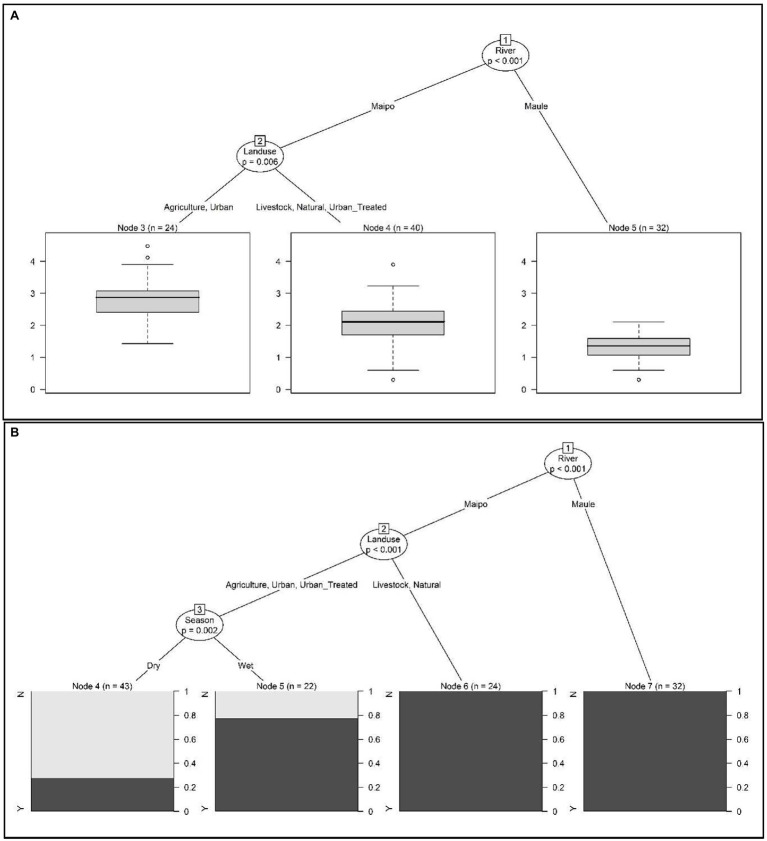
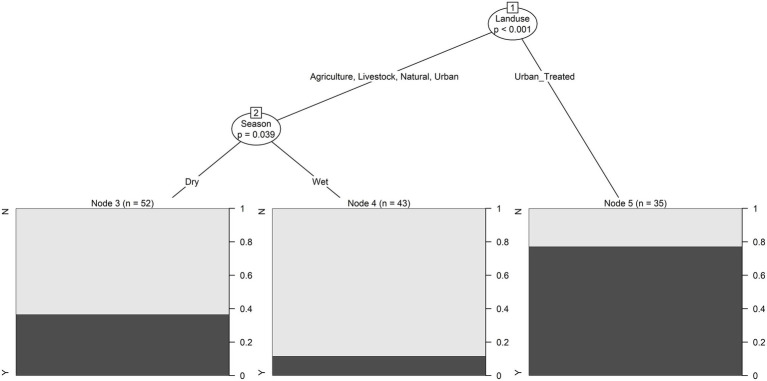
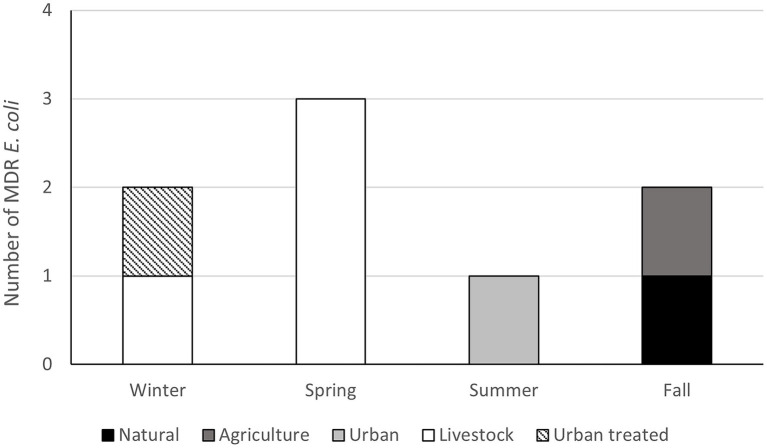
Freshwater bodies receive waste, feces, and fecal microorganisms from agricultural, urban, and natural activities. In this study, the probable sources of fecal contamination were determined. Also, antibiotic resistant bacteria (ARB) were detected in the two main rivers of central Chile. Surface water samples were collected from 12 sampling sites in the Maipo ( = 8) and Maule Rivers ( = 4) every 3 months, from August 2017 until April 2019. To determine the fecal contamination level, fecal coliforms were quantified using the most probable number (MPN) method and the source of fecal contamination was determined by Microbial Source Tracking (MST) using the and genotyping method. Separately, to determine if antimicrobial resistance bacteria (AMB) were present in the rivers, and environmental bacteria were isolated, and the antibiotic susceptibility profile was determined. Fecal coliform levels in the Maule and Maipo Rivers ranged between 1 and 130 MPN/100-ml, and 2 and 30,000 MPN/100-ml, respectively. Based on the MST results using and host-specific species, human, cattle, birds, and/or dogs hosts were the probable sources of fecal contamination in both rivers, with human and cattle host-specific species being more frequently detected. Conditional tree analysis indicated that coliform levels were significantly associated with the river system (Maipo versus Maule), land use, and season. Fecal coliform levels were significantly ( < 0.006) higher at urban and agricultural sites than at sites immediately downstream of treatment centers, livestock areas, or natural areas. Three out of eight (37.5%) isolates presented a multidrug-resistance (MDR) phenotype. Similarly, 6.6% (117/1768) and 5.1% (44/863) of environmental isolates, in Maipo and Maule River showed and MDR phenotype. Efforts to reduce fecal discharge into these rivers should thus focus on agriculture and urban land uses as these areas were contributing the most and more frequently to fecal contamination into the rivers, while human and cattle fecal discharges were identified as the most likely source of this fecal contamination by the MST approach. This information can be used to design better mitigation strategies, thereby reducing the burden of waterborne diseases and AMR in Central Chile.
淡水水体接收来自农业、城市和自然活动产生的废物、粪便及粪便微生物。在本研究中,确定了粪便污染的可能来源。此外,在智利中部的两条主要河流中检测到了抗生素抗性细菌(ARB)。从2017年8月至2019年4月,每3个月从迈波河(8个采样点)和毛莱河(4个采样点)的12个采样点采集地表水样本。为确定粪便污染水平,采用最大可能数(MPN)法对粪大肠菌群进行定量,并使用 和 基因分型方法通过微生物源追踪(MST)确定粪便污染来源。另外,为确定河流中是否存在抗菌抗性细菌(AMB),分离了 和 环境细菌,并确定了抗生素敏感性谱。毛莱河和迈波河中的粪大肠菌群水平分别在1至130 MPN/100毫升和2至30,000 MPN/100毫升之间。基于使用 和 宿主特异性物种的MST结果,人类、牛、鸟类和/或狗宿主是两条河流中粪便污染的可能来源,其中人类和牛宿主特异性物种被更频繁地检测到。条件树分析表明,大肠菌群水平与河流系统(迈波河与毛莱河)、土地利用和季节显著相关。城市和农业地点的粪大肠菌群水平显著(<0.006)高于处理中心、牲畜区或自然区域紧邻下游的地点。八株 分离株中有三株(37.5%)呈现多重耐药(MDR)表型。同样,迈波河和毛莱河环境分离株中分别有6.6%(117/1768)和5.1%(44/863)呈现MDR表型。因此,减少这些河流粪便排放的努力应集中在农业和城市土地利用上,因为这些地区对河流粪便污染的贡献最大且更频繁,而通过MST方法确定人类和牛的粪便排放是这种粪便污染最可能的来源。这些信息可用于设计更好的缓解策略,从而减轻智利中部水源性疾病和抗菌药物耐药性的负担。