Laboratorio de Ecología Microbiana, Facultad de Ciencias Biológicas de Universidad Nacional Mayor de San Marcos, Lima, Perú.
Oficina de Epidemiología y Salud Ambiental, Instituto Nacional Materno Perinatal, Lima Perú.
Rev Peru Med Exp Salud Publica. 2024 Aug 19;41(2):114-120. doi: 10.17843/rpmesp.2024.412.13246.
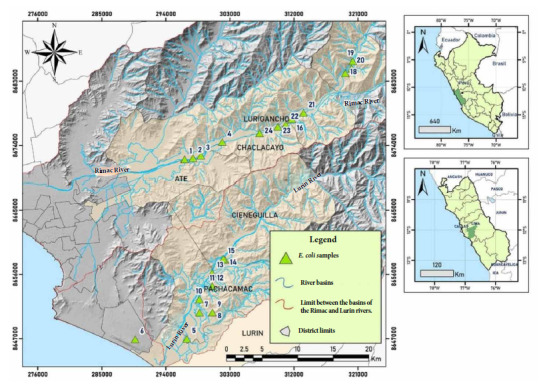
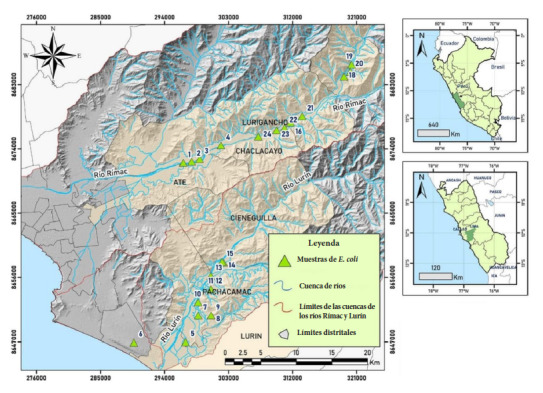
OBJECTIVES.: To evaluate the presence and sensitivity to antimicrobials of Escherichia coli strains isolated from 24 irrigation water samples from the Rimac river of East Lima, Peru.
MATERIALS AND METHODS.: The E. coli strains were identified by PCR. Antibiotic susceptibility was processed by the disk diffusion method. Genes involved in extended spectrum beta-lactamases (BLEE), quinolones and virulence were determined by PCR.
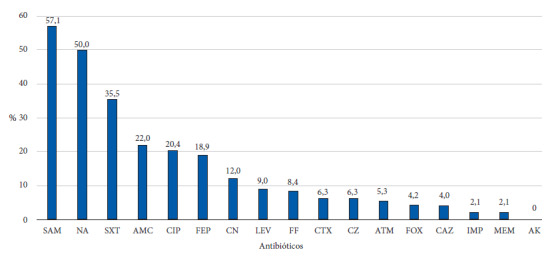
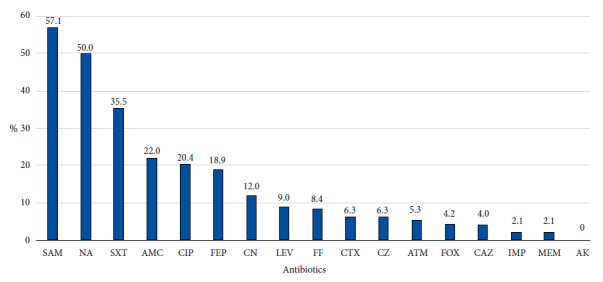
RESULTS.: All samples exceeded the acceptable limits established in the Environmental Quality Standards for vegetable irrigation. Of the 94 isolates, 72.3% showed resistance to at least one antibiotic, 24.5% were multidrug resistant (MDR) and 2.1% were extremely resistant. The highest percentages of resistance were observed for ampicillin-sulbactam (57.1%), nalidixic acid (50%), trimethoprim-sulfamethoxazole (35.5%) and ciprofloxacin (20.4%). Among the isolates, 3.2% had a BLEE phenotype related to the bla CTX-M-15 gene. qnrB (20.4%) was the most frequent transferable mechanism of resistance to quinolones, and 2.04% had qnrS. It was estimated that 5.3% were diarrheagenic E. coli and of these, 60% were enterotoxigenic E. coli, 20% were enteropathogenic E. coli and 20% were enteroaggregative E. coli.
CONCLUSIONS.: The results show the existence of diarrheogenic pathotypes in the water used for irrigation of fresh produce and highlight the presence of BLEE- and MDR-producing E. coli, demonstrating the role played by irrigation water in the dissemination of resistance genes in Peru.
Motivation for the study. Aquatic systems, including irrigation water, have been identified as reservoirs of antimicrobial resistance, with few studies in Peru on the presence of Escherichia coli and their levels of virulence and antimicrobial resistance. Main findings. Our results show the presence of E. coli above the established standard for vegetable irrigation water, some with very high levels of antimicrobial resistance. Implications. The presence of ESBL-producing strains of extended-spectrum beta-lactamases and multidrug-resistant E. coli in irrigation water could contribute to the dissemination of resistance genes in Peru, posing a significant threat to public health.
评估从秘鲁利马东部里马克河的 24 个灌溉水样中分离出的大肠杆菌菌株的存在情况和对各种抗菌药物的敏感性。
采用 PCR 方法鉴定大肠杆菌菌株。通过纸片扩散法检测抗生素敏感性。采用 PCR 方法检测与扩展谱β-内酰胺酶(BLEE)、喹诺酮类和毒力相关的基因。
所有样本均超过蔬菜灌溉环境质量标准规定的可接受限值。在 94 株分离株中,72.3%至少对一种抗生素表现出耐药性,24.5%为多重耐药(MDR),2.1%为极度耐药。对氨苄西林-舒巴坦(57.1%)、萘啶酸(50%)、甲氧苄啶-磺胺甲恶唑(35.5%)和环丙沙星(20.4%)的耐药率最高。分离株中有 3.2%具有与 bla CTX-M-15 基因相关的 BLEE 表型。qnrB(20.4%)是对喹诺酮类药物耐药的最常见可转移机制,2.04%有 qnrS。估计有 5.3%为致腹泻性大肠杆菌,其中 60%为肠毒素性大肠杆菌,20%为肠致病性大肠杆菌,20%为肠聚集性大肠杆菌。
结果表明,在用于新鲜农产品灌溉的水中存在致腹泻性病原型,并且存在产 BLEE 和 MDR 的大肠杆菌,这表明灌溉水在秘鲁耐药基因传播中所起的作用。