Libecap Timothy J, Zachariou Valentinos, Bauer Christopher E, Wilcock Donna M, Jicha Gregory A, Raslau Flavius D, Gold Brian T
Department of Neuroscience, College of Medicine, University of Kentucky, Lexington, KY, United States.
Department of Physiology, College of Medicine, University of Kentucky, Lexington, KY, United States.
Front Neurol. 2022 Jul 1;13:888511. doi: 10.3389/fneur.2022.888511. eCollection 2022.
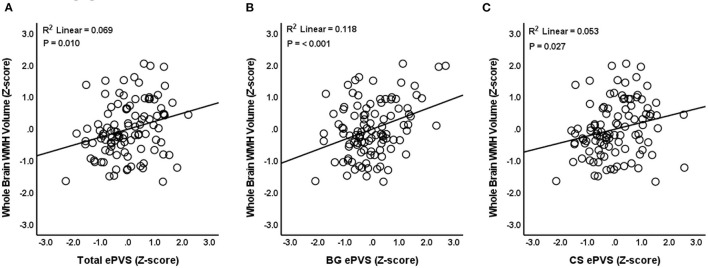
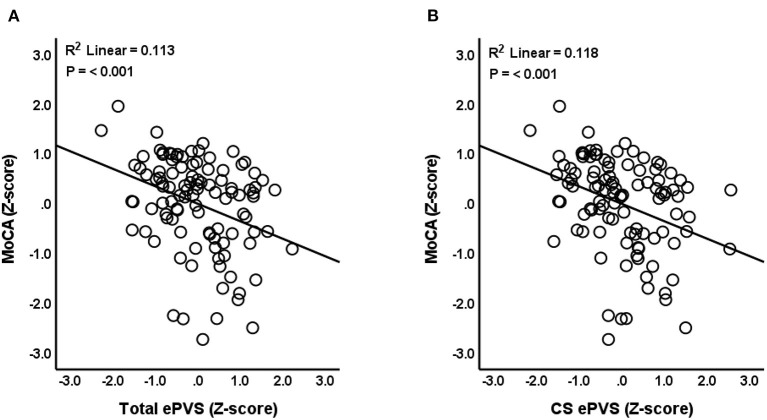
Emerging evidence suggests that enlarged perivascular spaces (ePVS) may be a clinically significant neuroimaging marker of global cognitive function related to cerebral small vessel disease (cSVD). We tested this possibility by assessing the relationship between ePVS and both a standardized measure of global cognitive function, the Montreal Cognitive Assessment (MoCA), and an established marker of cSVD, white matter hyperintensity volume (WMH) volume. One hundred and eleven community-dwelling older adults (56-86) underwent neuroimaging and MoCA testing. Quantification of region-specific ePVS burden was performed using a previously validated visual rating method and WMH volumes were computed using the standard ADNI pipeline. Separate linear regression models were run with ePVS as a predictor of MoCA scores and whole brain WMH volume. Results indicated a negative association between MoCA scores and both total ePVS counts ( ≤ 0.001) and centrum semiovale ePVS counts ( ≤ 0.001), after controlling for other relevant cSVD variables. Further, WMH volumes were positively associated with total ePVS ( = 0.010), basal ganglia ePVS ( ≤ 0.001), and centrum semiovale ePVS ( = 0.027). Our results suggest that ePVS burden, particularly in the centrum semiovale, may be a clinically significant neuroimaging marker of global cognitive dysfunction related to cSVD.
新出现的证据表明,血管周围间隙扩大(ePVS)可能是与脑小血管疾病(cSVD)相关的全球认知功能的一个具有临床意义的神经影像学标志物。我们通过评估ePVS与全球认知功能的标准化测量指标蒙特利尔认知评估量表(MoCA)以及cSVD的既定标志物白质高信号体积(WMH)之间的关系来检验这一可能性。111名社区居住的老年人(56 - 86岁)接受了神经影像学检查和MoCA测试。使用先前验证的视觉评分方法对特定区域的ePVS负担进行量化,并使用标准的阿尔茨海默病神经影像学倡议(ADNI)流程计算WMH体积。以ePVS作为MoCA评分和全脑WMH体积的预测因子运行单独的线性回归模型。结果表明,在控制其他相关的cSVD变量后,MoCA评分与总ePVS计数(≤0.001)和半卵圆中心ePVS计数(≤0.001)均呈负相关。此外,WMH体积与总ePVS(=0.010)、基底节ePVS(≤0.001)和半卵圆中心ePVS(=0.027)呈正相关。我们的结果表明,ePVS负担,尤其是在半卵圆中心,可能是与cSVD相关的全球认知功能障碍的一个具有临床意义的神经影像学标志物。