Tang Yuyun, Gao Jinchao, Wang Tao, Zhang Qian, Wang Antian, Huang Meng, Yu Renhe, Chen Hongzhuan, Gao Xiaoling
Department of Pharmacology and Chemical Biology, Shanghai Universities Collaborative Innovation Center for Translational Medicine, Shanghai Jiao Tong University School of Medicine, Shanghai 200025, China.
Department of Geriatric Psychiatry, Shanghai Mental Health Center, Shanghai Jiao Tong University School of Medicine, Alzheimer's Disease and Related Disorder Center, Shanghai Jiao Tong University, Shanghai 200025, China.
Acta Pharm Sin B. 2022 Apr;12(4):2043-2056. doi: 10.1016/j.apsb.2021.09.029. Epub 2021 Sep 30.
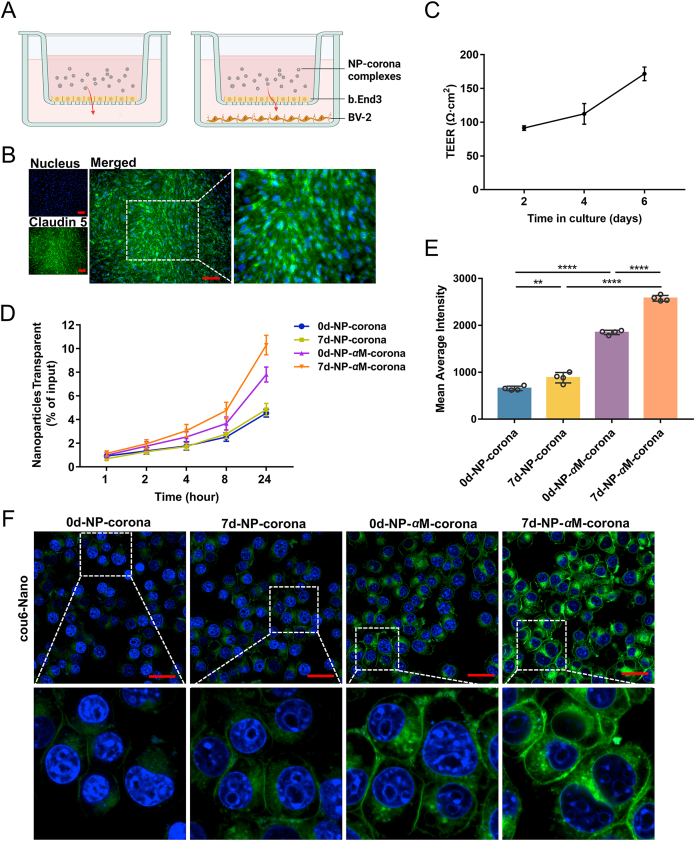
The presence of protein corona on the surface of nanoparticles modulates their physiological interactions such as cellular association and targeting property. It has been shown that -mangostin (M)-loaded poly(ethylene glycol)-poly(l-lactide) (PEG-PLA) nanoparticles (NP-M) specifically increased low density lipoprotein receptor (LDLR) expression in microglia and improved clearance of amyloid beta (A) after multiple administration. However, how do the nanoparticles cross the blood‒brain barrier and access microglia remain unknown. Here, we studied the brain delivery property of PEG-PLA nanoparticles under different conditions, finding that the nanoparticles exhibited higher brain transport efficiency and microglia uptake efficiency after M loading and multiple administration. To reveal the mechanism, we performed proteomic analysis to characterize the composition of protein corona formed under various conditions, finding that both drug loading and multiple dosing affect the composition of protein corona and subsequently influence the cellular uptake of nanoparticles in b.End3 and BV-2 cells. Complement proteins, immunoglobulins, RAB5A and CD36 were found to be enriched in the corona and associated with the process of nanoparticles uptake. Collectively, we bring a mechanistic understanding about the modulator role of protein corona on targeted drug delivery, and provide theoretical basis for engineering brain or microglia-specific targeted delivery system.
纳米颗粒表面蛋白质冠的存在会调节其生理相互作用,如细胞结合和靶向特性。研究表明,负载γ-山竹素(M)的聚乙二醇-聚(L-丙交酯)(PEG-PLA)纳米颗粒(NP-M)在多次给药后可特异性增加小胶质细胞中低密度脂蛋白受体(LDLR)的表达,并改善β淀粉样蛋白(Aβ)的清除。然而,纳米颗粒如何穿过血脑屏障并进入小胶质细胞仍不清楚。在此,我们研究了不同条件下PEG-PLA纳米颗粒的脑递送特性,发现纳米颗粒在负载M并多次给药后表现出更高的脑转运效率和小胶质细胞摄取效率。为揭示其机制,我们进行了蛋白质组学分析以表征在各种条件下形成的蛋白质冠的组成,发现药物负载和多次给药均会影响蛋白质冠的组成,进而影响纳米颗粒在b.End3和BV-2细胞中的细胞摄取。发现补体蛋白、免疫球蛋白、RAB5A和CD36在蛋白质冠中富集,并与纳米颗粒摄取过程相关。总的来说,我们对蛋白质冠在靶向药物递送中的调节作用有了机制上的理解,并为构建脑或小胶质细胞特异性靶向递送系统提供了理论依据。