Department of Pathology, Division of Diagnostic Oncology, the Netherlands Cancer Institute, Amsterdam, the Netherlands.
Department of Thoracic Oncology, Division of Medical Oncology, the Netherlands Cancer Institute, Amsterdam, the Netherlands.
Clin Cancer Res. 2022 Nov 14;28(22):4893-4906. doi: 10.1158/1078-0432.CCR-22-0992.
Durable clinical benefit to PD-1 blockade in non-small cell lung cancer (NSCLC) is currently limited to a small fraction of patients, underlining the need for predictive biomarkers. We recently identified a tumor-reactive tumor-infiltrating T lymphocyte (TIL) pool, termed PD-1T TILs, with predictive potential in NSCLC. Here, we examined PD-1T TILs as biomarker in NSCLC.
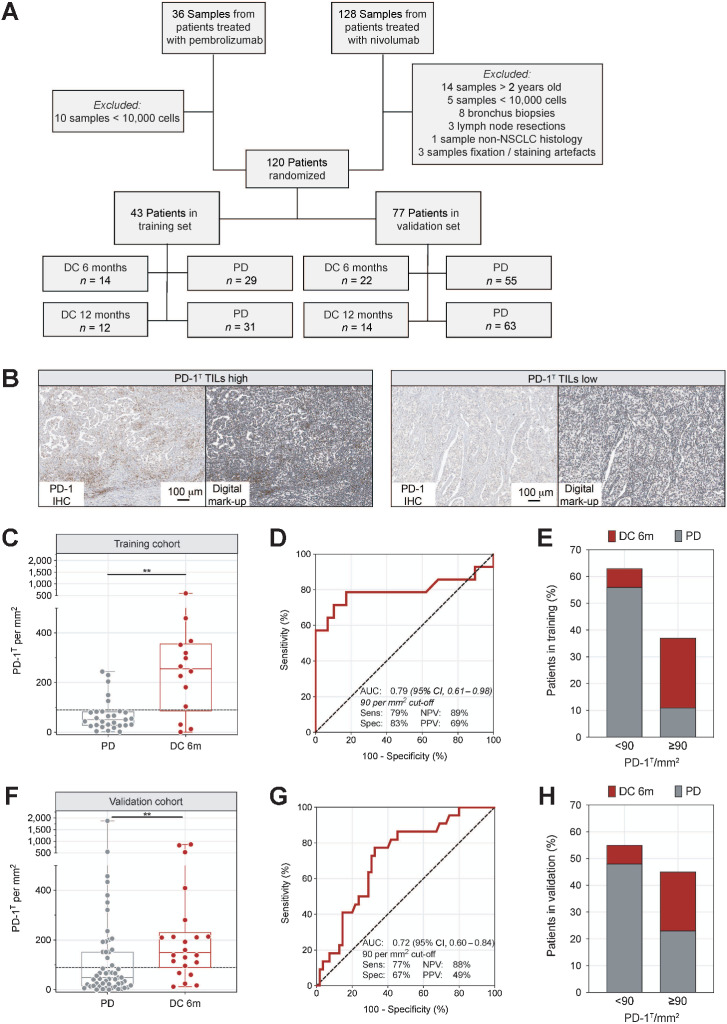
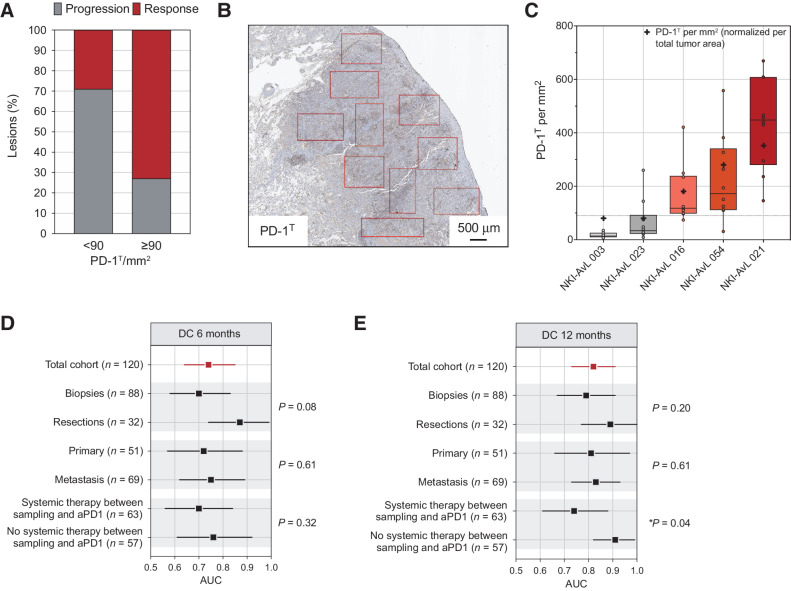
PD-1T TILs were digitally quantified in 120 baseline samples from advanced NSCLC patients treated with PD-1 blockade. Primary outcome was disease control (DC) at 6 months. Secondary outcomes were DC at 12 months and survival. Exploratory analyses addressed the impact of lesion-specific responses, tissue sample properties, and combination with other biomarkers on the predictive value of PD-1T TILs.
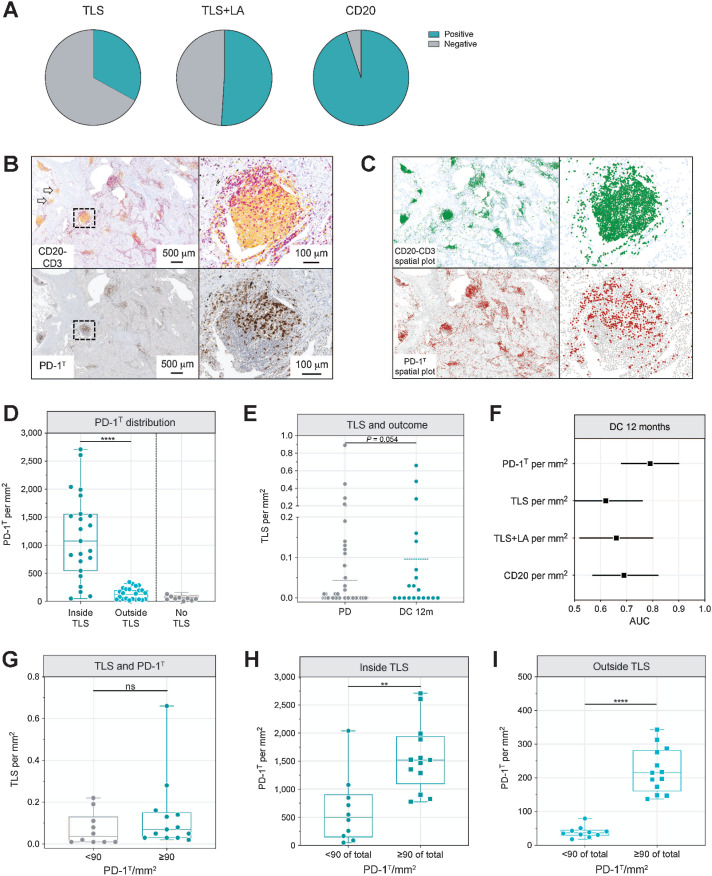
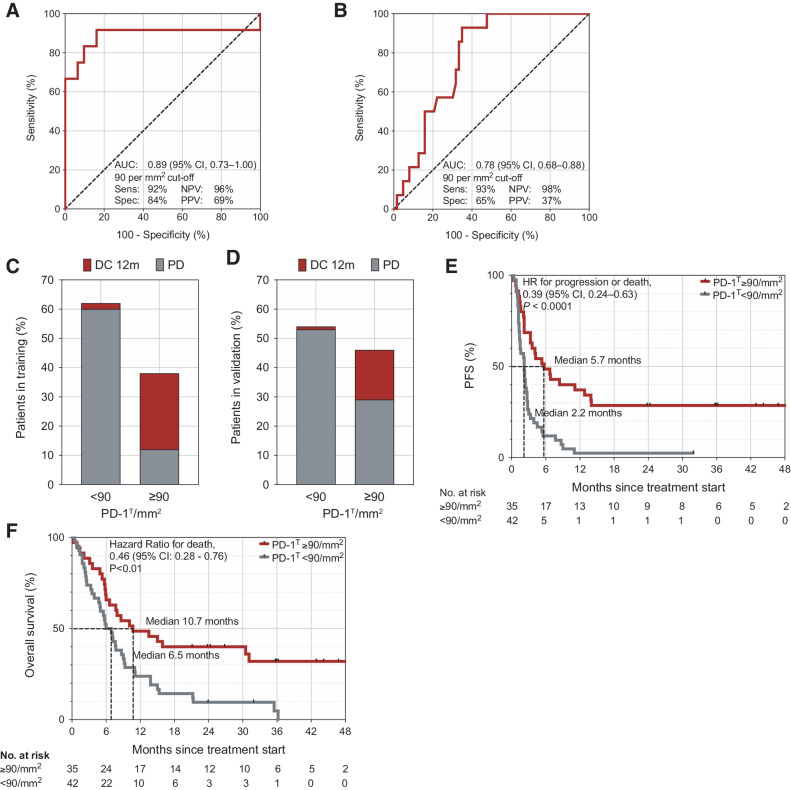
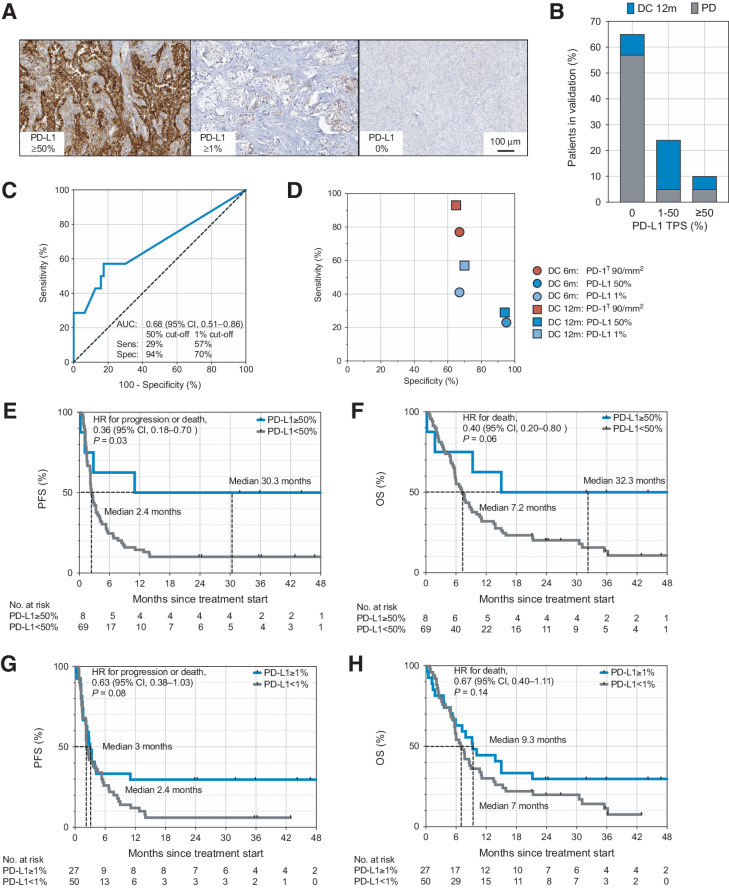
PD-1T TILs as a biomarker reached 77% sensitivity and 67% specificity at 6 months, and 93% and 65% at 12 months, respectively. Particularly, a patient group without clinical benefit was reliably identified, indicated by a high negative predictive value (NPV) (88% at 6 months, 98% at 12 months). High PD-1T TILs related to significantly longer progression-free (HR 0.39, 95% CI, 0.24-0.63, P < 0.0001) and overall survival (HR 0.46, 95% CI, 0.28-0.76, P < 0.01). Predictive performance was increased when lesion-specific responses and samples obtained immediately before treatment were assessed. Notably, the predictive performance of PD-1T TILs was superior to PD-L1 and tertiary lymphoid structures in the same cohort.
This study established PD-1T TILs as predictive biomarker for clinical benefit to PD-1 blockade in patients with advanced NSCLC. Most importantly, the high NPV demonstrates an accurate identification of a patient group without benefit. See related commentary by Anagnostou and Luke, p. 4835.
在非小细胞肺癌(NSCLC)中,PD-1 阻断的持久临床获益目前仅限于一小部分患者,这突显了预测生物标志物的必要性。我们最近发现了一种具有预测潜力的肿瘤反应性肿瘤浸润性 T 淋巴细胞(TIL)池,称为 PD-1T TILs。在这里,我们研究了 PD-1T TILs 作为 NSCLC 的生物标志物。
在接受 PD-1 阻断治疗的 120 例晚期 NSCLC 患者的基线样本中,对 PD-1T TILs 进行数字量化。主要结局是 6 个月时的疾病控制(DC)。次要结局是 12 个月时的 DC 和生存情况。探索性分析探讨了病变特异性反应、组织样本特性以及与其他生物标志物的联合应用对 PD-1T TILs 预测价值的影响。
PD-1T TILs 作为一种生物标志物,在 6 个月时的敏感性为 77%,特异性为 67%,在 12 个月时的敏感性为 93%,特异性为 65%。特别是,通过高阴性预测值(NPV)(6 个月时为 88%,12 个月时为 98%)可靠地识别出无临床获益的患者群体。高 PD-1T TILs 与无进展生存期(HR 0.39,95%CI,0.24-0.63,P < 0.0001)和总生存期(HR 0.46,95%CI,0.28-0.76,P < 0.01)显著延长相关。当评估病变特异性反应和治疗前立即获得的样本时,预测性能得到提高。值得注意的是,在同一队列中,PD-1T TILs 的预测性能优于 PD-L1 和三级淋巴结构。
本研究确立了 PD-1T TILs 作为预测生物标志物,可预测晚期 NSCLC 患者接受 PD-1 阻断治疗的临床获益。最重要的是,高 NPV 表明能够准确识别无获益的患者群体。另见 Anagnostou 和 Luke 的相关评论,第 4835 页。