Maharajgunj Medical Campus, Institute of Medicine, Tribhuvan University, Maharajgunj, Nepal.
Department of Public Health, Section for Global Health, Aarhus University, Aarhus, Denmark.
PLoS One. 2022 Jul 19;17(7):e0268356. doi: 10.1371/journal.pone.0268356. eCollection 2022.
The use of computers and other Visual Display Terminal (VDT) screens is increasing in Nepal. However, there is a paucity of evidence on the prevalence of Computer Vision Syndrome (CVS) and other occupational health concerns among employees working in front of VDT screens in the Nepalese population.
This study aims to estimate the prevalence of CVS, musculoskeletal and work-related stress among VDT screen users in the office, as well as their understanding and usage of preventive measures.
The study was a cross-sectional descriptive study among 319 VDT users in office settings in Kathmandu Metropolitan City, Nepal, using a semi-structured self-administered questionnaire. Multivariate logistic regression analysis was conducted to identify the associated factors at 95% CI. P-value <0.05 was considered as statistically significant.
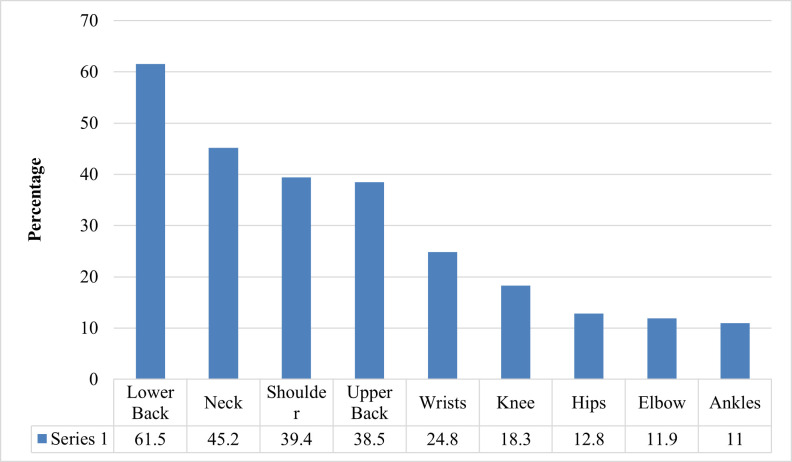
The prevalence of CVS was 89.4%. More than eight out of ten study participants reported at least one visual and musculoskeletal symptom. Work-related stress, which was moderate-difficult to handle, was present in 36.7% of the study population. The mean±SD computer usage per day was 7.9±1.9 hours. Tired eye (63.3%), feeling of dry eye (57.8%), headache (56.9%) were the common visual symptoms of CVS reported. Total computer use/day > = 8 hours OR 2.6, improper viewing distance OR 3.2, Not using an anti-glare screen OR 2.6, not using eye-drops, and not wearing protective goggles OR 3.1 were significantly associated with the presence of CVS. There was no statistically significant association between visual symptoms of CVS, musculoskeletal symptoms, and stress with gender.
CVS was substantially related to not employing preventive measures, working longer hours, and having an incorrect viewing distance. With more hours per day spent in front of a VDT screen, work-related stress and musculoskeletal complaints were also found to be important correlates. Similarly, work-related stress was found more among those who had less than five years of job.
在尼泊尔,人们越来越多地使用计算机和其他视觉显示终端(VDT)屏幕。然而,对于尼泊尔人口中在 VDT 屏幕前工作的员工中计算机视觉综合征(CVS)和其他职业健康问题的流行情况,证据很少。
本研究旨在评估办公室 VDT 屏幕使用者 CVS、肌肉骨骼和与工作相关的压力的患病率,以及他们对预防措施的理解和使用情况。
这是一项在尼泊尔加德满都都会市区办公室环境中对 319 名 VDT 用户进行的横断面描述性研究,使用半结构化自我管理问卷。采用多变量逻辑回归分析确定 95%CI 中的相关因素。P 值<0.05 被认为具有统计学意义。
CVS 的患病率为 89.4%。超过十分之八的研究参与者报告至少有一种视觉和肌肉骨骼症状。36.7%的研究人群存在中度到难以处理的与工作相关的压力。平均每天使用电脑的时间为 7.9±1.9 小时。报告的 CVS 常见视觉症状包括眼睛疲劳(63.3%)、眼睛干涩感(57.8%)、头痛(56.9%)。每天使用电脑的总时间> = 8 小时 OR 2.6、不正确的观看距离 OR 3.2、不使用防眩光屏幕 OR 2.6、不使用眼药水、不戴防护眼镜 OR 3.1 与 CVS 的存在显著相关。CVS 的视觉症状、肌肉骨骼症状和压力与性别之间没有统计学上的显著关联。
CVS 与不采取预防措施、工作时间更长、观看距离不正确显著相关。每天在 VDT 屏幕前花费的时间越多,与工作相关的压力和肌肉骨骼投诉也被发现是重要的相关因素。同样,工作相关的压力在工作年限少于 5 年的人中更为常见。