• 文献检索
  • 文档翻译
  • 深度研究
  • 学术资讯
  • Suppr Zotero 插件Zotero 插件
  • 邀请有礼
  • 套餐&价格
  • 历史记录
应用&插件
Suppr Zotero 插件Zotero 插件浏览器插件Mac 客户端Windows 客户端微信小程序
定价
高级版会员购买积分包购买API积分包
服务
文献检索文档翻译深度研究API 文档MCP 服务
关于我们
关于 Suppr公司介绍联系我们用户协议隐私条款
关注我们

Suppr 超能文献

核心技术专利:CN118964589B侵权必究
粤ICP备2023148730 号-1Suppr @ 2026

文献检索

告别复杂PubMed语法,用中文像聊天一样搜索,搜遍4000万医学文献。AI智能推荐,让科研检索更轻松。

立即免费搜索

文件翻译

保留排版,准确专业,支持PDF/Word/PPT等文件格式,支持 12+语言互译。

免费翻译文档

深度研究

AI帮你快速写综述,25分钟生成高质量综述,智能提取关键信息,辅助科研写作。

立即免费体验

利用通路衍生多基因风险评分预测缺血性脑卒中患者的死亡率。

Predicting mortality among ischemic stroke patients using pathways-derived polygenic risk scores.

机构信息

Department of Molecular and Functional Genomics, Weis Center for Research, Geisinger Health System, Danville, PA, 17822, USA.

Neuroscience Institute, Geisinger Health System, Danville, PA, 17822, USA.

出版信息

Sci Rep. 2022 Jul 19;12(1):12358. doi: 10.1038/s41598-022-16510-x.

DOI:10.1038/s41598-022-16510-x
PMID:35853973
原文链接:https://pmc.ncbi.nlm.nih.gov/articles/PMC9296485/
Abstract

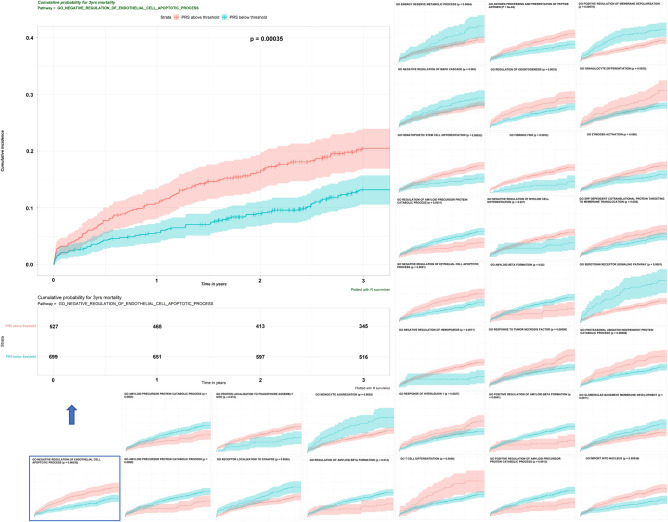
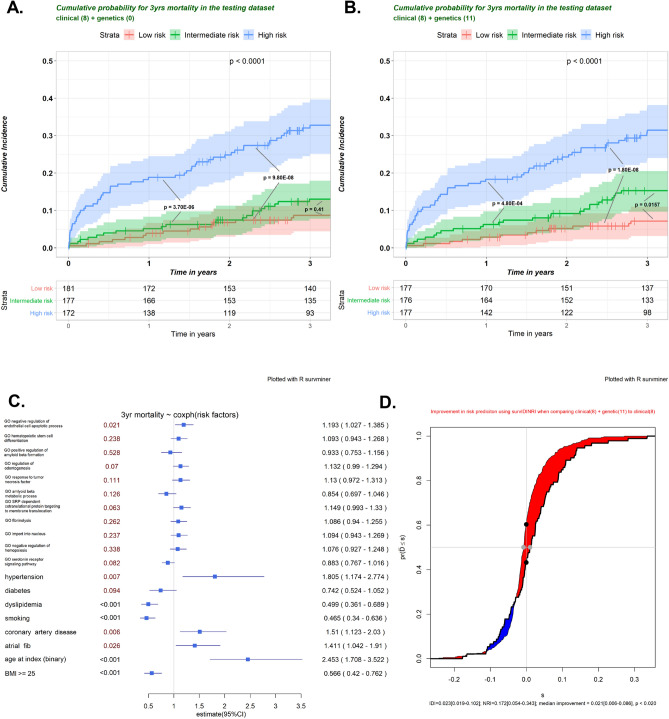
We aim to determine whether ischemic stroke(IS)-related PRSs are also associated with and further predict 3-year all-cause mortality. 1756 IS patients with European ancestry were randomly split into training (n = 1226) and testing (n = 530) groups with 3-year post-event observations. Univariate Cox proportional hazards regression model (CoxPH) was used for primary screening of individual prognostic PRSs. Only the significantly associated PRSs and clinical risk factors with the same direction for a causal relationship with IS were used to construct a multivariate CoxPH. Feature selection was conducted by the LASSO method. After feature selection, a prediction model with 11 disease-associated pathway-specific PRSs outperformed the base model, as demonstrated by a higher concordance index (0.751, 95%CI [0.693-0.809] versus 0.729, 95%CI [0.676-0.782]) in the testing sample. A PRS derived from endothelial cell apoptosis showed independent predictability in the multivariate CoxPH (Hazard Ratio = 1.193 [1.027-1.385], p = 0.021). These PRSs fine-tuned the model by better stratifying high, intermediate, and low-risk groups. Several pathway-specific PRSs were associated with clinical risk factors in an age-dependent manner and further confirmed some known etiologies of IS and all-cause mortality. In conclusion, Pathway-specific PRSs for IS are associated with all-cause mortality, and the integrated multivariate risk model provides prognostic value in this context.

摘要

我们旨在确定与缺血性脑卒中(IS)相关的PRS 是否也与 3 年全因死亡率相关,并进一步预测 3 年全因死亡率。1756 名具有欧洲血统的 IS 患者被随机分为训练组(n = 1226)和测试组(n = 530),并进行了 3 年的随访。采用单变量 Cox 比例风险回归模型(CoxPH)对个体预后 PRS 进行初步筛选。仅使用与 IS 具有因果关系且方向相同的显著相关 PRS 和临床危险因素构建多变量 CoxPH。采用 LASSO 方法进行特征选择。经过特征选择,具有 11 个疾病相关途径特异性 PRS 的预测模型表现优于基础模型,在测试样本中具有更高的一致性指数(0.751,95%CI [0.693-0.809] 与 0.729,95%CI [0.676-0.782])。来自内皮细胞凋亡的 PRS 在多变量 CoxPH 中具有独立的预测能力(危险比=1.193 [1.027-1.385],p=0.021)。这些 PRS 通过更好地区分高危、中危和低危组来微调模型。一些途径特异性 PRS 与临床危险因素呈年龄依赖性相关,并进一步证实了一些已知的 IS 和全因死亡率的病因。总之,IS 的途径特异性 PRS 与全因死亡率相关,综合的多变量风险模型在这种情况下提供了预后价值。
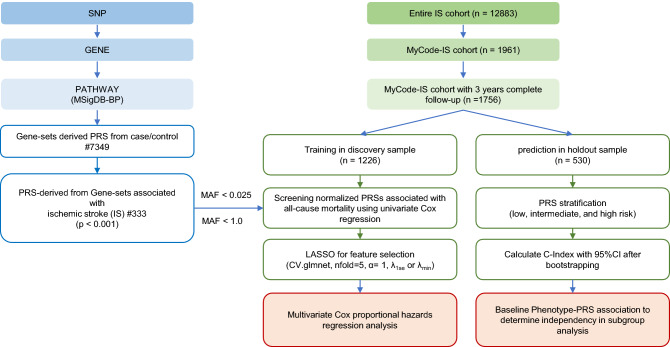
https://cdn.ncbi.nlm.nih.gov/pmc/blobs/d824/9296485/a181d7615c96/41598_2022_16510_Fig6_HTML.jpg
https://cdn.ncbi.nlm.nih.gov/pmc/blobs/d824/9296485/663a8e63e935/41598_2022_16510_Fig1_HTML.jpg
https://cdn.ncbi.nlm.nih.gov/pmc/blobs/d824/9296485/a07f1a88f7a8/41598_2022_16510_Fig2_HTML.jpg
https://cdn.ncbi.nlm.nih.gov/pmc/blobs/d824/9296485/26bfb4c974c9/41598_2022_16510_Fig3_HTML.jpg
https://cdn.ncbi.nlm.nih.gov/pmc/blobs/d824/9296485/150c72931a60/41598_2022_16510_Fig4_HTML.jpg
https://cdn.ncbi.nlm.nih.gov/pmc/blobs/d824/9296485/6d0b57d64987/41598_2022_16510_Fig5_HTML.jpg
https://cdn.ncbi.nlm.nih.gov/pmc/blobs/d824/9296485/a181d7615c96/41598_2022_16510_Fig6_HTML.jpg
https://cdn.ncbi.nlm.nih.gov/pmc/blobs/d824/9296485/663a8e63e935/41598_2022_16510_Fig1_HTML.jpg
https://cdn.ncbi.nlm.nih.gov/pmc/blobs/d824/9296485/a07f1a88f7a8/41598_2022_16510_Fig2_HTML.jpg
https://cdn.ncbi.nlm.nih.gov/pmc/blobs/d824/9296485/26bfb4c974c9/41598_2022_16510_Fig3_HTML.jpg
https://cdn.ncbi.nlm.nih.gov/pmc/blobs/d824/9296485/150c72931a60/41598_2022_16510_Fig4_HTML.jpg
https://cdn.ncbi.nlm.nih.gov/pmc/blobs/d824/9296485/6d0b57d64987/41598_2022_16510_Fig5_HTML.jpg
https://cdn.ncbi.nlm.nih.gov/pmc/blobs/d824/9296485/a181d7615c96/41598_2022_16510_Fig6_HTML.jpg

相似文献

1
Predicting mortality among ischemic stroke patients using pathways-derived polygenic risk scores.利用通路衍生多基因风险评分预测缺血性脑卒中患者的死亡率。
Sci Rep. 2022 Jul 19;12(1):12358. doi: 10.1038/s41598-022-16510-x.
2
Associations of polygenic risk scores with risks of stroke and its subtypes in Chinese.中国人种多基因风险评分与中风及其亚型风险的相关性研究。
Stroke Vasc Neurol. 2024 Aug 27;9(4):399-406. doi: 10.1136/svn-2023-002428.
3
Polygenic risk scores for prediction of breast cancer risk in women of African ancestry: a cross-ancestry approach.多基因风险评分预测非洲裔女性乳腺癌风险:跨种族方法。
Hum Mol Genet. 2022 Sep 10;31(18):3133-3143. doi: 10.1093/hmg/ddac102.
4
Dissecting Polygenic Etiology of Ischemic Stroke in the Era of Precision Medicine.精准医学时代缺血性卒中多基因病因剖析
J Clin Med. 2022 Oct 11;11(20):5980. doi: 10.3390/jcm11205980.
5
Application of hyperglycemia/diabetes-derived polygenic risk scores on the risk of poor outcomes after an ischemic stroke.高血糖/糖尿病衍生的多基因风险评分在缺血性中风后不良结局风险中的应用。
J Chin Med Assoc. 2022 Jan 1;85(1):81-87. doi: 10.1097/JCMA.0000000000000666.
6
Prognostic evaluation of polygenic risk score underlying pan-cancer analysis: evidence from two large-scale cohorts.多基因风险评分对泛癌分析的预后评估:来自两个大规模队列的证据。
EBioMedicine. 2023 Mar;89:104454. doi: 10.1016/j.ebiom.2023.104454. Epub 2023 Feb 3.
7
Discriminating bipolar depression from major depressive disorder with polygenic risk scores.利用多基因风险评分鉴别双相情感障碍抑郁发作与重度抑郁症
Psychol Med. 2021 Jul;51(9):1451-1458. doi: 10.1017/S003329172000015X. Epub 2020 Feb 17.
8
Polygenic and clinical risk scores and their impact on age at onset and prediction of cardiometabolic diseases and common cancers.多基因和临床风险评分及其对发病年龄和心血管代谢疾病及常见癌症预测的影响。
Nat Med. 2020 Apr;26(4):549-557. doi: 10.1038/s41591-020-0800-0. Epub 2020 Apr 7.
9
Genome-wide polygenic risk impact on intracranial aneurysms and acute ischemic stroke.全基因组多基因风险对颅内动脉瘤和急性缺血性卒中的影响。
PLoS One. 2022 Apr 15;17(4):e0265581. doi: 10.1371/journal.pone.0265581. eCollection 2022.
10
Polygenic risk scores: how much do they add?多基因风险评分:它们能增加多少?
Curr Opin Lipidol. 2021 Jun 1;32(3):157-162. doi: 10.1097/MOL.0000000000000759.

引用本文的文献

1
Genetic Architecture of Ischemic Stroke: Insights from Genome-Wide Association Studies and Beyond.缺血性中风的遗传结构:全基因组关联研究及其他方面的见解
J Cardiovasc Dev Dis. 2025 Jul 23;12(8):281. doi: 10.3390/jcdd12080281.
2
Pathway-Specific Polygenic Risk Scores for Blood Pressure Traits in a West African Cohort.西非队列中血压性状的特定通路多基因风险评分
medRxiv. 2025 Jul 1:2025.06.30.25330577. doi: 10.1101/2025.06.30.25330577.
3
Flexible imputation toolkit for electronic health records.用于电子健康记录的灵活插补工具包。

本文引用的文献

1
Prediction of primary venous thromboembolism based on clinical and genetic factors within the U.K. Biobank.基于英国生物银行的临床和遗传因素预测原发性静脉血栓栓塞症。
Sci Rep. 2021 Nov 1;11(1):21340. doi: 10.1038/s41598-021-00796-4.
2
Imputation of missing values for electronic health record laboratory data.电子健康记录实验室数据缺失值的插补
NPJ Digit Med. 2021 Oct 11;4(1):147. doi: 10.1038/s41746-021-00518-0.
3
Global, regional, and national burden of stroke and its risk factors, 1990-2019: a systematic analysis for the Global Burden of Disease Study 2019.
Sci Rep. 2025 May 17;15(1):17176. doi: 10.1038/s41598-025-02276-5.
4
Dissecting Polygenic Etiology of Ischemic Stroke in the Era of Precision Medicine.精准医学时代缺血性卒中多基因病因剖析
J Clin Med. 2022 Oct 11;11(20):5980. doi: 10.3390/jcm11205980.
1990—2019年全球、区域和国家的卒中负担及其风险因素:全球疾病负担研究2019的系统分析
Lancet Neurol. 2021 Oct;20(10):795-820. doi: 10.1016/S1474-4422(21)00252-0. Epub 2021 Sep 3.
4
Stroke Genetics: Turning Discoveries into Clinical Applications.中风遗传学:将发现转化为临床应用。
Stroke. 2021 Aug;52(9):2974-2982. doi: 10.1161/STROKEAHA.121.032616. Epub 2021 Aug 17.
5
Predicting short and long-term mortality after acute ischemic stroke using EHR.利用电子健康记录预测急性缺血性脑卒中患者的短期和长期死亡率。
J Neurol Sci. 2021 Aug 15;427:117560. doi: 10.1016/j.jns.2021.117560. Epub 2021 Jun 29.
6
Will polygenic risk scores for cancer ever be clinically useful?癌症的多基因风险评分会在临床上有用武之地吗?
NPJ Precis Oncol. 2021 May 21;5(1):40. doi: 10.1038/s41698-021-00176-1.
7
Polygenic Risk Scores Augment Stroke Subtyping.多基因风险评分增强中风亚型分类。
Neurol Genet. 2021 Mar 9;7(2):e560. doi: 10.1212/NXG.0000000000000560. eCollection 2021 Apr.
8
Trends in ischemic stroke outcomes in a rural population in the United States.美国农村人口缺血性中风的转归趋势
J Neurol Sci. 2021 Mar 15;422:117339. doi: 10.1016/j.jns.2021.117339. Epub 2021 Feb 9.
9
Obesity and mortality after the first ischemic stroke: Is obesity paradox real?肥胖与首次缺血性脑卒中后的死亡率:肥胖悖论是否真实存在?
PLoS One. 2021 Feb 10;16(2):e0246877. doi: 10.1371/journal.pone.0246877. eCollection 2021.
10
The influence of common polygenic risk and gene sets on social skills group training response in autism spectrum disorder.常见多基因风险和基因集对自闭症谱系障碍社交技能团体训练反应的影响。
NPJ Genom Med. 2020 Oct 12;5(1):45. doi: 10.1038/s41525-020-00152-x. eCollection 2020.