School of Nursing, The Hong Kong Polytechnic University, Hong Kong, China.
WHO Collaborating Centre for Community Health Services, The Hong Kong Polytechnic University, Hong Kong, China.
BMC Psychol. 2022 Jul 19;10(1):178. doi: 10.1186/s40359-022-00876-8.
Mindfulness-based intervention (MBI), an emotion-focused approach, has been shown promising and sustainable effects on enhancing the well-being of caregivers of patients with dementia (PWD). However, the conventional MBI was quite demanding, had high rates of attrition and inconsistent long-term effect. The social distancing measures introduced during the COVID-19 pandemic also restricted face-to-face psychosocial intervention. The study aims to evaluate the effectiveness of a 6-week hybrid MBI in caregivers of PWD over a 6-month follow up.
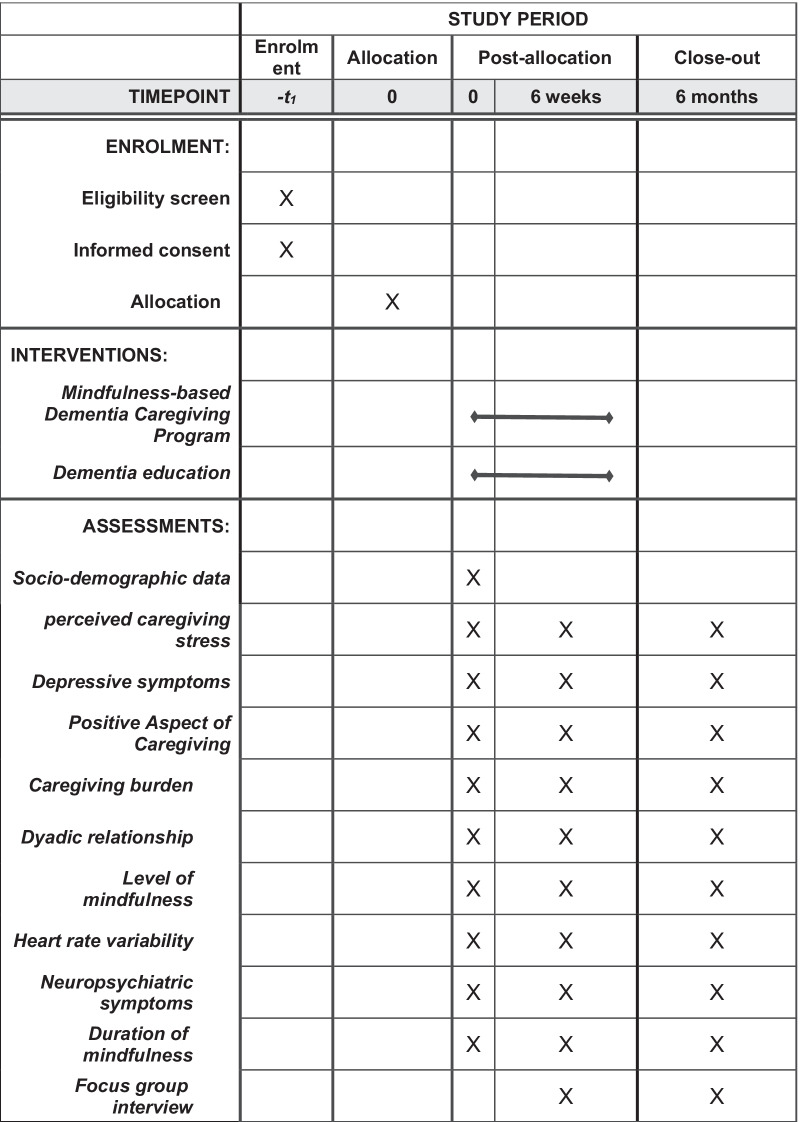
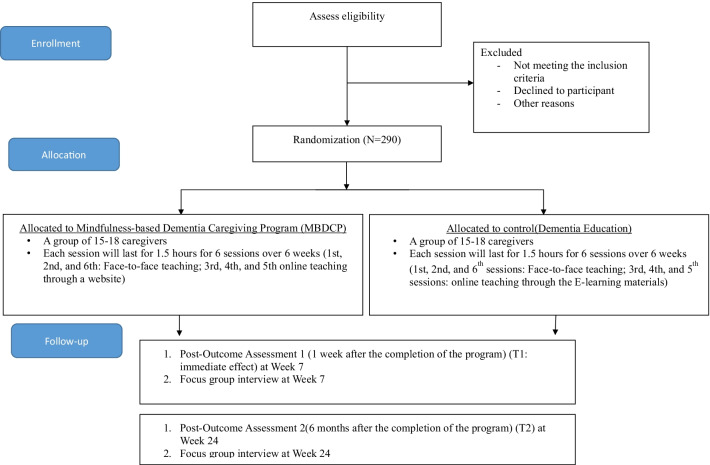
This is a single-blinded, parallel-group randomized controlled trial (RCT). Eligible participants from three local nongovernmental organizations (NGOs) will be randomly divided into intervention groups and control groups in a ratio of 1:1. The participants in the intervention group will receive 6 weekly 90-min group-based sessions delivered through a face-to-face and online approach. The participants in the control group will receive brief education on dementia care with the same group size, duration, and frequency as the sessions in the intervention group. Immediately after the intervention and at the 6-month follow-up, caring stress and other outcomes will be assessed. Besides, a focus group interview will be conducted to identify the strengths, limitations, and therapeutic components of the intervention from their perspectives. For quantitative data, intention-to-treat analysis and Generalized Estimating Equations (GEE) will be used. For qualitative data, content analysis will be used.
This proposed hybrid model of MBI has several advantages, such as lower duration, longer follow-up period and easier access by family caregivers. Also, physiological indicators (e.g., heart rate viability and neuropsychiatric symptoms) will be measured in this study to show the body change after MBI. The quantitative and qualitative data of this research can also benefit the development of online or hybrid MBI for caregivers of PWD during the COVID-19 pandemic. Despite these strengths, it does have practical challenges and limitations. However, this proposed intervention has the potential to benefit not only the participants, but also the researcher as well as public health providers.
NCT05242614. Registered on 2022-02-16, https://clinicaltrials.gov/ct2/show/NCT05242614.
基于正念的干预(MBI)是一种以情绪为焦点的方法,已显示出对增强痴呆症(PWD)患者照顾者的幸福感具有有希望和可持续的效果。然而,传统的 MBI 要求很高,退出率很高,长期效果不一致。COVID-19 大流行期间实施的社交距离措施也限制了面对面的心理社会干预。本研究旨在评估 6 周混合 MBI 在 PWD 照顾者中的有效性,随访时间为 6 个月。
这是一项单盲、平行组随机对照试验(RCT)。将来自三个地方非政府组织(NGO)的合格参与者以 1:1 的比例随机分为干预组和对照组。干预组的参与者将接受每周 6 次 90 分钟的小组团体课程,通过面对面和在线方式进行。对照组的参与者将接受与干预组相同的小组规模、时长和频率的痴呆症护理简要教育。干预结束后立即和 6 个月随访时,将评估照顾压力等结果。此外,还将进行焦点小组访谈,从他们的角度确定干预的优势、局限性和治疗成分。对于定量数据,将使用意向治疗分析和广义估计方程(GEE)。对于定性数据,将使用内容分析。
这种新提出的 MBI 混合模式有几个优点,例如持续时间更短、随访时间更长,以及更方便家庭照顾者参与。此外,该研究还将测量生理指标(例如心率变异性和神经精神症状),以显示 MBI 后的身体变化。这项研究的定量和定性数据也可以为 COVID-19 大流行期间痴呆症患者照顾者的在线或混合 MBI 发展提供参考。尽管有这些优势,但它确实存在实际挑战和局限性。然而,这种新提出的干预措施不仅有可能使参与者受益,而且还有可能使研究人员和公共卫生提供者受益。
NCT05242614。于 2022 年 2 月 16 日注册,网址为:https://clinicaltrials.gov/ct2/show/NCT05242614。