Bohl Michael A, Farber S Harrison, Kakarla U Kumar, Mirzadeh Zaman, Turner Jay D
Department of Neurosurgery, Barrow Neurological Institute, Phoenix, USA.
Cureus. 2022 Jun 15;14(6):e25964. doi: 10.7759/cureus.25964. eCollection 2022 Jun.
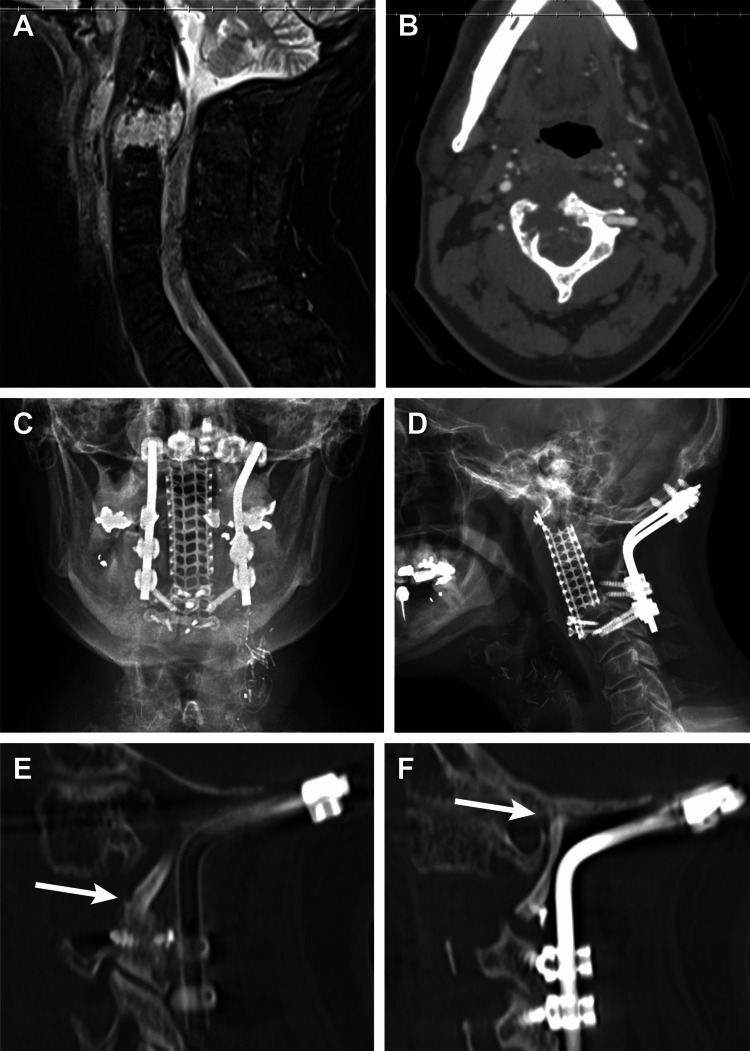
Occipitocervical fixation and fusion (OCF) is performed for patients who have destabilizing traumatic injuries or pathologies affecting the complex bony and ligamentous structures of the occipitoatlantal and atlantoaxial joint structures. Distal fixation failure and pseudoarthrosis are known risks of these constructs, especially for those constructs ending in the mid-cervical spine. We present the technical feasibility of using cervical pedicle screws (CPSs) as distal fixation anchors to strengthen OCF constructs ending in the mid-cervical spine and present a case series describing our early clinical experience with this technique. We used a freehand technique to place subaxial pedicle screws in the mid-cervical spine as the distal fixation point in OCF constructs. This technique involves performing a laminotomy to provide direct visualization of the pedicle borders to safely guide freehand pedicle screw placement. Our early clinical experience with this technique is presented. Three patients received OCF constructs ending in the mid-cervical subaxial spine between C3 and C6. CPSs were placed at the distal vertebra in each construct. Stable instrumentation and arthrodesis were confirmed postoperatively in all patients. This freehand technique uses direct visualization of the pedicle to aid in safe and accurate subaxial pedicle screw placement. CPS placement is clinically feasible and increases the robustness of OCF constructs in appropriately selected patients. Larger case series are needed to further validate the safety and effectiveness of this technique.
枕颈固定融合术(OCF)适用于患有导致枕寰关节和寰枢关节结构的复杂骨质和韧带结构不稳定的创伤性损伤或病变的患者。已知这些固定结构存在远端固定失败和假关节形成的风险,尤其是对于那些止于颈椎中段的固定结构。我们展示了使用颈椎椎弓根螺钉(CPS)作为远端固定锚来加强止于颈椎中段的OCF固定结构的技术可行性,并呈现了一系列病例描述我们使用该技术的早期临床经验。我们采用徒手技术在颈椎中段置入椎弓根螺钉作为OCF固定结构的远端固定点。该技术包括进行椎板切开术以直接观察椎弓根边界,从而安全地引导徒手置入椎弓根螺钉。展示了我们使用该技术的早期临床经验。三名患者接受了止于颈椎中段C3至C6的OCF固定结构。在每个固定结构的远端椎体置入了CPS。所有患者术后均证实固定器械稳定且实现了关节融合。这种徒手技术通过直接观察椎弓根来辅助安全、准确地置入颈椎中段椎弓根螺钉。在适当选择的患者中,置入CPS在临床上是可行的,并增加了OCF固定结构的坚固性。需要更大规模的病例系列来进一步验证该技术的安全性和有效性。