Department of Agricultural and Forest Systems and the Environment, Agrifood Research and Technology Centre of Aragon (CITA), Zaragoza, Spain.
School of Agriculture and Food Science, University College Dublin, Dublin, Ireland.
PeerJ. 2022 Jul 13;10:e13586. doi: 10.7717/peerj.13586. eCollection 2022.
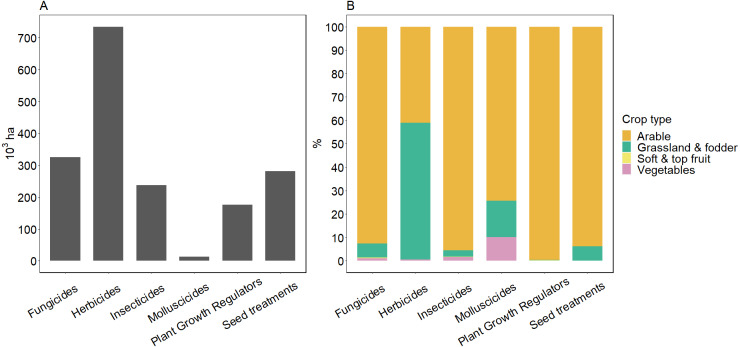
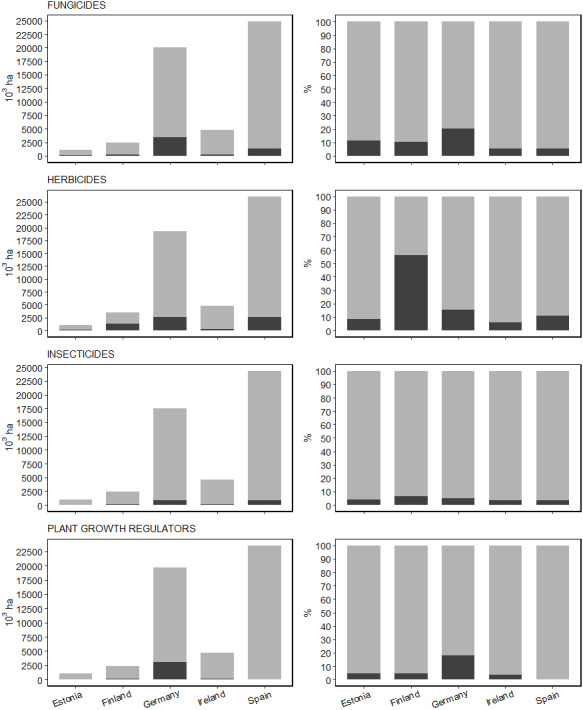
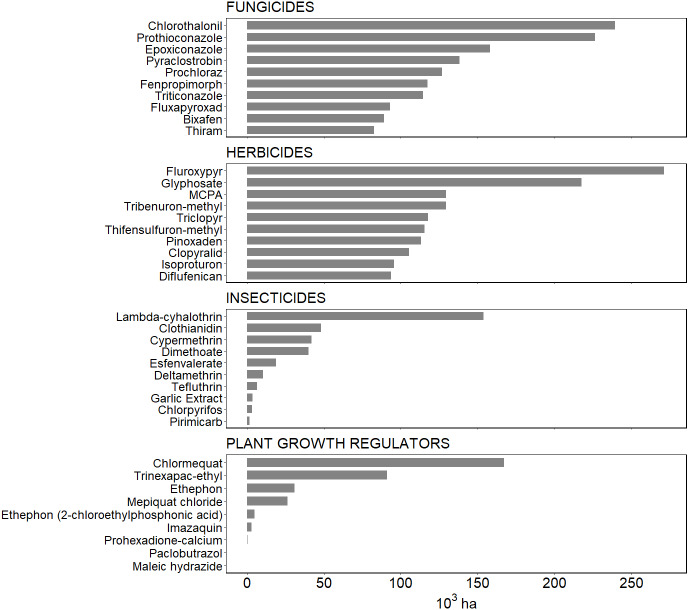
Besides the benefits of plant protection products (PPPs) for agricultural production, there is an increasing acknowledgement of the associated potential environmental risks. Here, we examine the feasibility of summarizing the extent of PPP usage at the country level, using Ireland as a case study, as well as at the European level. We used the area over which PPPs are applied (basic area) as an example variable that is relevant to initially assess the geographic extent of environmental risk. In Irish agricultural systems, which are primarily grass-based, herbicides fluroxypyr and glyphosate are the most widely applied active substances (ASs) in terms of basic area, followed by the fungicides chlorothalonil and prothioconazole that are closely associated with arable crops. Although all EU countries are subject to Regulation (EC) No 1185/2009, which sets the obligation of PPP usage data reporting at the national level, we only found usable data that met our criteria for Estonia, Germany, Finland, and Spain (4 of 30 countries reviewed). Overall, the most widely applied fungicide and herbicide in terms of basic area were prothioconazole (20%, 7% and 5% of national cultivated areas of Germany, Estonia and Ireland) and glyphosate (11%, 8% and 5% of national cultivated areas of Spain, Estonia and Ireland) respectively, although evaluations using application frequency may result in the observation of different trends. Several recommendations are proposed to tackle current data gaps and deficiencies in accessibility and usability of pesticide usage data across the EU in order to better inform environmental risk assessment and promote evidence-based policymaking.
除了植保产品(PPPs)对农业生产的益处外,人们越来越认识到其潜在的环境风险。在这里,我们以爱尔兰为例,研究了在国家层面和欧洲层面总结 PPP 使用程度的可行性。我们使用 PPP 施用面积(基础面积)作为一个示例变量,用于初步评估环境风险的地理范围。在以草为主的爱尔兰农业系统中,草甘膦和氟草烟这两种除草剂的基础面积最大,其次是与耕地作物密切相关的杀菌剂百菌清和丙硫菌唑。尽管所有欧盟国家都受到法规(EC)No 1185/2009 的约束,该法规规定了在国家层面报告 PPP 使用数据的义务,但我们仅找到了符合我们对爱沙尼亚、德国、芬兰和西班牙这 4 个国家数据标准的可用数据(共审查了 30 个国家中的 4 个)。总体而言,从基础面积来看,最广泛使用的杀菌剂和除草剂分别是丙硫菌唑(德国、爱沙尼亚和爱尔兰的全国耕地面积的 20%、7%和 5%)和草甘膦(西班牙、爱沙尼亚和爱尔兰的全国耕地面积的 11%、8%和 5%),尽管使用施用量进行评估可能会观察到不同的趋势。为了更好地进行环境风险评估和推动循证决策制定,我们提出了几项建议,以解决当前欧盟范围内农药使用数据在获取和可用性方面的差距和不足。