Haq Zulfqar Ul, Saleem Afnan, Khan Azmat Alam, Dar Mashooq Ahmad, Ganaie Abdul Majeed, Beigh Yasir Afzal, Hamadani Heena, Ahmad Syed Mudasir
Indian Council of Medical Research Project, Division of Livestock Production and Management, F.V.Sc & AH, Shuhama, Sher-e-Kashmir University of Agricultural Sciences and Technology of Kashmir 190006, India.
Division of Animal Biotechnology, Faculty of Veterinary Sciences and Animal Husbandry Shuhama, Sher-e- Kashmir University of Agricultural Sciences and Technology, Kashmir 190006, India.
Vet Anim Sci. 2022 Jul 6;17:100262. doi: 10.1016/j.vas.2022.100262. eCollection 2022 Sep.
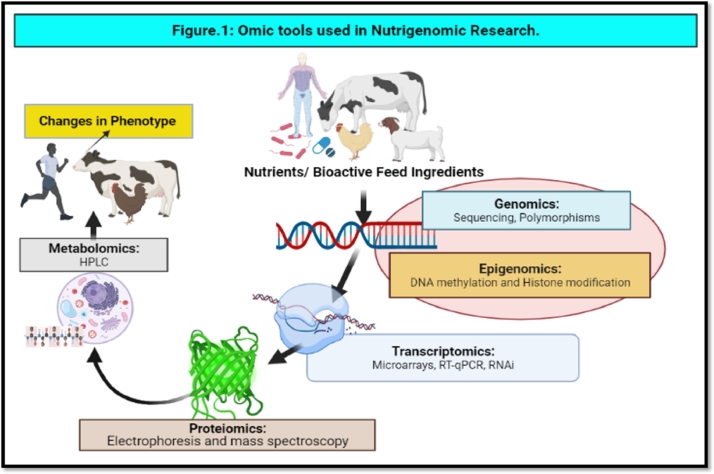
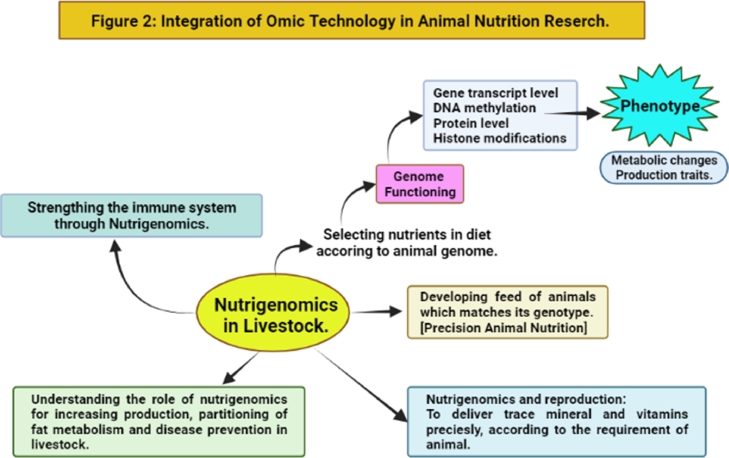
Noncommunicable diseases such as cardiovascular disease, obesity, diabetes, and cancer now outnumber all other health ailments in humans globally due to abrupt changes in lifestyle following the industrial revolution. The industrial revolution has also intensified livestock farming, resulting in an increased demand for productivity and stressed animals. The livestock industry faces significant challenges from a projected sharp increase in global food and high animal protein demand. Nutrition genomics holds great promise for the future as its advances have opened up a whole new world of disease understanding and prevention. Nutrigenomics is the study of the interactions between genes and diet. It investigates molecular relationships between nutrients and genes to identify how even minor modifications could potentially alter animal and human health/performance by using techniques like proteomics, transcriptomics, metabolomics, and lipidomics. Dietary modifications mostly studied in livestock focus mainly on health and production traits through protein, fat, mineral, and vitamin supplementation changes. Nutrigenomics meticulously selects nutrients for fine-tuning the expression of genes that match animal/human genotypes for better health, productivity, and the environment. As a step forward, nutrigenomics integrates nutrition, molecular biology, genomics, bioinformatics, molecular medicine, and epidemiology to better understand the role of food as an epigenetic factor in the occurrence of these diseases. This review aims to provide a comprehensive overview of the fundamental concepts, latest advances, and studies in the field of nutrigenomics, emphasizing the interaction of diet with gene expression, and how it relates to human and animal health along with its human-animal interphase.
由于工业革命后生活方式的突然改变,心血管疾病、肥胖症、糖尿病和癌症等非传染性疾病目前在全球人类所有其他健康问题中占比最高。工业革命还加剧了畜牧业发展,导致对生产力的需求增加,给动物带来了压力。畜牧业面临着全球粮食预计大幅增长和动物蛋白需求高涨带来的重大挑战。营养基因组学对未来有着巨大的前景,因为其进展开启了一个全新的疾病理解和预防的世界。营养基因组学是研究基因与饮食之间的相互作用。它研究营养素和基因之间的分子关系,以确定即使是微小的改变如何通过蛋白质组学、转录组学、代谢组学和脂质组学等技术潜在地改变动物和人类的健康/性能。在牲畜中主要研究的饮食改变主要集中在通过蛋白质、脂肪、矿物质和维生素补充剂的变化来改善健康和生产性状。营养基因组学精心选择营养素,以微调与动物/人类基因型相匹配的基因表达,从而改善健康、提高生产力并保护环境。更进一步,营养基因组学整合了营养、分子生物学、基因组学、生物信息学、分子医学和流行病学,以更好地理解食物作为表观遗传因素在这些疾病发生中的作用。本综述旨在全面概述营养基因组学领域的基本概念、最新进展和研究,强调饮食与基因表达的相互作用,以及它如何与人类和动物健康及其人畜界面相关。