Department of Evolution and Ecology, University of California, Davis, California, USA.
Data Science Initiative, University of Oregon, Eugene, Oregon, USA.
mSystems. 2022 Aug 30;7(4):e0022422. doi: 10.1128/msystems.00224-22. Epub 2022 Jul 20.
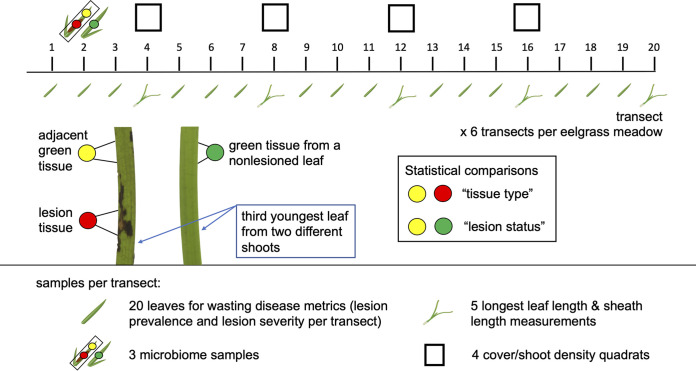
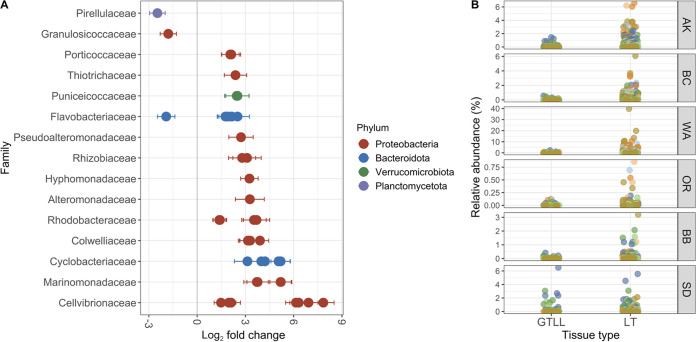
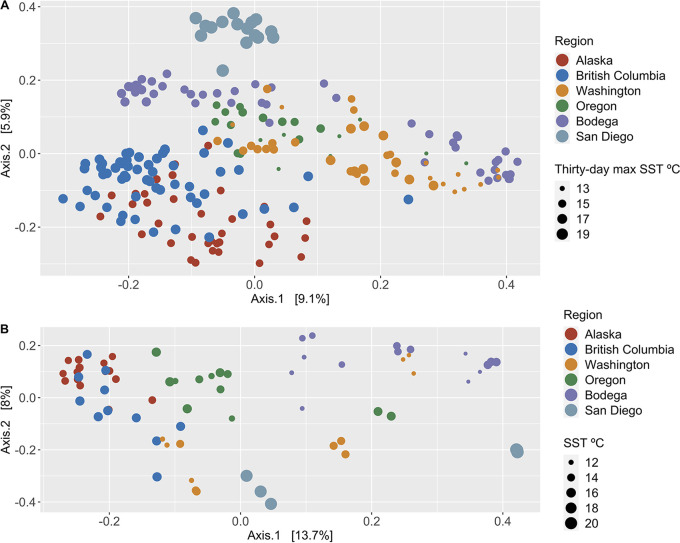
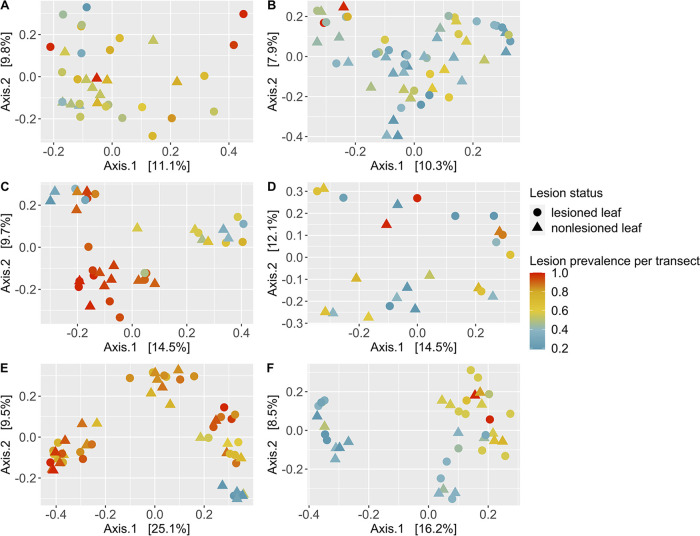
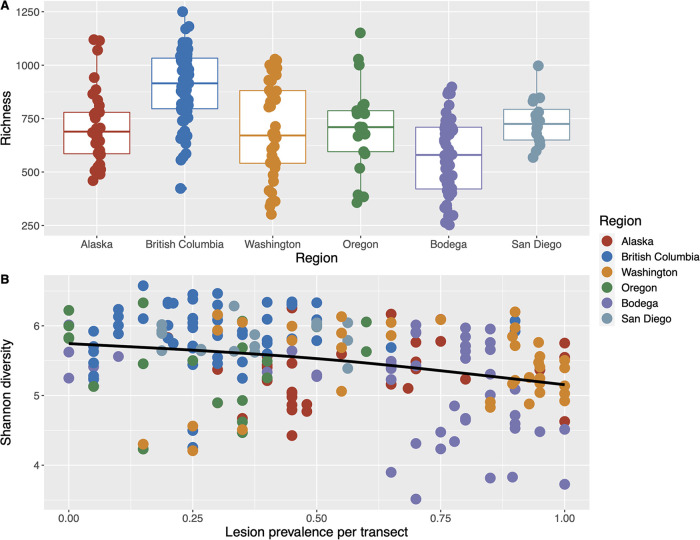
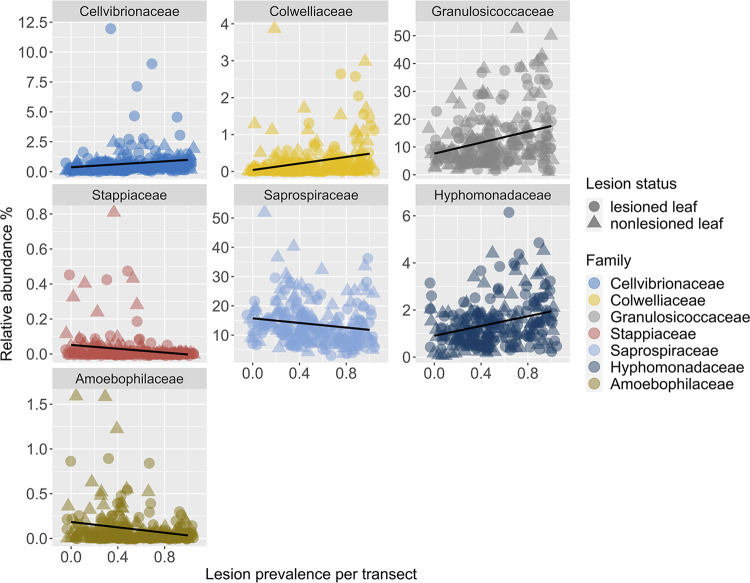
Predicting outcomes of marine disease outbreaks presents a challenge in the face of both global and local stressors. Host-associated microbiomes may play important roles in disease dynamics but remain understudied in marine ecosystems. Host-pathogen-microbiome interactions can vary across host ranges, gradients of disease, and temperature; studying these relationships may aid our ability to forecast disease dynamics. Eelgrass, , is impacted by outbreaks of wasting disease caused by the opportunistic pathogen . We investigated how phyllosphere microbial communities vary with rising wasting disease lesion prevalence and severity relative to plant and meadow characteristics like shoot density, longest leaf length, and temperature across 23° latitude in the Northeastern Pacific. We detected effects of geography (11%) and smaller, but distinct, effects of temperature (30-day max sea surface temperature, 4%) and disease (lesion prevalence, 3%) on microbiome composition. Declines in alpha diversity on asymptomatic tissue occurred with rising wasting disease prevalence within meadows. However, no change in microbiome variability (dispersion) was detected between asymptomatic and symptomatic tissues. Further, we identified members of Cellvibrionaceae, Colwelliaceae, and Granulosicoccaceae on asymptomatic tissue that are predictive of wasting disease prevalence across the geographic range (3,100 kilometers). Functional roles of Colwelliaceae and Granulosicoccaceae are not known. Cellvibrionaceae, degraders of plant cellulose, were also enriched in lesions and adjacent green tissue relative to nonlesioned leaves. Cellvibrionaceae may play important roles in disease progression by degrading host tissues or overwhelming plant immune responses. Thus, inclusion of microbiomes in wasting disease studies may improve our ability to understand variable rates of infection, disease progression, and plant survival. The roles of marine microbiomes in disease remain poorly understood due, in part, to the challenging nature of sampling at appropriate spatiotemporal scales and across natural gradients of disease throughout host ranges. This is especially true for marine vascular plants like eelgrass () that are vital for ecosystem function and biodiversity but are susceptible to rapid decline and die-off from pathogens like eukaryotic slime-mold (wasting disease). We link bacterial members of phyllosphere tissues to the prevalence of wasting disease across the broadest geographic range to date for a marine plant microbiome-disease study (3,100 km). We identify Cellvibrionaceae, plant cell wall degraders, enriched (up to 61% relative abundance) within lesion tissue, which suggests this group may be playing important roles in disease progression. These findings suggest inclusion of microbiomes in marine disease studies will improve our ability to predict ecological outcomes of infection across variable landscapes spanning thousands of kilometers.
预测海洋疾病爆发的结果在面对全球和地方压力时是一个挑战。宿主相关的微生物组在疾病动态中可能发挥着重要作用,但在海洋生态系统中仍研究不足。宿主-病原体-微生物组的相互作用在宿主范围、疾病程度和温度梯度上可能有所不同;研究这些关系可能有助于提高我们预测疾病动态的能力。鳗草,是一种受机会性病原体引起的消瘦病爆发影响的海洋植物。我们调查了在北太平洋 23°的纬度范围内,随着消瘦病病变患病率和严重程度的增加,与植物和草地特征(如茎密度、最长叶长和温度)相关的叶际微生物群落如何变化。我们检测到地理因素(11%)和较小但明显的温度因素(30 天最大海面温度,4%)以及疾病因素(病变患病率,3%)对微生物群落组成的影响。在无症状组织中,随着消瘦病患病率的升高,α多样性下降。然而,在无症状和有症状组织之间未检测到微生物组变异性(离散度)的变化。此外,我们在无症状组织上鉴定出 Cellvibrionaceae、Colwelliaceae 和 Granulosicoccaceae 的成员,它们可以预测整个地理范围(3100 公里)的消瘦病患病率。Colwelliaceae 和 Granulosicoccaceae 的功能作用尚不清楚。Cellvibrionaceae 是植物纤维素的降解者,在病变和相邻的绿叶组织中也比非病变叶片中更为丰富。Cellvibrionaceae 可能通过降解宿主组织或压倒植物免疫反应在疾病进展中发挥重要作用。因此,将微生物组纳入消瘦病研究可能会提高我们理解感染率、疾病进展和植物存活率变化的能力。由于在适当的时空尺度上采样以及在整个宿主范围内的自然疾病梯度上采样的挑战性,海洋微生物组在疾病中的作用仍知之甚少。对于鳗草等海洋维管束植物来说尤其如此,它们对生态系统功能和生物多样性至关重要,但容易受到真核粘菌等病原体的快速衰退和死亡的影响(消瘦病)。我们将叶际组织的细菌成员与迄今为止最广泛的地理范围的消瘦病患病率联系起来,这是一项针对海洋植物微生物组-疾病研究(3100 公里)。我们发现 Cellvibrionaceae,一种植物细胞壁的降解者,在病变组织中富集(相对丰度高达 61%),这表明该组可能在疾病进展中发挥重要作用。这些发现表明,在海洋疾病研究中纳入微生物组将提高我们预测跨数千公里不同景观的感染生态结果的能力。