Department of Population Health and Pathobiology, North Carolina State University, Raleigh, NC 27607, USA.
Bioinformatics Research Center, North Carolina State University, Raleigh, NC 27695, USA.
Philos Trans R Soc Lond B Biol Sci. 2020 Sep 28;375(1808):20190592. doi: 10.1098/rstb.2019.0592. Epub 2020 Aug 10.
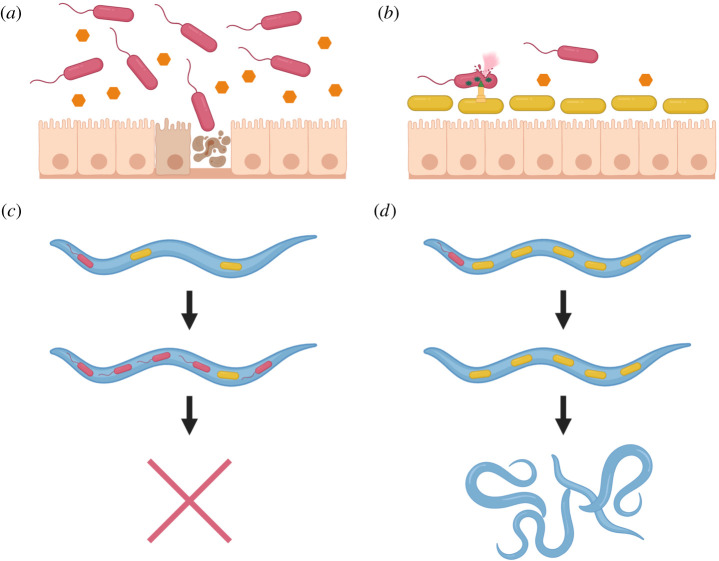
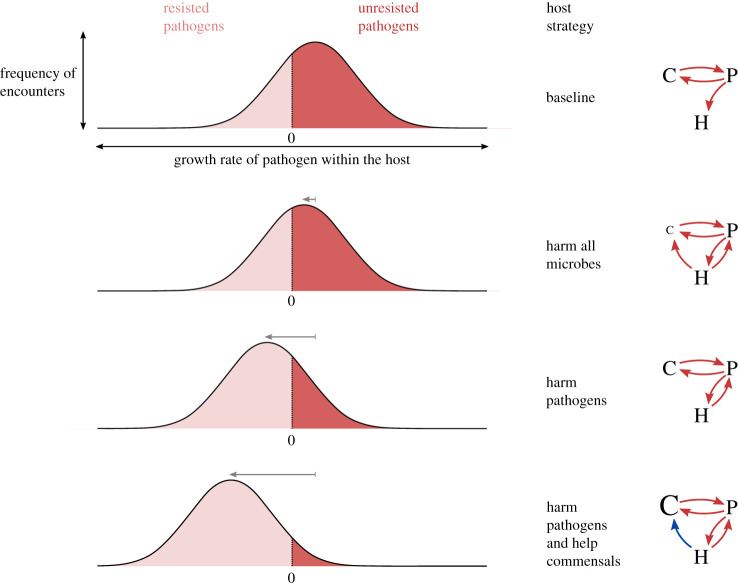
To survive, plants and animals must continually defend against pathogenic microbes that would invade and disrupt their tissues. Yet they do not attempt to extirpate all microbes. Instead, they tolerate and even encourage the growth of commensal microbes, which compete with pathogens for resources and via direct inhibition. We argue that hosts have evolved to cooperate with commensals in order to enhance the pathogen resistance this competition provides. We briefly describe competition between commensals and pathogens within the host, consider how natural selection might favour hosts that tilt this competition in favour of commensals, and describe examples of extant host traits that may serve this purpose. Finally, we consider ways that this cooperative immunity may have facilitated the adaptive evolution of non-pathogen-related host traits. On the basis of these observations, we argue that pathogen resistance vies with other commensal-provided benefits for being the principal evolutionary advantage provided by the microbiome to host lineages across the tree of life. This article is part of the theme issue 'The role of the microbiome in host evolution'.
为了生存,动植物必须不断抵御会入侵和破坏其组织的致病微生物。然而,它们并不试图消灭所有的微生物。相反,它们容忍甚至鼓励共生微生物的生长,这些微生物通过竞争资源和直接抑制与病原体竞争。我们认为,宿主已经进化到与共生微生物合作,以增强这种竞争提供的病原体抗性。我们简要描述了宿主内共生微生物和病原体之间的竞争,考虑了自然选择如何有利于将这种竞争倾斜到共生微生物一方的宿主,并描述了现存的宿主特征的例子,这些特征可能有助于达到这一目的。最后,我们考虑了这种合作免疫如何促进与非病原体相关的宿主特征的适应性进化。基于这些观察,我们认为,病原体抗性与其他共生微生物提供的益处竞争,以成为微生物组为整个生命之树的宿主谱系提供的主要进化优势。本文是主题为“微生物组在宿主进化中的作用”的一部分。