School of Biomedical Engineering, University of British Columbia, Vancouver, BC, Canada.
Mathematics Department, Scripps College, Claremont, CA, USA.
Bull Math Biol. 2022 Jul 20;84(9):91. doi: 10.1007/s11538-022-01030-6.
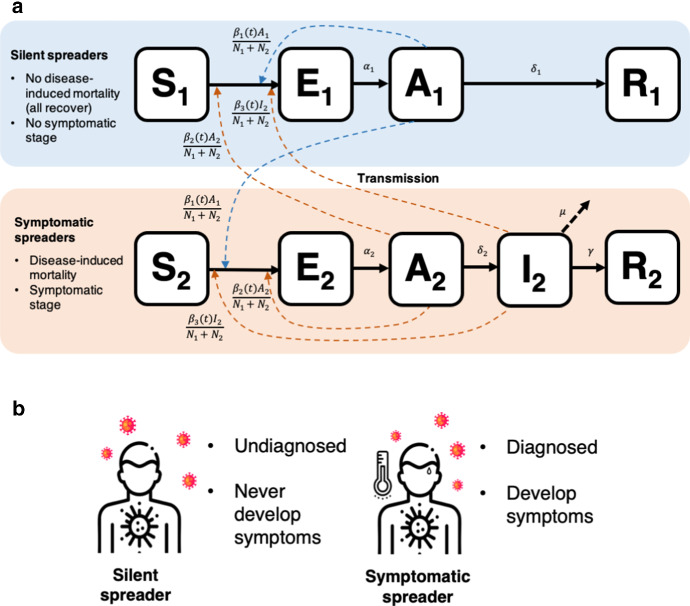
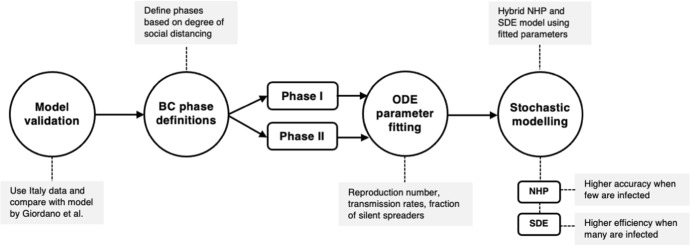
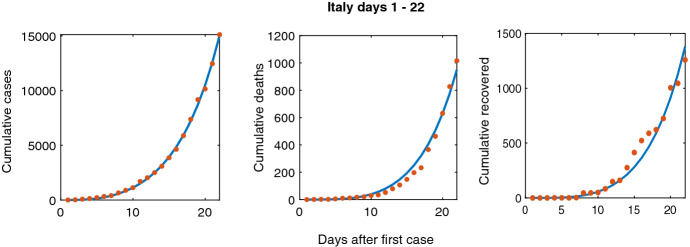
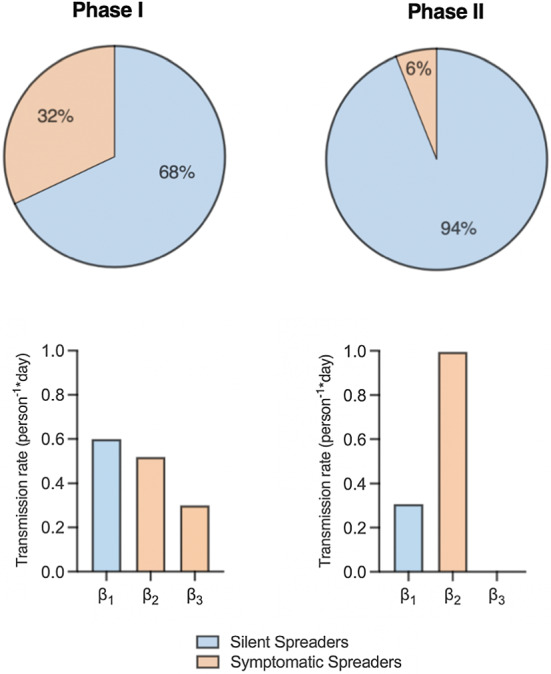
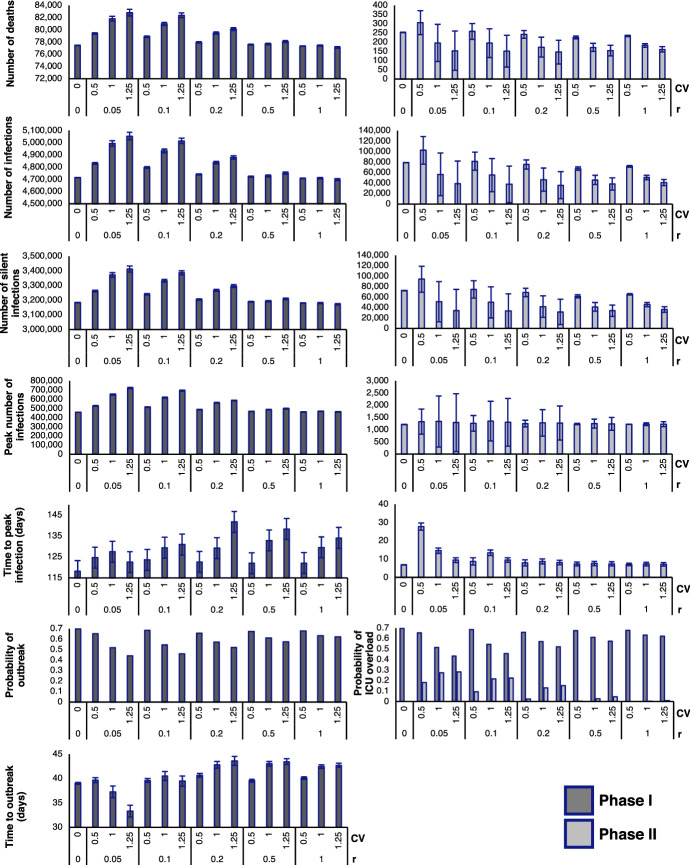
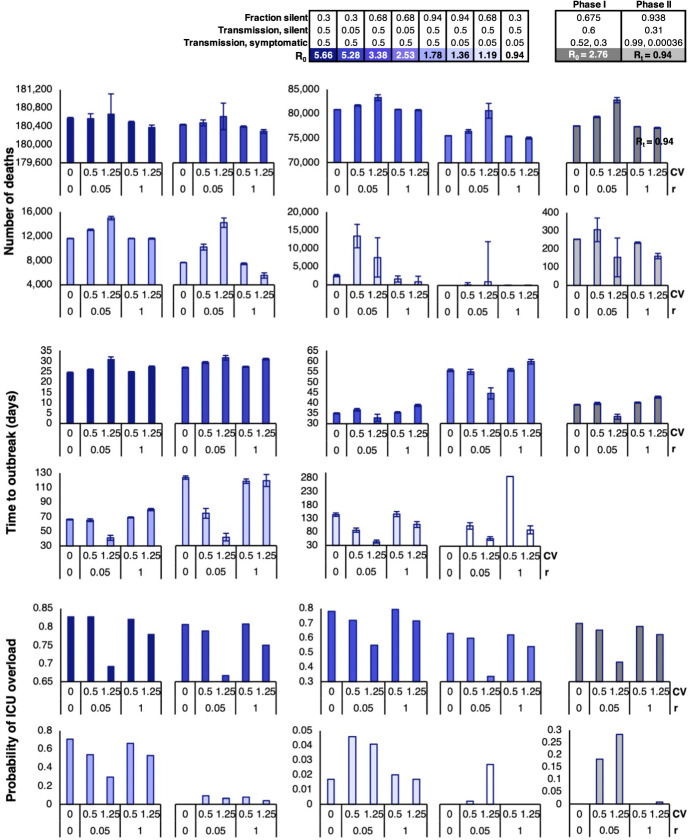
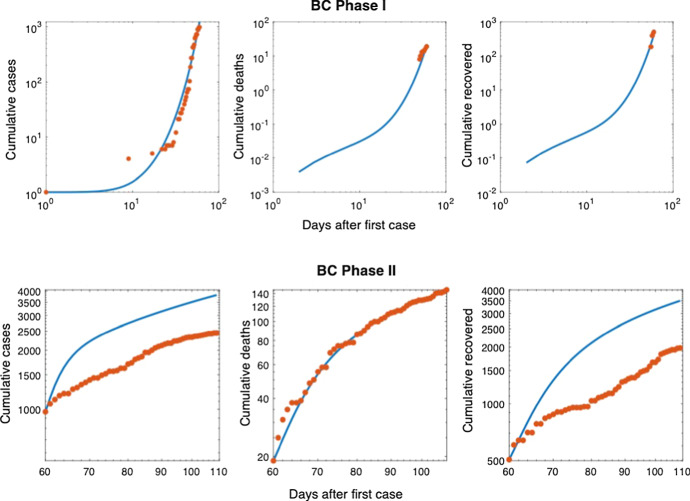
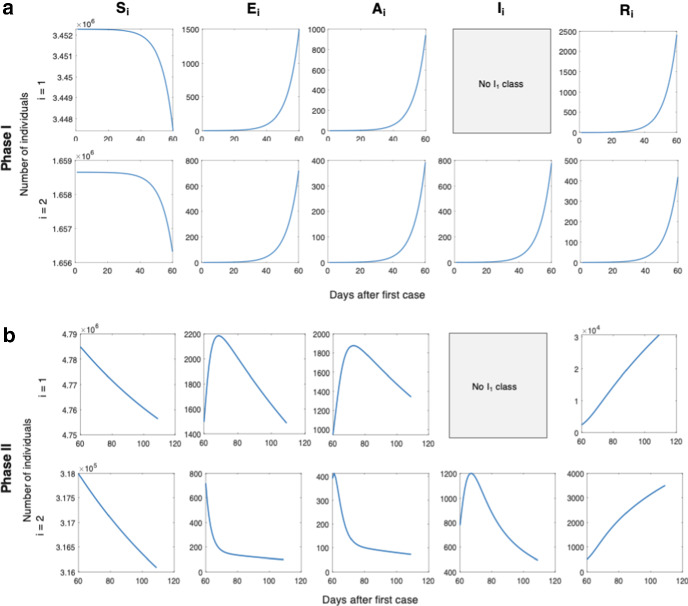
The dynamic nature of the COVID-19 pandemic has demanded a public health response that is constantly evolving due to the novelty of the virus. Many jurisdictions in the USA, Canada, and across the world have adopted social distancing and recommended the use of face masks. Considering these measures, it is prudent to understand the contributions of subpopulations-such as "silent spreaders"-to disease transmission dynamics in order to inform public health strategies in a jurisdiction-dependent manner. Additionally, we and others have shown that demographic and environmental stochasticity in transmission rates can play an important role in shaping disease dynamics. Here, we create a model for the COVID-19 pandemic by including two classes of individuals: silent spreaders, who either never experience a symptomatic phase or remain undetected throughout their disease course; and symptomatic spreaders, who experience symptoms and are detected. We fit the model to real-time COVID-19 confirmed cases and deaths to derive the transmission rates, death rates, and other relevant parameters for multiple phases of outbreaks in British Columbia (BC), Canada. We determine the extent to which SilS contributed to BC's early wave of disease transmission as well as the impact of public health interventions on reducing transmission from both SilS and SymS. To do this, we validate our model against an existing COVID-19 parameterized framework and then fit our model to clinical data to estimate key parameter values for different stages of BC's disease dynamics. We then use these parameters to construct a hybrid stochastic model that leverages the strengths of both a time-nonhomogeneous discrete process and a stochastic differential equation model. By combining these previously established approaches, we explore the impact of demographic and environmental variability on disease dynamics by simulating various scenarios in which a COVID-19 outbreak is initiated. Our results demonstrate that variability in disease transmission rate impacts the probability and severity of COVID-19 outbreaks differently in high- versus low-transmission scenarios.
由于病毒的新颖性,COVID-19 大流行的动态性质要求公共卫生应对措施不断发展。美国、加拿大和世界各地的许多司法管辖区都采取了社会隔离措施,并建议使用口罩。考虑到这些措施,了解亚人群(如“沉默传播者”)对疾病传播动态的贡献,以便根据司法管辖区的情况为公共卫生策略提供信息,是谨慎的做法。此外,我们和其他人已经表明,传播率的人口统计学和环境随机性可以在塑造疾病动态方面发挥重要作用。在这里,我们通过包括两类个体来创建 COVID-19 大流行模型:沉默传播者,他们要么从未经历过症状期,要么在整个疾病过程中未被发现;以及有症状传播者,他们经历症状并被发现。我们将模型拟合到实时 COVID-19 确诊病例和死亡病例中,以推导出不列颠哥伦比亚省(BC)加拿大多个疫情阶段的传播率、死亡率和其他相关参数。我们确定了 SilS 在 BC 疾病传播早期波中的贡献程度,以及公共卫生干预措施对降低 SilS 和 SymS 传播的影响程度。为此,我们使用现有的 COVID-19 参数化框架来验证我们的模型,然后将我们的模型拟合到临床数据中,以估计 BC 疾病动态不同阶段的关键参数值。然后,我们使用这些参数构建一个混合随机模型,利用时间非均匀离散过程和随机微分方程模型的优势。通过结合这些先前建立的方法,我们通过模拟 COVID-19 爆发启动的各种情况,探索了人口统计学和环境变异性对疾病动态的影响。我们的结果表明,疾病传播率的变异性以不同的方式影响高传播和低传播情景中 COVID-19 爆发的可能性和严重程度。