Leng Xueyuan, Duxin Julien P
The Novo Nordisk Foundation Center for Protein Research, Faculty of Health and Medical Sciences, University of Copenhagen, Copenhagen, Denmark.
Front Mol Biosci. 2022 Jul 4;9:944775. doi: 10.3389/fmolb.2022.944775. eCollection 2022.
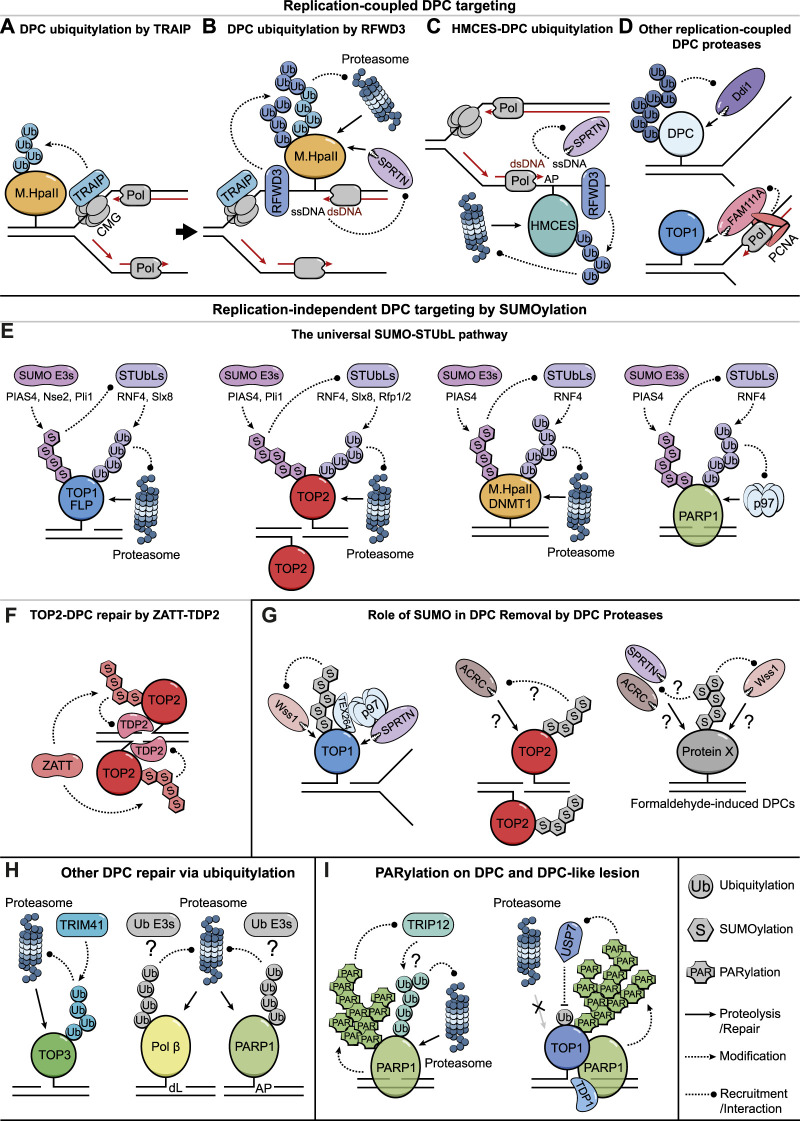
Covalent binding of proteins to DNA forms DNA-protein crosslinks (DPCs), which represent cytotoxic DNA lesions that interfere with essential processes such as DNA replication and transcription. Cells possess different enzymatic activities to counteract DPCs. These include enzymes that degrade the adducted proteins, resolve the crosslinks, or incise the DNA to remove the crosslinked proteins. An important question is how DPCs are sensed and targeted for removal the most suited pathway. Recent advances have shown the inherent role of DNA replication in triggering DPC removal by proteolysis. However, DPCs are also efficiently sensed and removed in the absence of DNA replication. In either scenario, post-translational modifications (PTMs) on DPCs play essential and versatile roles in orchestrating the repair routes. In this review, we summarize the current knowledge of the mechanisms that trigger DPC removal PTMs, focusing on ubiquitylation, small ubiquitin-related modifier (SUMO) conjugation (SUMOylation), and poly (ADP-ribosyl)ation (PARylation). We also briefly discuss the current knowledge gaps and emerging hypotheses in the field.
蛋白质与DNA的共价结合形成DNA-蛋白质交联(DPC),这是一种细胞毒性DNA损伤,会干扰DNA复制和转录等基本过程。细胞具有不同的酶活性来对抗DPC。这些酶包括降解加合物蛋白质、解开交联或切割DNA以去除交联蛋白质的酶。一个重要的问题是DPC如何被感知并靶向去除——最适合的途径。最近的进展表明DNA复制在通过蛋白水解触发DPC去除中具有内在作用。然而,在没有DNA复制的情况下,DPC也能被有效地感知和去除。在任何一种情况下,DPC上的翻译后修饰(PTM)在协调修复途径中都起着至关重要且多样的作用。在这篇综述中,我们总结了当前关于触发DPC去除的机制——PTM的知识,重点关注泛素化、小泛素相关修饰物(SUMO)结合(SUMO化)和聚(ADP-核糖)化(PAR化)。我们还简要讨论了该领域当前的知识空白和新出现的假说。