Department of Cardiology, Faculty of Medicine, University of Tsukuba, Tsukuba, 305-8575, Japan.
Department of Clinical Research and Regional Innovation, Faculty of Medicine, University of Tsukuba, Tsukuba, 305-8575, Japan.
F1000Res. 2022 Jan 26;11:97. doi: 10.12688/f1000research.75712.2. eCollection 2022.
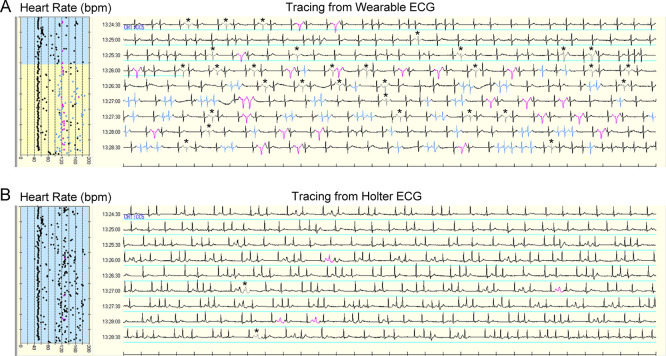
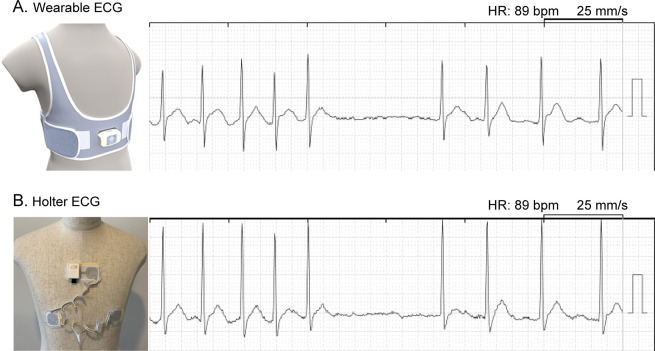
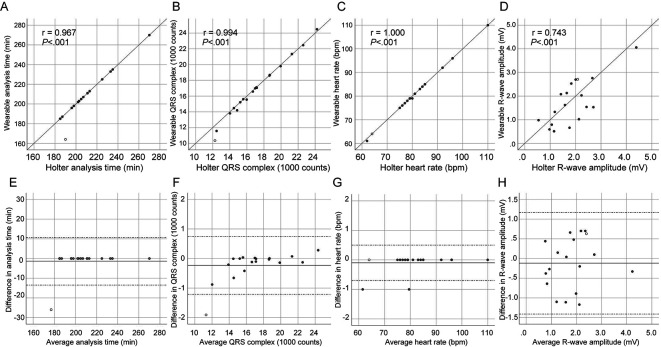
: Holter electrocardiogram (ECG) is the gold standard for ambulatory monitoring of atrial fibrillation (AF) but it is insufficient because of its limited recording time. Although several consumer ECG devices provide longer recording time, they generally do not undergo the regulatory process for medical use. Furthermore, current medical-grade devices for longer ECG monitoring are not continuous or too invasive for AF monitoring. A wearable ECG with a medical-grade dry textile electrode is a promising technology to remedy this limitation. This pilot study aimed to simultaneously compare the wearable and Holter ECGs for ambulatory monitoring in a clinical setting. This prospective observational study enrolled 18 patients who underwent AF ablation. One day after AF ablation, ambulatory ECG was obtained for three hours simultaneously using both the wearable and Holter ECG devices. Automatic ECG interpretations between devices were compared with correlation and agreement analyses. Simultaneous ECG monitoring demonstrated a comparable analysis time and total heart beats between the two devices. Almost complete correlation and agreement were also demonstrated in all clinically relevant testing aspects except in R-wave amplitude (r = 0.743, p < .001). AF was detected in three patients. AF duration was the same in both ECG devices in two patients with continuous AF. In the remaining patient with intermittent AF, AF duration was shortened by 0.6% with the wearable ECG as compared to that with the Holter ECG. Simultaneous ECG comparison revealed a high consistency between the wearable and Holter ECG devices. The results of this study warrant further clinical studies for long-term monitoring of ambulatory ECG after AF ablation.
动态心电图(ECG)是监测心房颤动(AF)的金标准,但由于记录时间有限,其应用受到限制。尽管一些消费者用 ECG 设备可提供更长的记录时间,但它们通常未经过医疗用途的监管程序。此外,目前用于长时间 ECG 监测的医疗级设备不是连续的,或者对于 AF 监测来说过于侵入性。具有医疗级干式纺织电极的可穿戴 ECG 是弥补这一局限性的有前途的技术。这项初步研究旨在同时比较可穿戴式和 Holter ECG 在临床环境下的动态监测。这项前瞻性观察性研究纳入了 18 名接受 AF 消融治疗的患者。AF 消融治疗后一天,同时使用可穿戴式和 Holter ECG 设备进行三小时的动态心电图监测。对设备之间的自动心电图解释进行了比较,并进行了相关性和一致性分析。同时进行的 ECG 监测显示,两种设备的分析时间和总心搏数相当。除了 R 波幅度外(r = 0.743,p <.001),所有临床相关检测方面均显示出几乎完全的相关性和一致性。在 3 名患者中检测到 AF。在两名持续 AF 患者中,两种 ECG 设备检测到的 AF 持续时间相同。在另一名间歇性 AF 患者中,与 Holter ECG 相比,可穿戴 ECG 检测到的 AF 持续时间缩短了 0.6%。同时进行的 ECG 比较显示,可穿戴式和 Holter ECG 设备之间具有高度一致性。这项研究的结果需要进一步进行 AF 消融后动态 ECG 长期监测的临床研究。