Department of Internal Medicine, Seoul National University Hospital, Seoul, Republic of Korea.
Department of Internal Medicine, Seoul National University College of Medicine, Seoul, Republic of Korea.
J Med Internet Res. 2022 May 9;24(5):e37970. doi: 10.2196/37970.
There is insufficient evidence for the use of single-lead electrocardiogram (ECG) monitoring with an adhesive patch-type device (APD) over an extended period compared to that of the 24-hour Holter test for atrial fibrillation (AF) detection.
In this paper, we aimed to compare AF detection by the 24-hour Holter test and 72-hour single-lead ECG monitoring using an APD among patients with AF.
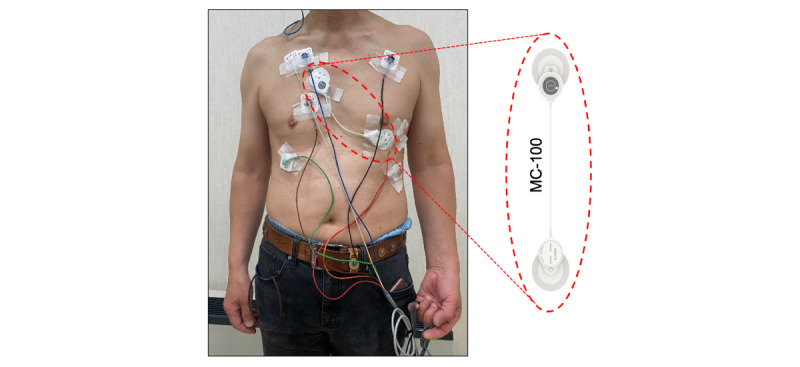
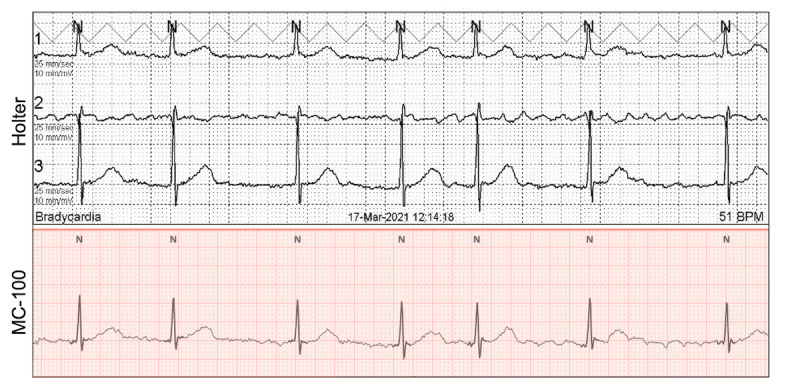
This was a prospective, single-center cohort study. A total of 210 patients with AF with clinical indications for the Holter test at cardiology outpatient clinics were enrolled in the study. The study participants were equipped with both the Holter device and APD for the first 24 hours. Subsequently, only the APD continued ECG monitoring for an additional 48 hours. AF detection during the first 24 hours was compared between the two devices. The diagnostic benefits of extended monitoring using the APD were evaluated.
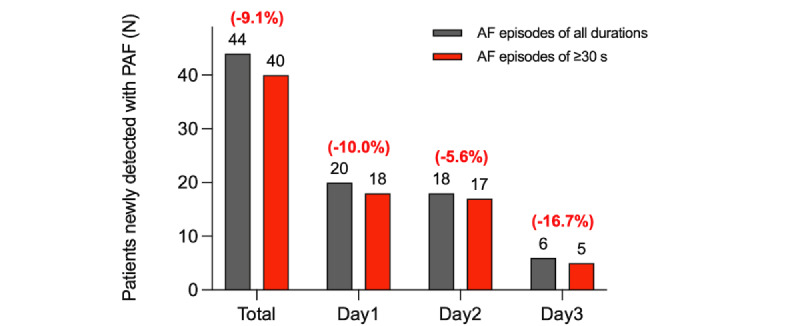
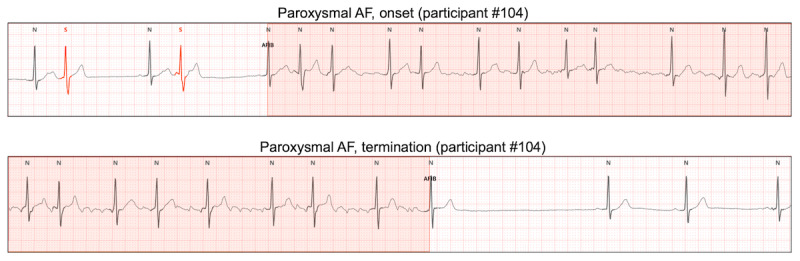
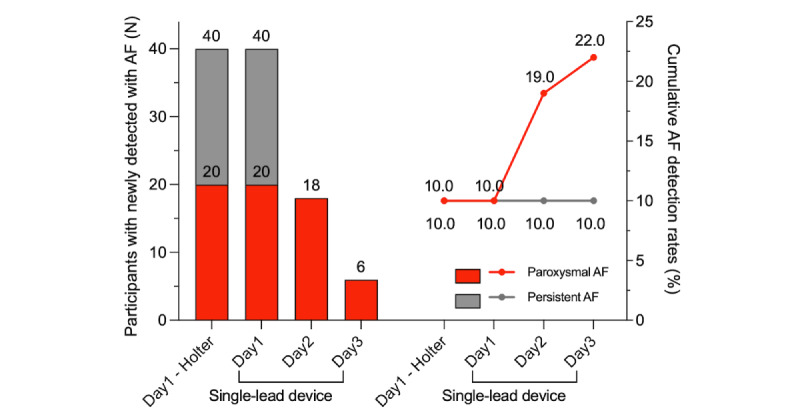
A total of 200 patients (mean age 60 years; n=141, 70.5% male; and n=59, 29.5% female) completed 72-hour ECG monitoring with the APD. During the first 24 hours, both monitoring methods detected AF in the same 40/200 (20%) patients (including 20 patients each with paroxysmal and persistent AF). Compared to the 24-hour Holter test, the APD increased the AF detection rate by 1.5-fold (58/200; 29%) and 1.6-fold (64/200; 32%) with 48- and 72-hour monitoring, respectively. With the APD, the number of newly discovered patients with paroxysmal AF was 20/44 (45.5%), 18/44 (40.9%), and 6/44 (13.6%) at 24-, 48-, and 72-hour monitoring, respectively. Compared with 24-hour Holter monitoring, 72-hour monitoring with the APD increased the detection rate of paroxysmal AF by 2.2-fold (44/20).
Compared to the 24-hour Holter test, AF detection could be improved with 72-hour single-lead ECG monitoring with the APD.
与 24 小时动态心电图(Holter)相比,使用粘贴式单导联心电图(APD)进行延长时间的房颤(AF)检测的证据有限。
本研究旨在比较 24 小时 Holter 试验与 APD 进行的 72 小时单导联心电图监测在 AF 患者中的 AF 检出率。
这是一项前瞻性、单中心队列研究。共纳入 210 例在心血管门诊有 Holter 检查适应证的 AF 患者。研究参与者在最初的 24 小时内同时配备 Holter 设备和 APD。随后,仅 APD 继续进行另外 48 小时的心电图监测。比较两种设备在最初 24 小时内的 AF 检出率。评估使用 APD 进行延长监测的诊断获益。
共有 200 例患者(平均年龄 60 岁;n=141,70.5%为男性;n=59,29.5%为女性)完成了 72 小时 APD 心电图监测。在最初的 24 小时内,两种监测方法均在 40/200(20%)例患者中检出 AF(包括 20 例阵发性和持续性 AF 各 20 例)。与 24 小时 Holter 试验相比,APD 分别以 48 小时和 72 小时监测将 AF 检出率提高了 1.5 倍(58/200;29%)和 1.6 倍(64/200;32%)。使用 APD,新发阵发性 AF 患者的数量分别为 24、48 和 72 小时监测时的 20/44(45.5%)、18/44(40.9%)和 6/44(13.6%)。与 24 小时 Holter 监测相比,APD 进行 72 小时监测将阵发性 AF 的检出率提高了 2.2 倍(44/20)。
与 24 小时 Holter 试验相比,APD 进行 72 小时单导联心电图监测可提高 AF 的检出率。