Al-Soudi Aram, Vegting Yosta, Klarenbeek Paul L, Hilhorst Marc L
Department of Rheumatology, Amsterdam UMC, University of Amsterdam, Amsterdam, Netherlands.
Rheumatology and Immunology Center (ARC), Amsterdam UMC, University of Amsterdam, Amsterdam, Netherlands.
Front Med (Lausanne). 2022 Jul 4;9:844112. doi: 10.3389/fmed.2022.844112. eCollection 2022.
ANCA-vasculitis (AAV) patients frequently suffer from relapses and risk subsequent organ damage. There is much debate on the value of serial ANCA level evaluation to monitor disease activity. We aimed to evaluate the association between ANCA rises and disease relapses at (I) moment of the rise, (II) within 6 months or (III) within a year from the rise.
3 databases (MEDLINE, EMBASE, COCHRANE) were searched from 1993 through September 2021. We included studies that reported relapse incidence within 12 months after an ANCA rise measured by antigen-specific immunoassays in peripheral blood of AAV patients in remission. Quality assessment was performed using QUADAS-2. Finally, a meta-analysis was carried out to estimate average OR using a random effects model.
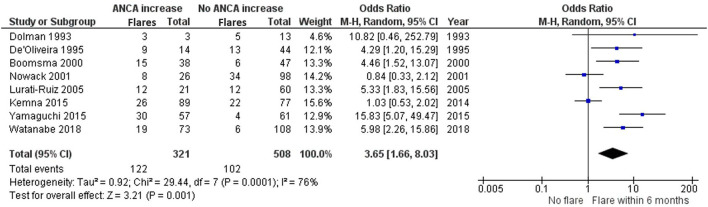
Twenty unique studies were included. The methodological quality was limited due to risk of selection bias. An ANCA rise often preceded a disease relapse within 6 months (OR 3.65, 95% CI 1.66-8.03) and less often within 12 months (OR 2.88, 95% CI 1.21-6.88), while it was not indicative of a concurrent relapse (OR 0.13, 95% CI 0.03-0.53). Once a relapse is diagnosed, ANCA is significantly more often present than not (OR 10.80, 95% CI 3.82-30.55). As expected based on clinical, technical and methodological variability between studies, there was substantial heterogeneity across studies in all analyses (I2 = 70-87%).
In previously ANCA-positive patients, the ANCA test is often positive upon clinical suspicion of a disease relapse. Patients with a rise in ANCA are at risk of encountering disease relapses in the upcoming 6 or 12 months.
抗中性粒细胞胞浆抗体相关性血管炎(AAV)患者经常复发,并面临后续器官损伤的风险。关于连续检测抗中性粒细胞胞浆抗体(ANCA)水平以监测疾病活动的价值存在诸多争议。我们旨在评估ANCA升高与疾病复发之间的关联,时间范围为:(I)升高之时;(II)升高后6个月内;或(III)升高后1年内。
检索了1993年至2021年9月的3个数据库(MEDLINE、EMBASE、Cochrane)。我们纳入了报告缓解期AAV患者外周血中通过抗原特异性免疫测定法测得ANCA升高后12个月内复发率的研究。使用QUADAS-2进行质量评估。最后,采用随机效应模型进行荟萃分析以估计平均比值比(OR)。
纳入了20项独立研究。由于存在选择偏倚风险,方法学质量有限。ANCA升高通常在6个月内先于疾病复发(OR 3.65,95%置信区间1.66 - 8.03),在12个月内较少出现(OR 2.88,95%置信区间1.21 - 6.88),而它并不表明同时复发(OR 0.13,95%置信区间0.03 - 0.53)。一旦诊断出复发,ANCA呈阳性的情况显著多于阴性(OR 10.80,95%置信区间3.82 - 30.55)。基于研究之间临床、技术和方法学的变异性,正如预期的那样,所有分析中各研究之间均存在大量异质性(I² = 70 - 87%)。
在既往ANCA阳性的患者中,临床怀疑疾病复发时ANCA检测通常呈阳性。ANCA升高的患者在未来6个月或12个月有疾病复发的风险。