Petit Matthieu, Lascarrou Jean-Baptiste, Colin Gwenhael, Merdji Hamid, Cariou Alain, Geri Guillaume
Medical Intensive Care Unit, Ambroise Paré Hospital, APHP, Boulogne-Billancourt, France.
Paris-Saclay University, UVSQ, Inserm, CESP, 94807 Villejuif, France.
Resusc Plus. 2022 Jul 12;11:100271. doi: 10.1016/j.resplu.2022.100271. eCollection 2022 Sep.
Patients admitted after cardiac arrest with non-shockable rhythm frequently experience hemodynamic instability. This study assessed the hemodynamic consequences of TTM in this sub population.
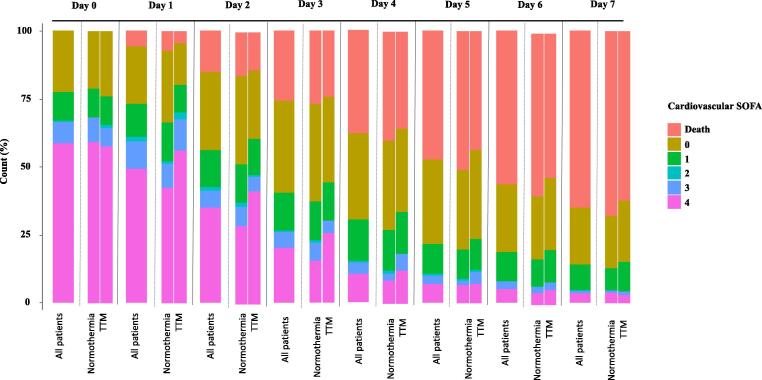
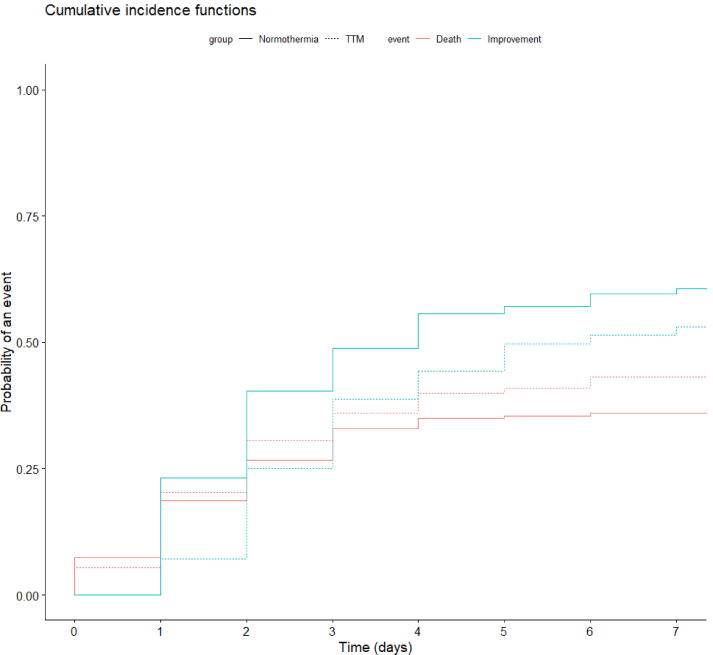
This is a post hoc analysis of the HYPERION trial (NCT01994772), that randomized patients to either hypothermia or normothermia after non-shockable rhythm related cardiac arrest. Patients with no, moderate or severe circulatory failure were identified with cardiovascular Sequential Organ Failure Assessment at randomization. Primary outcome was the number of patients at day 7 with resolution of shock, accounting for the risk of death (competing risk analysis). Secondary endpoint included neurological outcome and death at day-90.
584 patients were included in the analysis: 195 (34%), 46 (8%) and 340 (59%) had no, moderate and severe circulatory failure, respectively. Resolution of circulatory failure at day 7 was more frequently observed in the normothermia group than in the TTM group (60% [95 %CI 54-66] versus 53% [95 %CI 46-60], Gray-test: p = 0.016). The severity of circulatory failure at randomization was associated with its less frequent resolution at day 7 accounting for the risk of death (76 % [62-86] versus 54% [49-59] for patients with moderate versus severe circulatory failure, Gray test, p < 0.001, respectively). At day 90, the proportion of patients with Cerebral Performance Category score of 1 or 2 was lower in patients presenting severe circulatory failure (p = 0.038).
Circulatory failure is frequent after CA with non-shockable rhythm. Its severity at admission and TTM were associated with delayed resolution of circulatory failure.
心脏骤停后以不可电击心律入院的患者经常出现血流动力学不稳定。本研究评估了该亚组人群中目标温度管理(TTM)对血流动力学的影响。
这是对HYPERION试验(NCT01994772)的事后分析,该试验将与不可电击心律相关的心脏骤停后的患者随机分为低温组或常温组。在随机分组时,通过心血管序贯器官衰竭评估来确定无、中度或重度循环衰竭的患者。主要结局是第7天时休克缓解且考虑死亡风险的患者数量(竞争风险分析)。次要终点包括第90天时的神经学结局和死亡情况。
584例患者纳入分析:分别有195例(34%)、46例(8%)和340例(59%)无、中度和重度循环衰竭。第7天时,常温组比TTM组更常观察到循环衰竭缓解(60%[95%CI 54 - 66]对53%[95%CI 46 - 60],Gray检验:p = 0.016)。随机分组时循环衰竭的严重程度与其在第7天时缓解频率较低相关,且考虑了死亡风险(中度与重度循环衰竭患者分别为76%[62 - 86]对54%[49 - 59],Gray检验,p < 0.001)。在第90天时,出现严重循环衰竭的患者中脑功能分类评分1或2的患者比例较低(p = 0.038)。
心脏骤停后以不可电击心律出现循环衰竭很常见。入院时其严重程度和TTM与循环衰竭缓解延迟相关。