Department of Anesthesiology and Intensive Care Medicine, St. Olav's University Hospital, Trondheim, Norway.
Institute of Circulation and Medical Imaging, Faculty of Medicine and Health Sciences, Norwegian University of Science and Technology (NTNU), Trondheim, Norway.
BMC Anesthesiol. 2021 Sep 8;21(1):219. doi: 10.1186/s12871-021-01434-2.
Circulatory failure frequently occurs after out-of-hospital cardiac arrest (OHCA) and is part of post-cardiac arrest syndrome (PCAS). The aim of this study was to investigate circulatory disturbances in PCAS by assessing the circulatory trajectory during treatment in the intensive care unit (ICU).
This was a prospective single-center observational cohort study of patients after OHCA. Circulation was continuously and invasively monitored from the time of admission through the following five days. Every hour, patients were classified into one of three predefined circulatory states, yielding a longitudinal sequence of states for each patient. We used sequence analysis to describe the overall circulatory development and to identify clusters of patients with similar circulatory trajectories. We used ordered logistic regression to identify predictors for cluster membership.
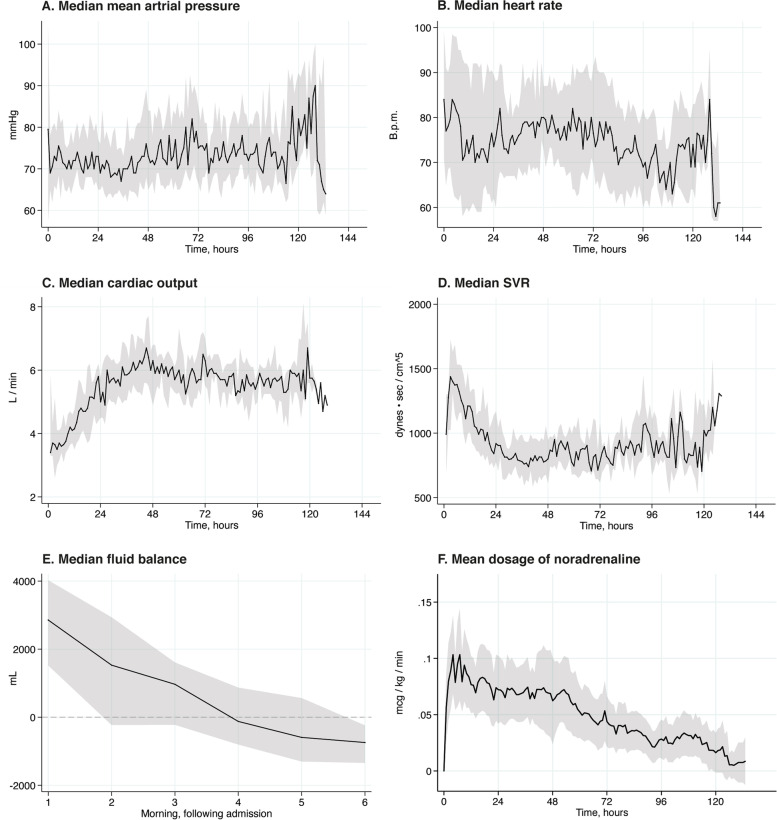
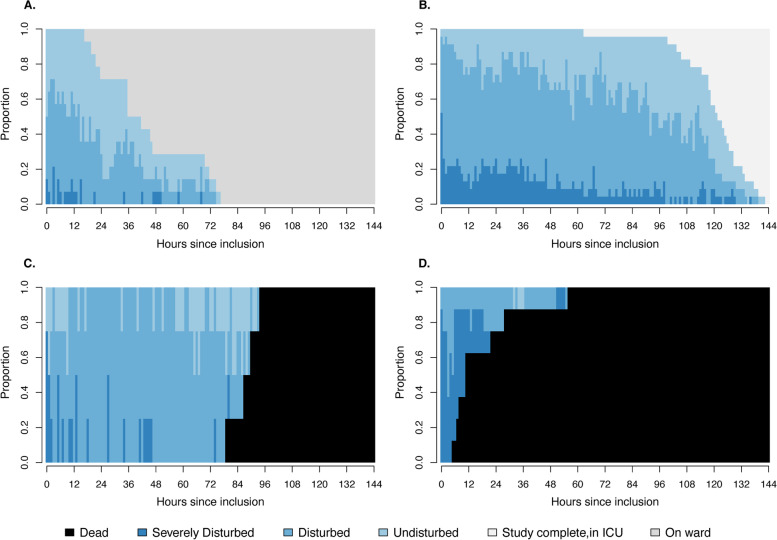
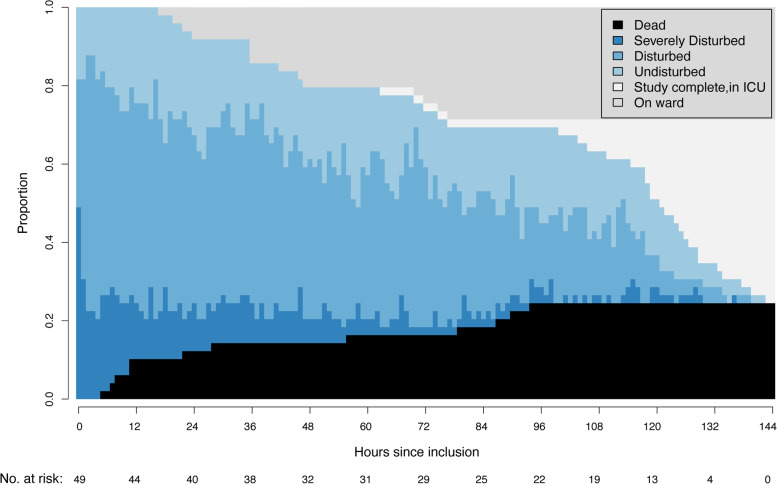
Among 71 patients admitted to the ICU after OHCA during the study period, 50 were included in the study. The overall circulatory development after OHCA was two-phased. Low cardiac output (CO) and high systemic vascular resistance (SVR) characterized the initial phase, whereas high CO and low SVR characterized the later phase. Most patients were stabilized with respect to circulatory state within 72 h after cardiac arrest. We identified four clusters of circulatory trajectories. Initial shockable cardiac rhythm was associated with a favorable circulatory trajectory, whereas low base excess at admission was associated with an unfavorable circulatory trajectory.
Circulatory failure after OHCA exhibits time-dependent characteristics. We identified four distinct circulatory trajectories and their characteristics. These findings may guide clinical support for circulatory failure after OHCA.
ClinicalTrials.gov: NCT02648061.
院外心脏骤停(OHCA)后常发生循环衰竭,是心脏骤停后综合征(PCAS)的一部分。本研究旨在通过评估 ICU 治疗期间的循环轨迹来研究 PCAS 中的循环紊乱。
这是一项针对 OHCA 后患者的前瞻性单中心观察队列研究。从入院开始,连续和侵入性监测循环,持续五天。每小时,患者被分为三个预先定义的循环状态之一,为每个患者产生一个纵向的状态序列。我们使用序列分析来描述整体循环发展,并确定具有相似循环轨迹的患者聚类。我们使用有序逻辑回归来确定聚类成员的预测因素。
在研究期间,71 名因 OHCA 而入住 ICU 的患者中,有 50 名被纳入研究。OHCA 后的整体循环发展是两阶段的。低心输出量(CO)和高全身血管阻力(SVR)是初始阶段的特征,而高 CO 和低 SVR 是后期阶段的特征。大多数患者在心脏骤停后 72 小时内循环状态稳定。我们确定了四个循环轨迹聚类。初始可电击的心律与有利的循环轨迹相关,而入院时低基础碱值与不利的循环轨迹相关。
OHCA 后循环衰竭表现出时间依赖性特征。我们确定了四个不同的循环轨迹及其特征。这些发现可能为 OHCA 后循环衰竭的临床支持提供指导。
ClinicalTrials.gov:NCT02648061。