Diener Hans-Christoph, Lehmacher Walter, Kroth Elmar, Lampert Anette, Weiser Thomas
Abteilung für Neuroepidemiologie, Institut für Medizinische Informatik, Biometrie und Epidemiologie (IMIBE), Medizinische Fakultät, Universität Duisburg-Essen, Hufelandstr 55, 45147, Essen, Deutschland.
Institut für Medizinische Statistik und Bioinformatik (IMSB), Universität zu Köln, Robert-Koch-Str. 10, Geb. 55, 50924, Köln, Deutschland.
Schmerz. 2023 Dec;37(6):461-466. doi: 10.1007/s00482-022-00661-x. Epub 2022 Jul 21.
There are previously published data on the per capita use of analgesics in Germany, but only to 2005. In the present analysis, data for the years 2008-2019 were evaluated. The use of prescription and nonprescription analgesics was investigated and possible influencing factors were discussed.
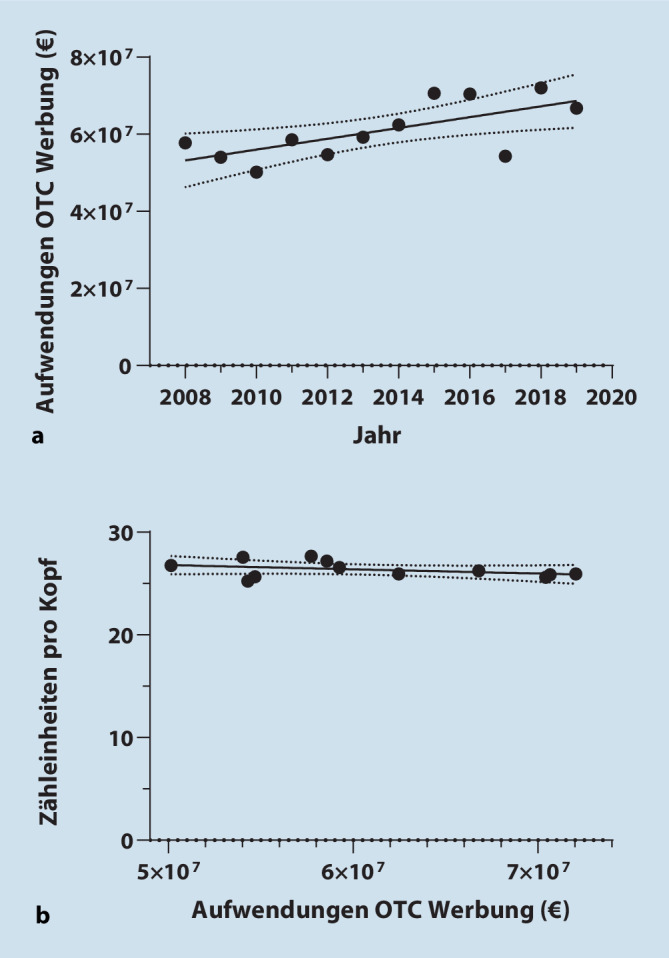
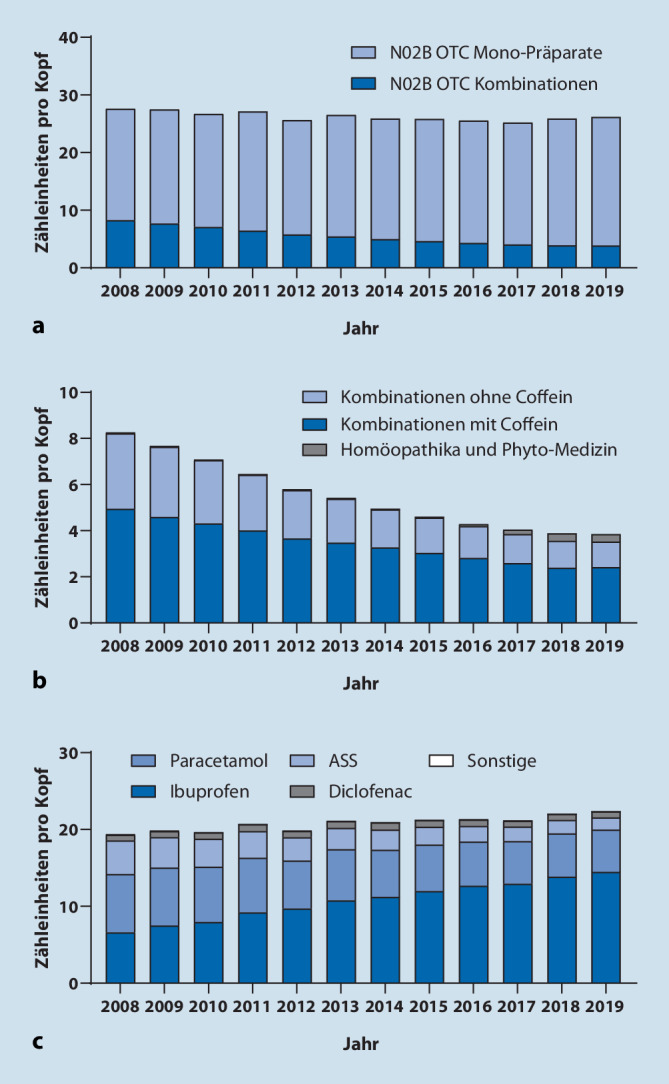
The per capita use of prescription and nonprescription analgesics was determined based on data on prescriptions and cash purchases in pharmacies (IMS Pharmascope®, Wiener Neudorf, Austria). Moreover, an evaluation according to active substances was performed for nonprescription drugs. In addition, pharmaceutical manufacturers' advertising expenditures and changes in distribution channels were analyzed as possible influencing factors.
During the observation period 2008-2019, the use of prescription analgesics in Germany increased, while the use of nonprescription analgesics decreased. Single-agent drugs constitute the majority of sales of nonprescription analgesics. The share of combination drugs has decreased in recent years.
The use of nonprescription analgesics in Germany decreased between 2008 and 2019. The trend as of 1995, which was observed in a previous investigation, is therefore continuing. External factors, such as the increase in advertising expenses or easier access via mail-order pharmacies, do not appear to influence use.
此前已有关于德国人均镇痛药使用情况的数据,但仅截至2005年。在本分析中,对2008 - 2019年的数据进行了评估。调查了处方药和非处方药的使用情况,并讨论了可能的影响因素。
根据药店的处方和现金购买数据(奥地利维也纳新多夫的IMS Pharmascope®)确定处方药和非处方药的人均使用量。此外,对非处方药按活性成分进行了评估。另外,分析了制药商的广告支出和分销渠道的变化作为可能的影响因素。
在2008 - 2019年观察期内,德国处方药的使用量增加,而非处方药的使用量减少。单成分药物占非处方药销售额的大部分。近年来复方药物的份额有所下降。
2008年至2019年期间,德国非处方药的使用量下降。因此,先前调查中观察到的自1995年以来的趋势仍在持续。广告费用增加或通过邮购药店更容易获取等外部因素似乎并未影响使用情况。