Sarganas Giselle, Buttery Amanda K, Zhuang Wanli, Wolf Ingrid-Katharina, Grams Daniel, Rosario Angelika Schaffrath, Scheidt-Nave Christa, Knopf Hildtraud
Robert Koch Institute, Department of Epidemiology and Health Monitoring, General-Pape-Str. 64, 12101, Berlin, Germany.
BMC Pharmacol Toxicol. 2015 Oct 1;16:28. doi: 10.1186/s40360-015-0028-7.
Despite the public health relevance of analgesic use, large-scale studies on this topic in Germany are lacking. This study describes the prevalence, trends, associations and patterns of use of prescription and over-the-counter (OTC) analgesics, focusing on five of the most common agents: aspirin, diclofenac, ibuprofen, naproxen and paracetamol.
Data from two representative population-based surveys: The German National Health Interview and Examination Survey 1998 (GNHIES98 n = 7099) and the German Health Interview and Examination Survey for Adults 2008-2011 (DEGS1 n = 7091) was investigated. Information on all medicines consumed in the previous 7 days was collected via computer-assisted personal interviews with adults aged 18-79 years. Associations between analgesic use and socio-demographic and health-behaviour factors were analysed using logistic regression models.
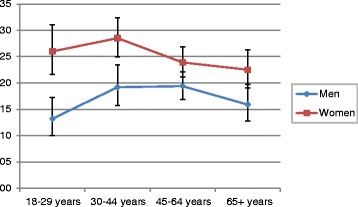
Analgesic use has increased over the last decade from 19 to 21%. This was exclusively due to the rise in OTC analgesic use from 10.0 to 12.2%. Prescribed analgesic use remained constant (7.9%). Findings from DEGS1 indicate that ibuprofen is the most commonly used analgesic followed by aspirin and paracetamol. OTC analgesic use is higher among women and smokers, but lower among older adults (65-79 years). Prescribed analgesics use is higher among women, older adults, smokers and obese adults with medium or high socio- economic status. Adults performing more than 2 h/week of physical exercise use fewer analgesics.
Among the adult population of Germany, the prevalence of OTC analgesic use has significantly increased over the last decade. We found differences between adults consuming OTC and prescribed analgesics (or both) concerning their health behaviour and health conditions. International direct comparison between prevalence rates of analgesic use was limited due to varying availability of analgesics between countries and to methodological differences.
About one in five community dwelling adults aged 18-79 years in Germany use analgesics in a given week. Considering the potential harms of analgesic use, monitoring of prevalence, patterns and determinants of use at the population level are important steps to inform disease prevention and health promotion policies.
尽管止痛药物的使用与公共卫生密切相关,但德国缺乏关于该主题的大规模研究。本研究描述了处方和非处方(OTC)止痛药物的使用 prevalence、趋势、关联和模式,重点关注五种最常见的药物:阿司匹林、双氯芬酸、布洛芬、萘普生和对乙酰氨基酚。
调查了两项具有代表性的基于人群的调查数据:1998年德国国民健康访谈与检查调查(GNHIES98,n = 7099)和2008 - 2011年德国成人健康访谈与检查调查(DEGS1,n = 7091)。通过对18 - 79岁成年人进行计算机辅助个人访谈,收集过去7天内服用的所有药物的信息。使用逻辑回归模型分析止痛药物使用与社会人口统计学和健康行为因素之间的关联。
在过去十年中,止痛药物的使用从19%增加到21%。这完全是由于非处方止痛药物的使用从10.0%上升到12.2%。处方止痛药物的使用保持不变(7.9%)。DEGS1的结果表明,布洛芬是最常用的止痛药物,其次是阿司匹林和对乙酰氨基酚。非处方止痛药物在女性和吸烟者中的使用率较高,但在老年人(65 - 79岁)中较低。处方止痛药物在女性、老年人、吸烟者以及社会经济地位中等或较高的肥胖成年人中的使用率较高。每周进行超过2小时体育锻炼的成年人使用的止痛药物较少。
在德国成年人群中,非处方止痛药物的使用 prevalence在过去十年中显著增加。我们发现服用非处方和处方止痛药物(或两者都服用)的成年人在健康行为和健康状况方面存在差异。由于各国止痛药物的可得性不同以及方法学差异,止痛药物使用 prevalence率的国际直接比较受到限制。
在德国,每五名18 - 79岁居住在社区的成年人中约有一人在特定一周内使用止痛药物。考虑到止痛药物使用的潜在危害,在人群层面监测使用 prevalence、模式和决定因素是为疾病预防和健康促进政策提供信息的重要步骤。