Department of Psychiatry, Royal College of Surgeons in Ireland, Dublin, Ireland.
Trinity College Institute of Neuroscience, Trinity College Dublin, Dublin, Ireland.
Eur Child Adolesc Psychiatry. 2023 Oct;32(10):2067-2076. doi: 10.1007/s00787-022-02045-z. Epub 2022 Jul 21.
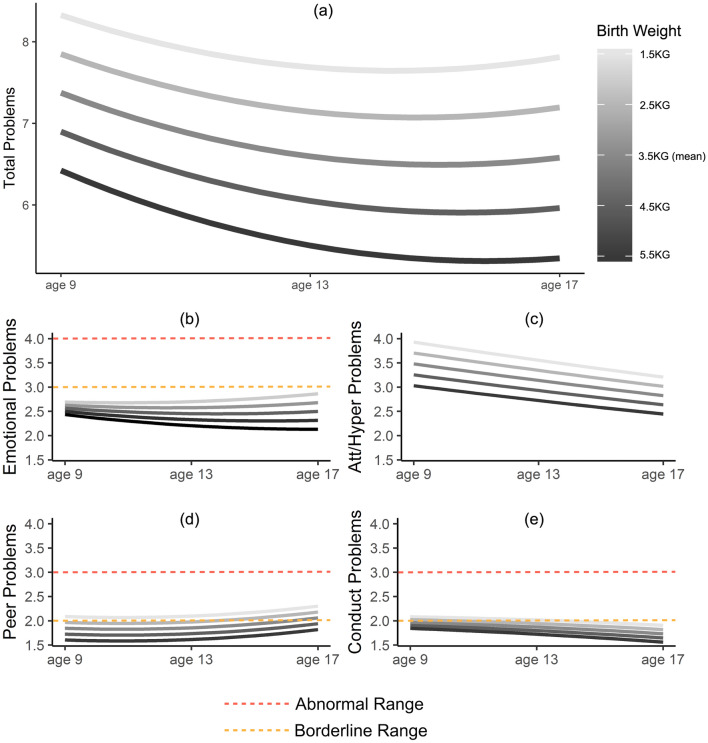
Low birth weight for one's gestational age is associated with higher rates of child psychopathology, however, most studies assess psychopathology cross-sectionally. The effect of such foetal growth restriction appears to be strongest for attention problems in childhood, although adult studies have found associations with a range of outcomes, from depression to psychosis. We explore how associations between foetal growth and psychopathology change across age, and whether they vary by sex. We used a large nationally representative cohort of children from Ireland (N ~ 8000). Parents completed the Strengths and Difficulties Questionnaire (SDQ) at 3 time points (age 9, 13 and 17). Outcomes included a total problems scale and subscales measuring attention/hyperactivity, peer, conduct and emotional problems. Foetal growth had significant associations with all problem scales, even after controlling for sex, socioeconomic factors and parental mental health. The magnitude of these effects was small but relatively stable across ages 9-17. In males, foetal growth had the strongest associations with attention/hyperactivity and peer problems, whereas females showed more widespread associations with all four subscales. There was a trend for the association between foetal growth and emotional problems to increase with advancing age, approaching the borderline-abnormal threshold by age 17. Reduced foetal growth predicted persistently higher scores on all measured aspects of child and adolescent psychopathology. Associations with child attention/hyperactivity may generalize to a wider array of adult psychopathologies via adolescent-onset emotional problems. Future studies should explore potential age-dependent effects of foetal growth into the early 20s.
胎儿生长受限与儿童精神病理学的发生率较高有关,但大多数研究都是通过横断面评估精神病理学的。这种胎儿生长受限的影响似乎对儿童时期的注意力问题最为明显,尽管成人研究发现其与一系列结果相关,从抑郁到精神病不等。我们探讨了胎儿生长与精神病理学之间的关联如何随年龄变化而变化,以及它们是否因性别而异。我们使用了来自爱尔兰的一个大型全国代表性儿童队列(N≈8000)。父母在三个时间点(9 岁、13 岁和 17 岁)完成了《长处与困难问卷》(SDQ)。结果包括一个总分和四个分量表,分别测量注意力/多动、同伴、品行和情绪问题。即使控制了性别、社会经济因素和父母的心理健康状况,胎儿生长与所有问题量表都有显著关联。这些影响的幅度很小,但在 9-17 岁之间相对稳定。在男性中,胎儿生长与注意力/多动和同伴问题的关联最强,而女性则表现出与所有四个分量表更广泛的关联。胎儿生长与情绪问题之间的关联随着年龄的增长而增加,到 17 岁时接近边缘异常阈值。胎儿生长受限预测儿童和青少年精神病理学的所有测量方面的得分持续较高。与儿童注意力/多动的关联可能通过青春期开始的情绪问题而泛化到更广泛的成年精神病理学。未来的研究应该探索胎儿生长对 20 岁出头的潜在年龄依赖性影响。