Department of Microbiology and Cell Biology, Indian Institute of Science, Bangalore, India.
Department of Biochemistry, Indian Institute of Science, Bangalore, India.
Microbiol Spectr. 2022 Aug 31;10(4):e0078122. doi: 10.1128/spectrum.00781-22. Epub 2022 Jul 6.
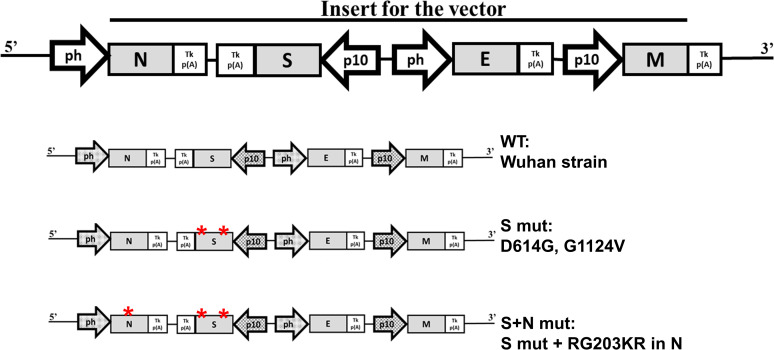
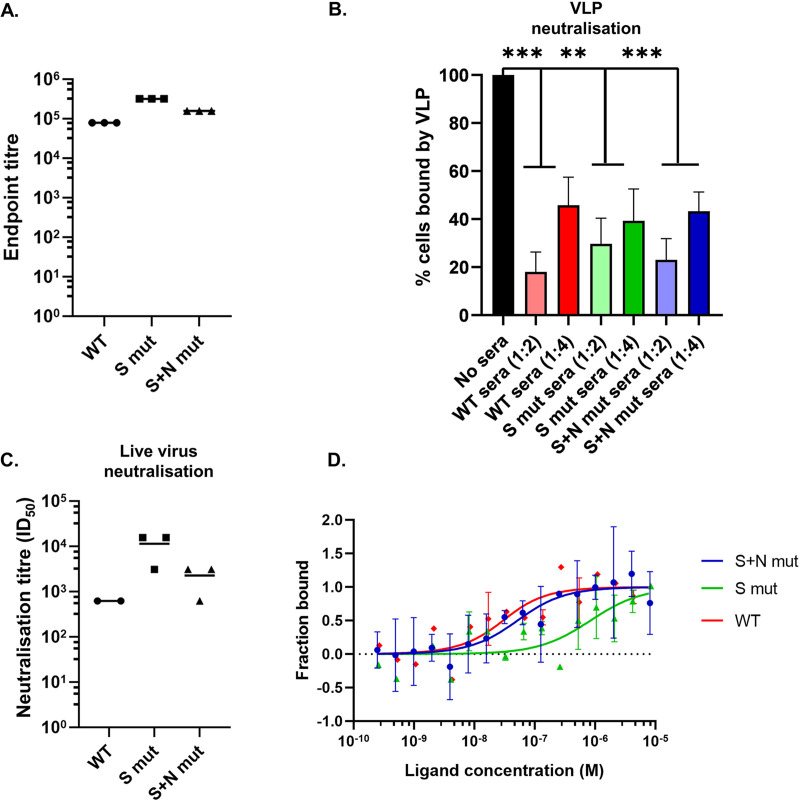
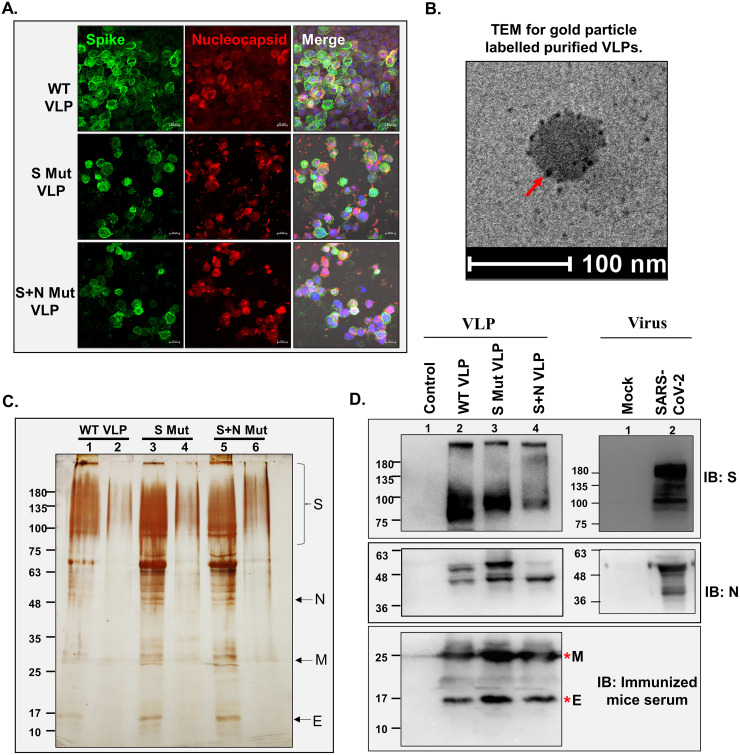
The emergence and evolution of SARS-CoV-2 is characterized by the occurrence of diverse sets of mutations that affect virus characteristics, including transmissibility and antigenicity. Recent studies have focused mostly on spike protein mutations; however, SARS-CoV-2 variants of interest (VoI) or concern (VoC) contain significant mutations in the nucleocapsid protein as well. To study the relevance of mutations at the virion level, recombinant baculovirus expression system-based virus-like particles (VLPs) were generated for the prototype Wuhan sequence along with spike protein mutants like D614G and G1124V and the significant RG203KR mutation in nucleocapsid. All four structural proteins were assembled in a particle for which the morphology and size, confirmed by transmission electron microscopy, closely resembled that of the native virion. The VLP harboring RG203KR mutations in nucleocapsid exhibited augmentation of humoral immune responses and enhanced neutralization by immunized mouse sera. Results demonstrate a noninfectious platform to quickly assess the implication of mutations in structural proteins of the emerging variant. Since its origin in late 2019, the SARS-CoV-2 virus has been constantly mutating and evolving. Current studies mostly employ spike protein (S) pseudovirus systems to determine the effects of mutations on the infectivity and immunogenicity of variants. Despite its functional importance and emergence as a mutational hot spot, the nucleocapsid (N) protein has not been widely studied. The generation of SARS-CoV-2 VLPs in a baculoviral system in this study, with mutations in the S and N proteins, allowed examination of the involvement of all the structural proteins involved in viral entry and eliciting an immune response. This approach provides a platform to study the effect of mutations in structural proteins of SARS-CoV-2 that potentially contribute to cell infectivity, immune response, and immune evasion, bypassing the use of infectious virus for the same analyses.
SARS-CoV-2 的出现和进化以多种影响病毒特征的突变集为特征,包括传染性和抗原性。最近的研究主要集中在刺突蛋白突变上;然而,感兴趣的 SARS-CoV-2 变体(VoI)或关注的变体(VoC)在核衣壳蛋白中也存在显著突变。为了研究病毒水平突变的相关性,我们使用基于重组杆状病毒表达系统的病毒样颗粒(VLPs)生成了武汉原型序列以及刺突蛋白突变体,如 D614G 和 G1124V 以及核衣壳中的显著 RG203KR 突变。所有四个结构蛋白都组装在一个颗粒中,该颗粒的形态和大小通过透射电子显微镜确认,与天然病毒颗粒非常相似。携带核衣壳 RG203KR 突变的 VLP 显示出增强的体液免疫反应,并增强了免疫小鼠血清的中和作用。结果表明,这是一种快速评估新兴变体结构蛋白突变影响的非感染性平台。自 2019 年底以来,SARS-CoV-2 病毒一直在不断突变和进化。目前的研究主要采用刺突蛋白(S)假病毒系统来确定突变对变体的感染性和免疫原性的影响。尽管核衣壳(N)蛋白具有重要的功能和作为突变热点出现,但它并未得到广泛研究。本研究在杆状病毒系统中生成 SARS-CoV-2 VLPs,并在 S 和 N 蛋白中引入突变,允许检查所有参与病毒进入和引发免疫反应的结构蛋白的参与。这种方法提供了一个研究 SARS-CoV-2 结构蛋白突变的平台,这些突变可能有助于细胞感染性、免疫反应和免疫逃避,从而避免使用感染性病毒进行相同的分析。