
不同环境、克隆和时间跨度的粪肠球菌中氯己定敏感性和 efrEF 操纵子的演变。
Evolution of Chlorhexidine Susceptibility and of the EfrEF Operon among Enterococcus faecalis from Diverse Environments, Clones, and Time Spans.
机构信息
UCIBIO-Applied Molecular Biosciences Unit, Laboratory of Microbiology, Department of Biological Sciences, REQUIMTE Faculty of Pharmacy, University of Porto, Porto, Portugal.
Associate Laboratory i4HB, Institute for Health and Bioeconomy, Faculty of Pharmacy, University of Porto, Porto, Portugal.
出版信息
Microbiol Spectr. 2022 Aug 31;10(4):e0117622. doi: 10.1128/spectrum.01176-22. Epub 2022 Jul 7.
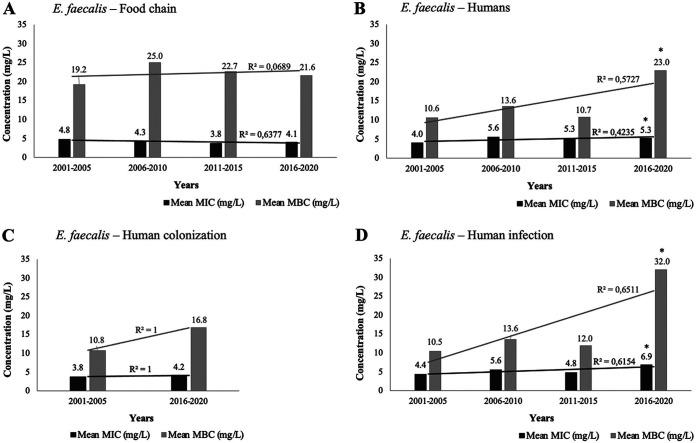
Chlorhexidine (CHX) is widely used to control the spread of pathogens (e.g., human/animal clinical settings, ambulatory care, food industry). Enterococcus faecalis, a major nosocomial pathogen, is broadly distributed in diverse hosts and environments facilitating its exposure to CHX over the years. Nevertheless, CHX activity against E. faecalis is understudied. Our goal was to assess CHX activity and the variability of ChlR-EfrEF proteins (associated with CHX tolerance) among 673 field isolates and 1,784 E. faecalis genomes from the PATRIC database from different sources, time spans, clonal lineages, and antibiotic-resistance profiles. The CHX MIC (MIC) and minimum bactericidal concentration (MBC) against E. faecalis presented normal distributions (0.5 to 64 mg/L). However, more CHX-tolerant isolates were detected in the food chain and recent human infections, suggesting an adaptability of E. faecalis populations in settings where CHX is heavily used. Heterogeneity in ChlR-EfrEF sequences was identified, with isolates harboring incomplete ChlR-EfrEF proteins, particularly the EfrE identified in the ST40 clonal lineage, showing low MIC (≤1mg/L). Distinct ST40-E. faecalis subpopulations carrying truncated and nontruncated EfrE were detected, with the former being predominant in human isolates. This study provides a new insight about CHX susceptibility and ChlR-EfrEF variability within diverse E. faecalis populations. The MIC/MBC of more tolerant E. faecalis (MIC = 8 mg/L; MBC = 64 mg/L) remain lower than in-use concentrations of CHX (≥500 mg/L). However, increased CHX use, combined with concentration gradients occurring in diverse environments, potentially selecting multidrug-resistant strains with different CHX susceptibilities, signals the importance of monitoring the trends of E. faecalis CHX tolerance within a One Health approach. Chlorhexidine (CHX) is a disinfectant and antiseptic used since the 1950s and included in the World Health Organization's list of essential medicines. It has been widely applied in hospitals, the community, the food industry, animal husbandry and pets. CHX tolerance in Enterococcus faecalis, a ubiquitous bacterium and one of the leading causes of human hospital-acquired infections, remains underexplored. Our study provides novel and comprehensive insights about CHX susceptibility within the E. faecalis population structure context, revealing more CHX-tolerant subpopulations from the food chain and recent human infections. We further show a detailed analysis of the genetic diversity of the efrEF operon (previously associated with E. faecalis CHX tolerance) and its correlation with CHX phenotypes. The recent strains with a higher tolerance to CHX and the multiple sources where bacteria are exposed to this biocide alert us to the need for the continuous monitoring of E. faecalis adaptation toward CHX tolerance within a One Health approach.
洗必泰(CHX)广泛用于控制病原体的传播(例如,人类/动物临床环境、门诊护理、食品工业)。粪肠球菌是一种主要的医院病原体,广泛分布于各种宿主和环境中,使其多年来暴露于 CHX 之下。然而,CHX 对粪肠球菌的活性研究不足。我们的目标是评估 CHX 活性和 ChlR-EfrEF 蛋白(与 CHX 耐受性相关)的变异性,这些蛋白来自 PATRIC 数据库中的 673 个现场分离株和 1784 个粪肠球菌基因组,这些分离株和基因组来自不同的来源、时间跨度、克隆谱系和抗生素耐药谱。粪肠球菌对 CHX 的 MIC(MIC)和最低杀菌浓度(MBC)呈正态分布(0.5 至 64mg/L)。然而,在食物链和最近的人类感染中检测到更多的 CHX 耐受分离株,这表明在大量使用 CHX 的环境中,粪肠球菌种群具有适应性。鉴定到 ChlR-EfrEF 序列的异质性,具有不完整 ChlR-EfrEF 蛋白的分离株,特别是在 ST40 克隆谱系中鉴定到的 EfrE,表现出较低的 MIC(≤1mg/L)。检测到携带截短和非截短 EfrE 的不同 ST40 粪肠球菌亚群,前者在人类分离株中更为常见。本研究提供了关于不同粪肠球菌种群中 CHX 敏感性和 ChlR-EfrEF 变异性的新见解。更耐受的粪肠球菌(MIC=8mg/L;MBC=64mg/L)的 MIC/MBC 仍低于 CHX 的实际使用浓度(≥500mg/L)。然而,CHX 的使用增加,以及在不同环境中发生的浓度梯度,可能会选择具有不同 CHX 敏感性的多药耐药菌株,这表明需要在一个健康的方法中监测粪肠球菌对 CHX 耐受性的趋势。 洗必泰(CHX)是一种自 20 世纪 50 年代以来使用的消毒剂和防腐剂,被列入世界卫生组织的基本药物清单。它已广泛应用于医院、社区、食品工业、畜牧业和宠物行业。粪肠球菌是一种普遍存在的细菌,也是导致人类医院获得性感染的主要原因之一,但其对 CHX 的耐受性仍未得到充分研究。我们的研究提供了关于粪肠球菌种群结构背景下 CHX 敏感性的新的和全面的见解,揭示了更多来自食物链和最近人类感染的 CHX 耐受亚群。我们进一步展示了对 efrEF 操纵子(先前与粪肠球菌 CHX 耐受性相关)的遗传多样性及其与 CHX 表型的相关性的详细分析。最近对 CHX 耐受性更高的菌株以及细菌暴露于这种杀菌剂的多种来源提醒我们需要在一个健康的方法中持续监测粪肠球菌对 CHX 耐受性的适应性。



 Zotero 插件