Zhang Xueying, Yamada Yosuke, Sagayama Hiroyuki, Ainslie Philip N, Blaak Ellen E, Buchowski Maciej S, Close Graeme L, Cooper Jamie A, Das Sai Krupa, Dugas Lara R, Gurven Michael, El Hamdouchi Asmaa, Hu Sumei, Joonas Noorjehan, Katzmarzyk Peter, Kraus William E, Kushner Robert F, Leonard William R, Martin Corby K, Meijer Erwin P, Neuhouser Marian L, Ojiambo Robert M, Pitsiladis Yannis P, Plasqui Guy, Prentice Ross L, Racette Susan B, Ravussin Eric, Redman Leanne M, Reynolds Rebecca M, Roberts Susan B, Sardinha Luis B, Silva Analiza M, Stice Eric, Urlacher Samuel S, Van Mil Edgar A, Wood Brian M, Murphy-Alford Alexia J, Loechl Cornelia, Luke Amy H, Rood Jennifer, Schoeller Dale A, Westerterp Klaas R, Wong William W, Pontzer Herman, Speakman John R
Shenzhen Key Laboratory of Metabolic Health, Center for Energy Metabolism and Reproduction, Shenzhen Institutes of Advanced Technology, Chinese Academy of Sciences, Shenzhen, China.
Institute of Biological and Environmental Sciences, University of Aberdeen, Aberdeen, UK.
iScience. 2022 Jun 28;25(8):104682. doi: 10.1016/j.isci.2022.104682. eCollection 2022 Aug 19.
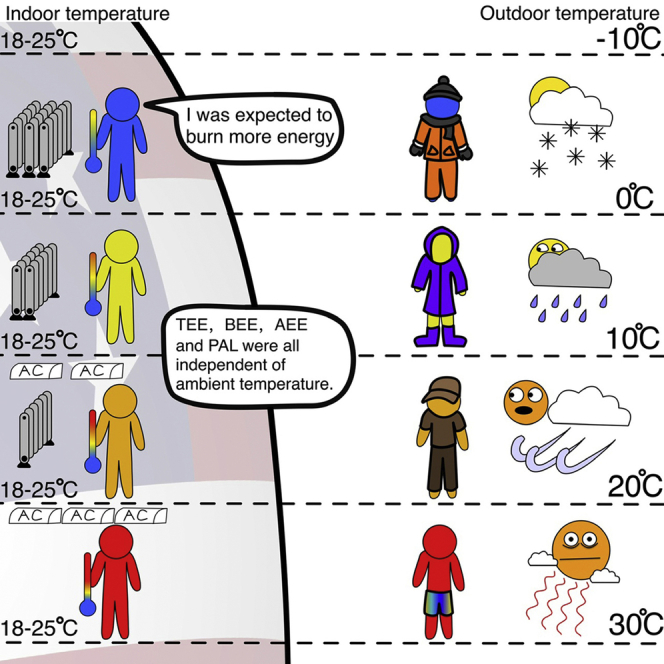
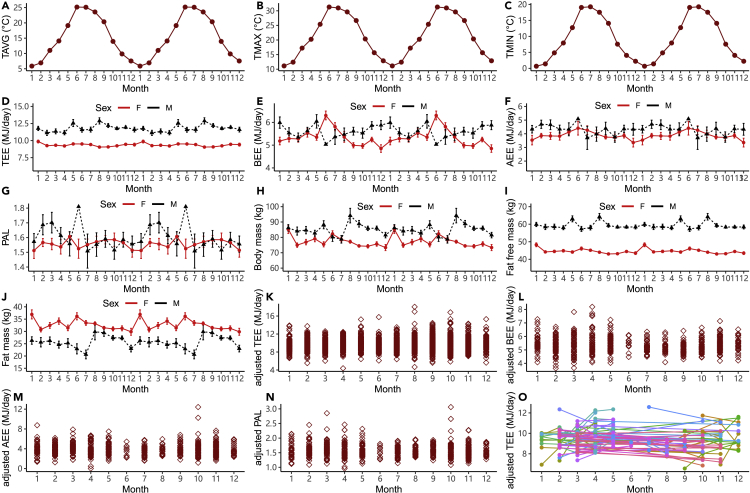
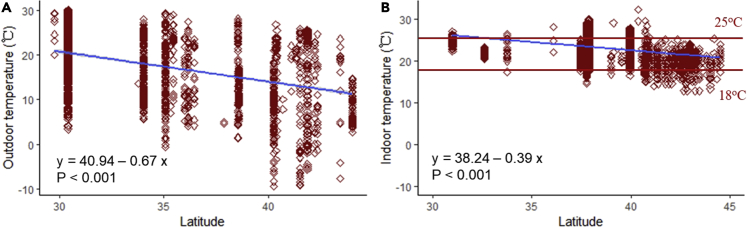
Lower ambient temperature (T) requires greater energy expenditure to sustain body temperature. However, effects of T on human energetics may be buffered by environmental modification and behavioral compensation. We used the IAEA DLW database for adults in the USA (n = 3213) to determine the effect of T (-10 to +30°C) on TEE, basal (BEE) and activity energy expenditure (AEE) and physical activity level (PAL). There were no significant relationships (p > 0.05) between maximum, minimum and average T and TEE, BEE, AEE and PAL. After adjustment for fat-free mass, fat mass and age, statistically significant (p < 0.01) relationships between TEE, BEE and T emerged in females but the effect sizes were not biologically meaningful. Temperatures inside buildings are regulated at 18-25°C independent of latitude. Hence, adults in the US modify their environments to keep TEE constant across a wide range of external ambient temperatures.
较低的环境温度(T)需要更多的能量消耗来维持体温。然而,环境温度对人体能量代谢的影响可能会被环境调节和行为补偿所缓冲。我们使用国际原子能机构双标记水(DLW)数据库中美国成年人的数据(n = 3213)来确定温度(-10至+30°C)对总能量消耗(TEE)、基础能量消耗(BEE)、活动能量消耗(AEE)和体力活动水平(PAL)的影响。最高、最低和平均温度与TEE、BEE、AEE和PAL之间均无显著关系(p > 0.05)。在对去脂体重、脂肪量和年龄进行调整后,女性的TEE、BEE与温度之间出现了具有统计学意义(p < 0.01)的关系,但效应大小在生物学上并无实际意义。建筑物内的温度被调节在18 - 25°C,与纬度无关。因此,美国成年人会调整他们的环境,以使TEE在广泛的外部环境温度范围内保持恒定。