Melwani Daswani Mohit, Vance Steven D, Mayne Matthew J, Glein Christopher R
Jet Propulsion Laboratory California Institute of Technology Pasadena CA USA.
Department of Earth Sciences Stellenbosch University Stellenbosch South Africa.
Geophys Res Lett. 2021 Sep 28;48(18):e2021GL094143. doi: 10.1029/2021GL094143. Epub 2021 Sep 15.
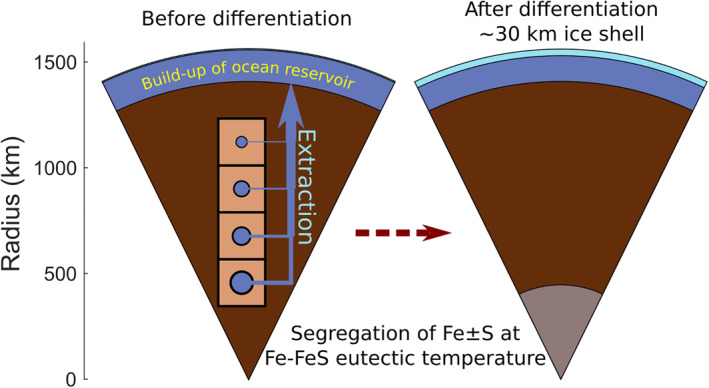
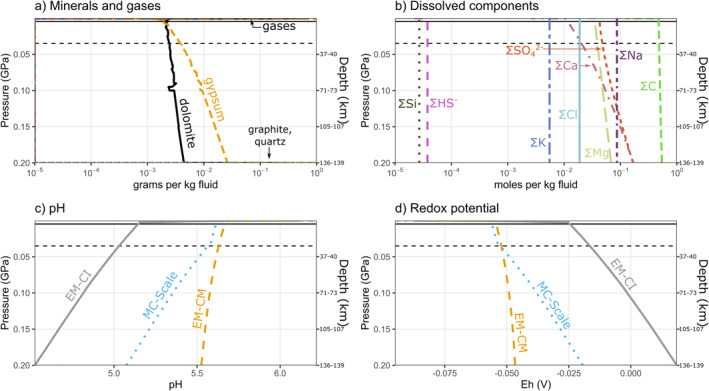
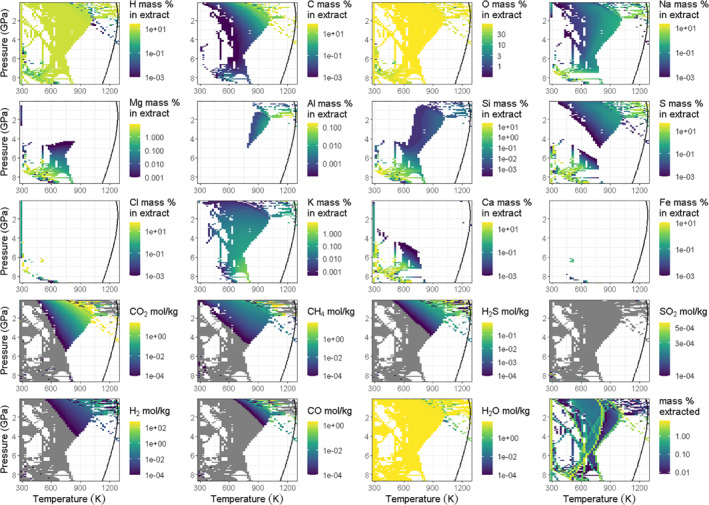
Europa likely contains an iron-rich metal core. For it to have formed, temperatures within Europa reached 1250 K. Going up to that temperature, accreted chondritic minerals - for example, carbonates and phyllosilicates - would partially devolatilize. Here, we compute the amounts and compositions of exsolved volatiles. We find that volatiles released from the interior would have carried solutes, redox-sensitive species, and could have generated a carbonic ocean in excess of Europa's present-day hydrosphere, and potentially an early atmosphere. No late delivery of cometary water was necessary. Contrasting with prior work, could be the most abundant solute in the ocean, followed by , , and . However, gypsum precipitation going from the seafloor to the ice shell decreases the dissolved S/Cl ratio, such that Cl S at the shallowest depths, consistent with recently inferred endogenous chlorides at Europa's surface. Gypsum would form a 3-10 km thick sedimentary layer at the seafloor.
木卫二可能含有一个富含铁的金属内核。为了形成这样的内核,木卫二内部的温度达到了1250K。在升温到这个温度的过程中,积聚的球粒陨石矿物——例如碳酸盐和层状硅酸盐——会部分挥发。在这里,我们计算了析出挥发物的数量和成分。我们发现,从内部释放出的挥发物会携带溶质、对氧化还原敏感的物质,并且可能形成一个超过木卫二当前水圈的碳酸海洋,甚至可能形成早期大气层。不需要彗星水的后期输送。与之前的研究不同, 可能是海洋中最丰富的溶质,其次是 、 和 。然而,从海底到冰壳的石膏沉淀会降低溶解的硫/氯比值,使得在最浅深度处氯 硫,这与最近推断的木卫二表面的内源氯化物一致。石膏会在海底形成一个3 - 10千米厚的沉积层。