Egorova Elena A, Lamers Gerda E M, Monikh Fazel Abdolahpur, Boyle Aimee L, Slütter Bram, Kros Alexander
Department of Supramolecular & Biomaterials Chemistry, Leiden Institute of Chemistry, Leiden University The Netherlands
Core Facility Microscopy, Institute of Biology, Leiden University The Netherlands.
RSC Adv. 2022 Jul 7;12(31):19703-19716. doi: 10.1039/d2ra03027f. eCollection 2022 Jul 6.
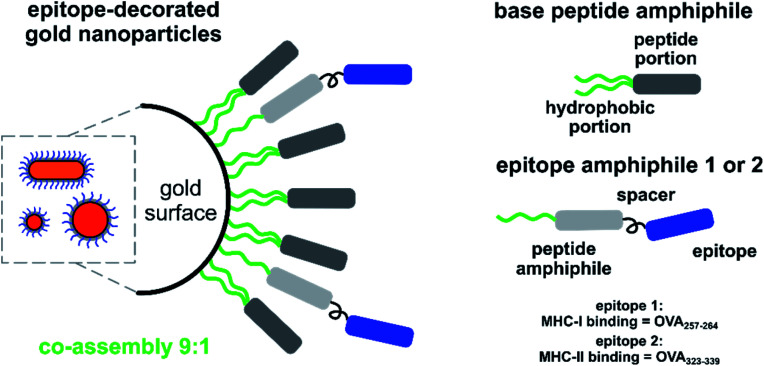
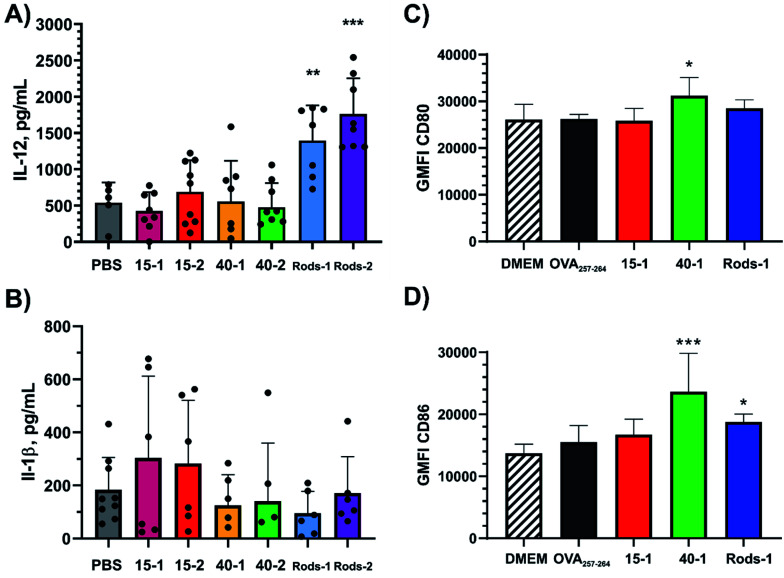
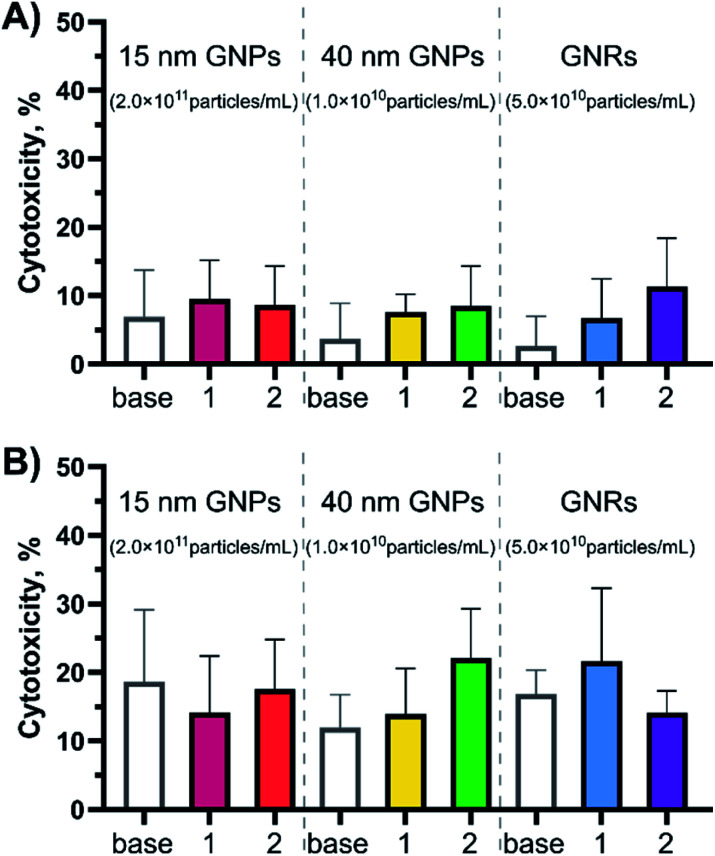
Gold nanoparticles (GNPs) can be manufactured in various shapes, and their size is programmable, which permits the study of the effects imposed by these parameters on biological processes. However, there is currently no clear evidence that a certain shape or size is beneficial. To address this issue, we have utilised GNPs and gold nanorods (GNRs) functionalised with model epitopes derived from chicken ovalbumin (OVA and OVA). By using two distinct epitopes, it was possible to draw conclusions regarding the impact of nanoparticle shape and size on different aspects of the immune response. Our findings indicate that the peptide amphiphile-coated GNPs and GNRs are a safe and versatile epitope-presenting system. Smaller GNPs (∼15 nm in diameter) induce significantly less intense T-cell responses. Furthermore, effective antigen presentation MHC-I was observed for larger spherical particles (∼40 nm in diameter), and to a lesser extent for rod-like particles (40 by 15 nm). At the same time, antigen presentation MHC-II strongly correlated with the cellular uptake, with smaller GNPs being the least efficient. We believe these findings will have implications for vaccine development, and lead to a better understanding of cellular uptake and antigen egress from lysosomes into the cytosol.
金纳米颗粒(GNPs)可以制成各种形状,其尺寸也可设定,这使得研究这些参数对生物过程的影响成为可能。然而,目前尚无明确证据表明特定的形状或尺寸具有益处。为解决这一问题,我们利用了用源自鸡卵清蛋白(OVA和OVA)的模型表位功能化的金纳米颗粒和金纳米棒(GNRs)。通过使用两种不同的表位,就有可能得出关于纳米颗粒形状和尺寸对免疫反应不同方面影响的结论。我们的研究结果表明,肽两亲物包被的GNPs和GNRs是一种安全且通用的表位呈递系统。较小的GNPs(直径约15纳米)诱导的T细胞反应强度明显较低。此外,对于较大的球形颗粒(直径约40纳米)观察到有效的抗原呈递至MHC-I,而对于棒状颗粒(40×15纳米)则程度较低。同时,抗原呈递至MHC-II与细胞摄取密切相关,较小的GNPs效率最低。我们相信这些发现将对疫苗开发产生影响,并有助于更好地理解细胞摄取以及抗原从溶酶体进入胞质溶胶的过程。