Ryan Robert G, Marais Eloise A, Balhatchet Chloe J, Eastham Sebastian D
Department of Geography University College London London UK.
Yusuf Hamied Department of Chemistry University of Cambridge Cambridge UK.
Earths Future. 2022 Jun;10(6):e2021EF002612. doi: 10.1029/2021EF002612. Epub 2022 Jun 24.
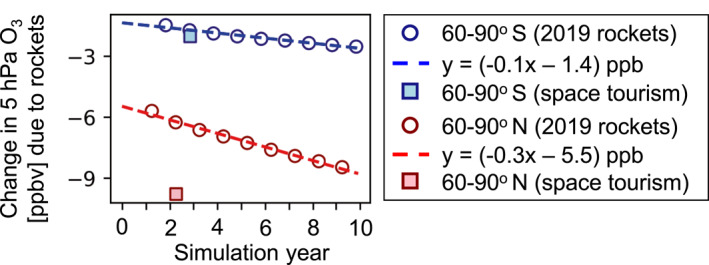
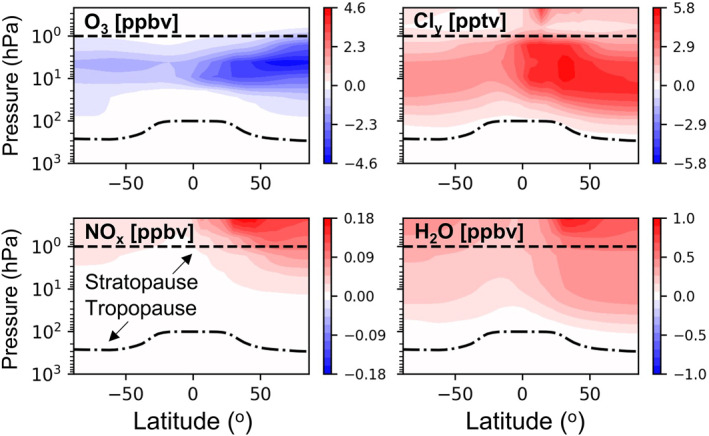
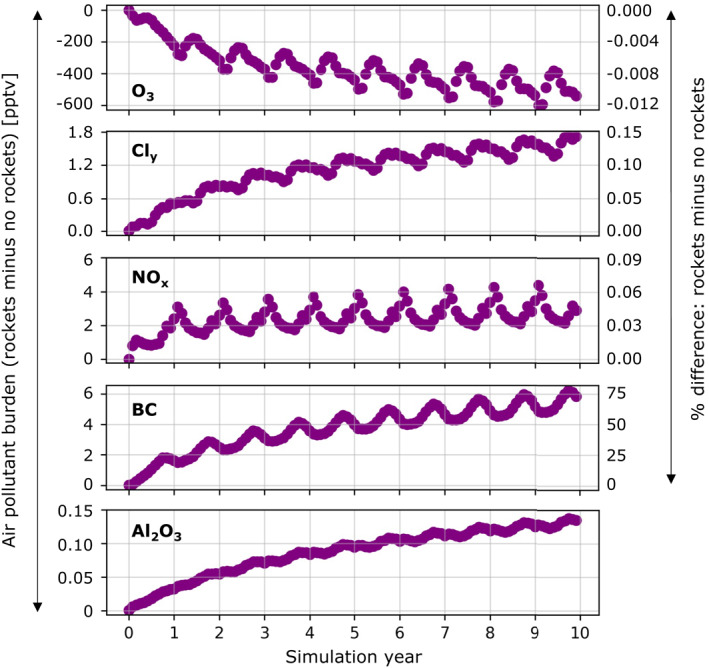
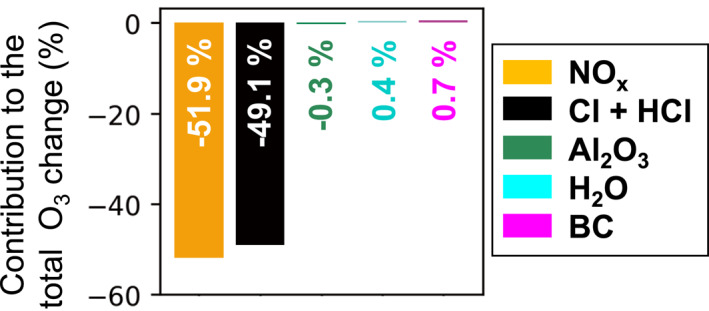
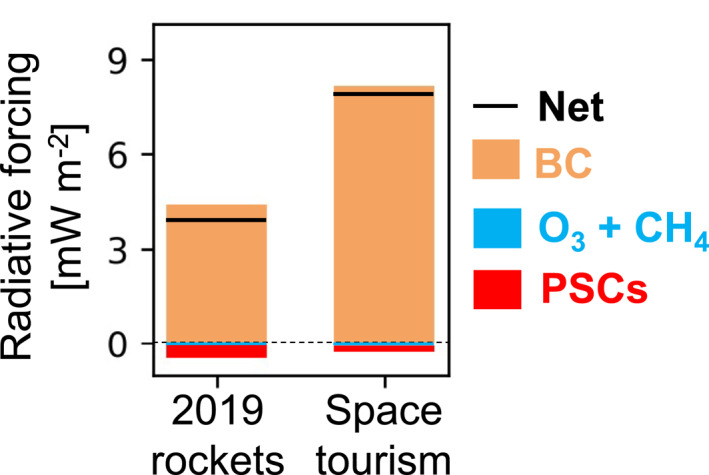
Detailed examination of the impact of modern space launches on the Earth's atmosphere is crucial, given booming investment in the space industry and an anticipated space tourism era. We develop air pollutant emissions inventories for rocket launches and re-entry of reusable components and debris in 2019 and for a speculative space tourism scenario based on the recent billionaire space race. This we include in the global GEOS-Chem model coupled to a radiative transfer model to determine the influence on stratospheric ozone (O) and climate. Due to recent surge in re-entering debris and reusable components, nitrogen oxides from re-entry heating and chlorine from solid fuels contribute equally to all stratospheric O depletion by contemporary rockets. Decline in global stratospheric O is small (0.01%), but reaches 0.15% in the upper stratosphere (∼5 hPa, 40 km) in spring at 60-90°N after a decade of sustained 5.6% a growth in 2019 launches and re-entries. This increases to 0.24% with a decade of emissions from space tourism rockets, undermining O recovery achieved with the Montreal Protocol. Rocket emissions of black carbon (BC) produce substantial global mean radiative forcing of 8 mW m after just 3 years of routine space tourism launches. This is a much greater contribution to global radiative forcing (6%) than emissions (0.02%) of all other BC sources, as radiative forcing per unit mass emitted is ∼500 times more than surface and aviation sources. The O damage and climate effect we estimate should motivate regulation of an industry poised for rapid growth.
鉴于太空产业投资的蓬勃发展以及太空旅游时代的预期,详细研究现代太空发射对地球大气的影响至关重要。我们编制了2019年火箭发射以及可重复使用部件和碎片重返大气层的空气污染物排放清单,并根据近期的亿万富翁太空竞赛编制了一个推测性的太空旅游情景清单。我们将这些纳入与辐射传输模型耦合的全球GEOS-Chem模型中,以确定对平流层臭氧(O)和气候的影响。由于近期重返大气层的碎片和可重复使用部件激增,重返大气层加热产生的氮氧化物和固体燃料中的氯对当代火箭造成的平流层臭氧消耗的贡献相同。全球平流层臭氧的减少幅度很小(0.01%),但在2019年发射和重返大气层持续以每年5.6%的速度增长十年后,春季在北纬60 - 90°的平流层上部(约5百帕,40公里)达到0.15%。如果太空旅游火箭排放十年,这一比例将增至0.24%,破坏了《蒙特利尔议定书》所实现的臭氧恢复。仅仅经过3年的常规太空旅游发射,火箭排放的黑碳(BC)就产生了8毫瓦/平方米的显著全球平均辐射强迫。这对全球辐射强迫的贡献(6%)比所有其他黑碳源的排放(0.02%)大得多,因为单位质量排放的辐射强迫比地表和航空源大约500倍。我们估计的臭氧破坏和气候效应应该促使对一个即将快速增长的行业进行监管。