Department of Systems Biology, Beckman Research Institute of City of Hope, Monrovia, CA, United States.
Department of Hematological Malignancies, Beckman Research Institute of City of Hope, Monrovia, CA, United States.
Front Immunol. 2022 Jul 5;13:901277. doi: 10.3389/fimmu.2022.901277. eCollection 2022.
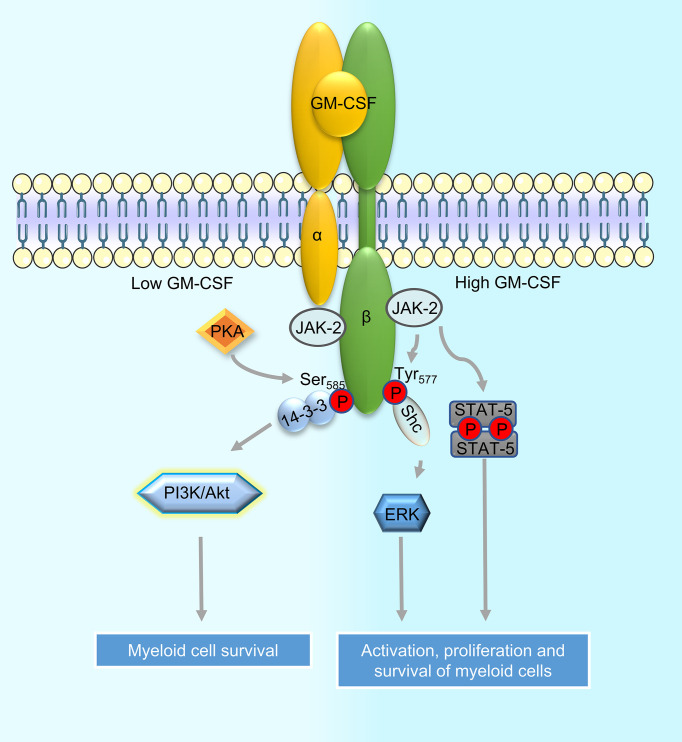
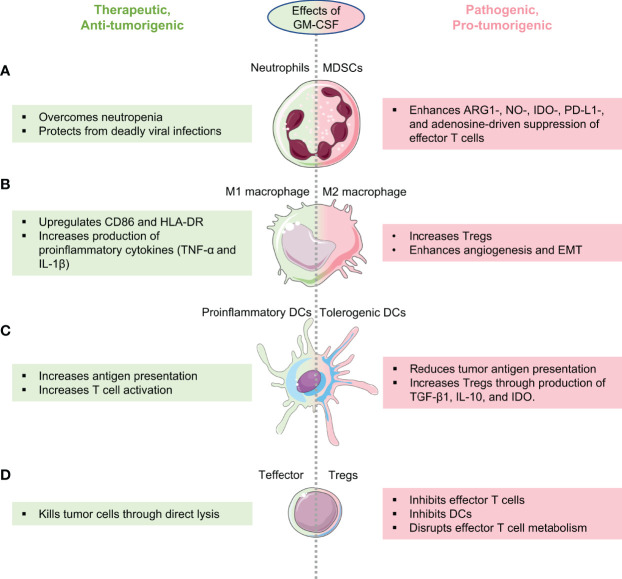
Granulocyte-macrophage colony-stimulating factor (GM-CSF) is a cytokine that drives the generation of myeloid cell subsets including neutrophils, monocytes, macrophages, and dendritic cells in response to stress, infections, and cancers. By modulating the functions of innate immune cells that serve as a bridge to activate adaptive immune responses, GM-CSF globally impacts host immune surveillance under pathologic conditions. As with other soluble mediators of immunity, too much or too little GM-CSF has been found to promote cancer aggressiveness. While too little GM-CSF prevents the appropriate production of innate immune cells and subsequent activation of adaptive anti-cancer immune responses, too much of GM-CSF can exhaust immune cells and promote cancer growth. The consequences of GM-CSF signaling in cancer progression are a function of the levels of GM-CSF, the cancer type, and the tumor microenvironment. In this review, we first discuss the secretion of GM-CSF, signaling downstream of the GM-CSF receptor, and GM-CSF's role in modulating myeloid cell homeostasis. We then outline GM-CSF's anti-tumorigenic and pro-tumorigenic effects both on the malignant cells and on the non-malignant immune and other cells in the tumor microenvironment. We provide examples of current clinical and preclinical strategies that harness GM-CSF's anti-cancer potential while minimizing its deleterious effects. We describe the challenges in achieving the Goldilocks effect during administration of GM-CSF-based therapies to patients with cancer. Finally, we provide insights into how technologies that map the immune microenvironment spatially and temporally may be leveraged to intelligently harness GM-CSF for treatment of malignancies.
粒细胞-巨噬细胞集落刺激因子(GM-CSF)是一种细胞因子,可在应激、感染和癌症的情况下驱动髓样细胞亚群(包括中性粒细胞、单核细胞、巨噬细胞和树突状细胞)的生成。通过调节作为激活适应性免疫反应桥梁的固有免疫细胞的功能,GM-CSF 在病理条件下对宿主免疫监视产生全局性影响。与其他免疫可溶性介质一样,过多或过少的 GM-CSF 已被发现可促进癌症侵袭性。虽然 GM-CSF 过少会阻止先天免疫细胞的适当产生和随后的适应性抗癌免疫反应的激活,但 GM-CSF 过多会耗尽免疫细胞并促进癌症生长。GM-CSF 信号在癌症进展中的后果是 GM-CSF 的水平、癌症类型和肿瘤微环境的功能。在这篇综述中,我们首先讨论 GM-CSF 的分泌、GM-CSF 受体下游的信号转导以及 GM-CSF 在调节髓样细胞动态平衡中的作用。然后,我们概述了 GM-CSF 在调节髓样细胞动态平衡中的作用。然后,我们概述了 GM-CSF 在调节髓样细胞动态平衡中的作用。然后,我们概述了 GM-CSF 在调节髓样细胞动态平衡中的作用。然后,我们概述了 GM-CSF 在调节髓样细胞动态平衡中的作用。然后,我们概述了 GM-CSF 在调节髓样细胞动态平衡中的作用。然后,我们概述了 GM-CSF 在调节髓样细胞动态平衡中的作用。然后,我们概述了 GM-CSF 在调节髓样细胞动态平衡中的作用。然后,我们概述了 GM-CSF 在调节髓样细胞动态平衡中的作用。然后,我们概述了 GM-CSF 在调节髓样细胞动态平衡中的作用。然后,我们概述了 GM-CSF 在调节髓样细胞动态平衡中的作用。然后,我们概述了 GM-CSF 在调节髓样细胞动态平衡中的作用。然后,我们概述了 GM-CSF 在调节髓样细胞动态平衡中的作用。然后,我们概述了 GM-CSF 在调节髓样细胞动态平衡中的作用。然后,我们概述了 GM-CSF 在调节髓样细胞动态平衡中的作用。然后,我们概述了 GM-CSF 在调节髓样细胞动态平衡中的作用。然后,我们概述了 GM-CSF 在调节髓样细胞动态平衡中的作用。最后,我们提供了一些关于如何利用 GM-CSF 治疗恶性肿瘤的见解,这些见解涉及到利用空间和时间上绘制免疫微环境的技术,以智能地利用 GM-CSF 进行治疗。